Best Compact Language Models on Hugging Face: Overview and Practical Selection
Small language models (SLM) by 2026 are already smart enough for real work and run locally on your computer. Hugging Face has dozens of great options — Mistral 7B, Meta Llama, Google Gemma, Microsoft Phi, and others. They all save money on API tokens, suit mobile applications, don't require the cloud, and support commercial use. We've selected the most reliable options for production. *Meta has been designated as an extremist organization and is banned in the Russian Federation.
AI-processed from KDnuggets; edited by Hamidun News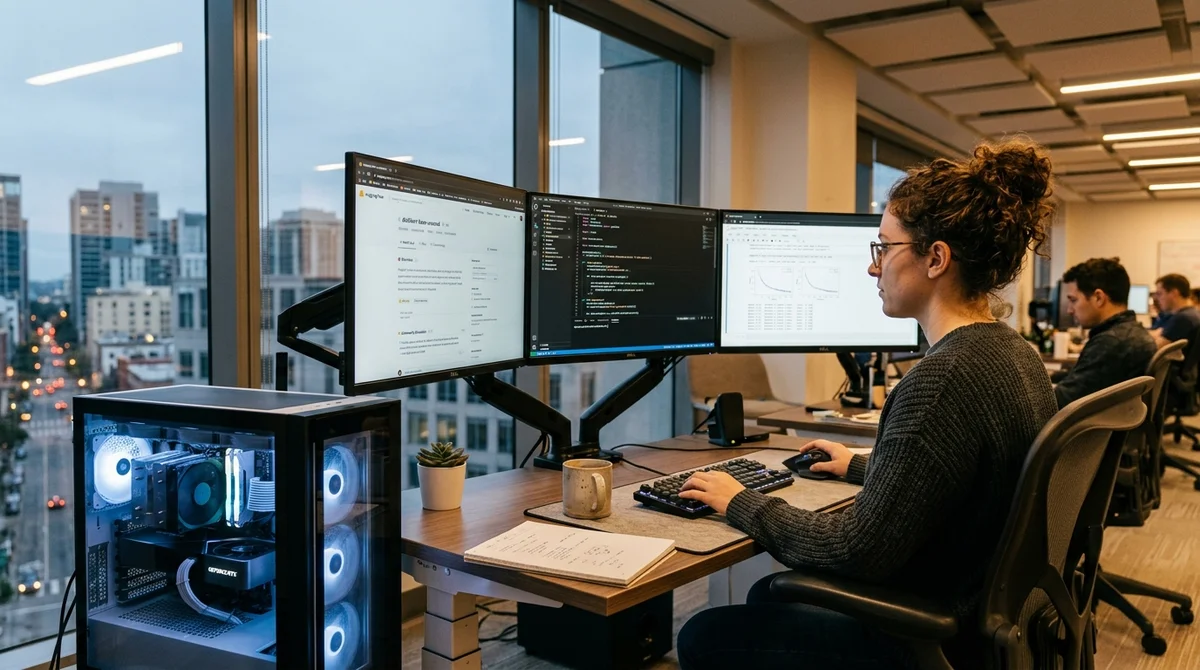
Small language models (SLM) are a revolution for developers. A year ago they were considered an experiment, but today Mistral, Llama, and Gemma handle tasks that previously required expensive cloud APIs.
Why Small Models Win Now
Large models like GPT-4 require payments for every request. With small models, you take a ready-made weight (3–13 GB in size), put it on your server or laptop — and it works for free, locally, without the internet. This solves three main problems:
- Cost — no token payments, download once and forget about the API
- Privacy — your data stays with you, doesn't go to the cloud
- Speed — responses come in milliseconds, not dependent on cloud provider overload
Benchmarks show: Mistral 7B handles logic tasks almost as well as GPT-3.5, and Llama 13B performs even better on complex questions.
Which Models to Look at Right Now
There are thousands of SLMs on Hugging Face, but the main players are five:
- Mistral 7B — best balance between size and quality, excels at writing code and logic
- Meta Llama 2 13B — proven model, used in production by dozens of companies
- Google Gemma 7B — fast and optimized, fits on a mobile phone
- Microsoft Phi 2.7B — micro-model with 2.7 billion parameters, runs on weak hardware
- Mistral 8x7B Mixture of Experts — if you need power without 80 GB of memory
All of them are available on Hugging Face under licenses that permit commercial use.
How to Run SLM on Your Computer
The process is simple: install ollama (one command), select a model from the Hugging Face catalog — and it will automatically download and be available via API at localhost:11434.
For your first experience, choose Mistral 7B: it requires a GPU with 8 GB of memory, but can also run on CPU (slower, but it works). On a modern graphics card (RTX 3060 and above), response time is 1–2 seconds for a complete answer.
There are ready-made integrations: Python ollama client, LangChain adapter, REST API. You can integrate it into your application in an hour.
What This Means for Developers
SLMs destroy the argument for cloud AI. If before you had to choose between expensive GPT and nothing, now there's a third option — a local model that works fast and requires no payments.
For startups, this saves tens of thousands per year. For companies that handle sensitive data, it's simply a necessity.
*Meta has been designated as an extremist organization and is banned in the Russian Federation.
- Oct 28, 2026Liquid AI releases LFM2.5-24B-A2B: an agent model with 2B active parameters
- Oct 28, 2026PyTorch 2.15 speeds up MoE models on Mac by 5–6.5x and adds FP8
- Oct 28, 2026NVIDIA Kumo Relational Beats Supervised ML on 41 Tasks Without Any Training
- Oct 28, 2026Switzerland's Apertus 1.5 Gains Vision, Hearing and a 262K-Token Context Window
Key Questions Answered
Why Small Models Win Now?
Large models like GPT-4 require payments for every request. With small models, you take a ready-made weight (3–13 GB in size), put it on your server or laptop — and it works for free, locally, without the internet. This solves three main problems: Cost — no token payments, download once and forget about the API Privacy — your data stays with you, doesn't go to the cloud Speed — responses come in milliseconds, not dependent on cloud provider overload Benchmarks show: Mistral 7B handles logic tasks almost as well as GPT-3.5, and Llama 13B performs even better on complex quest
Which Models to Look at Right Now?
There are thousands of SLMs on Hugging Face, but the main players are five: Mistral 7B — best balance between size and quality, excels at writing code and logic Meta Llama 2 13B — proven model, used in production by dozens of companies Google Gemma 7B — fast and optimized, fits on a mobile phone Microsoft Phi 2.7B — micro-model with 2.7 billion parameters, runs on weak hardware Mistral 8x7B Mixture of Experts — if you need power without 80 GB of memory All of them are available on Hugging Face under licenses that permit commercial use.
How to Run SLM on Your Computer?
The process is simple: install ollama (one command), select a model from the Hugging Face catalog — and it will automatically download and be available via API at localhost:11434. For your first experience, choose Mistral 7B: it requires a GPU with 8 GB of memory, but can also run on CPU (slower, but it works). On a modern graphics card (RTX 3060 and above), response time is 1–2 seconds for a complete answer. There are ready-made integrations: Python ollama client, LangChain adapter, REST API. You can integrate it into your application in an hour.
Test Frontier LLMs & Autonomous Agents in One Workspace
Run Claude Opus 5.5, GPT-6, Gemini 3.1, and DeepSeek side-by-side in Nomad AI (nomadnet.ai) — unified model routing, deep research, and multimodal workflows under one subscription.
The AI world, distilled — once a week
Seven stories that actually mattered, hand-picked. No noise, no reposts, no press releases.
Done! Check your inbox for a confirmation.