AI will make a Nobel-level discovery within a year, Anthropic co-founder predicts
Anthropic founder Jack Clark has predicted a series of breakthroughs: within a year, AI will make a Nobel-level discovery; within two years, bipedal robots will help workers; and within 18 months, companies run 100% by AI will earn millions of dollars. By the end of 2028, AI systems may be able to design their own successors.
AI-processed from Guardian; edited by Hamidun News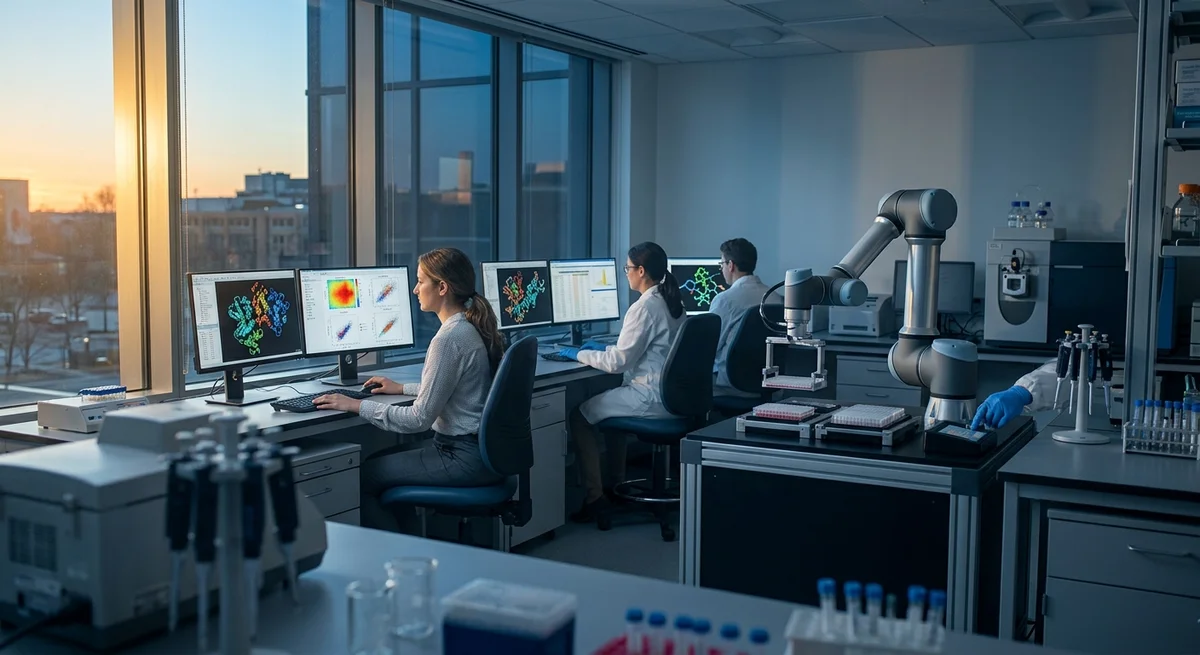
Anthropic founder Jack Clark has laid out a series of ambitious predictions about the development of artificial intelligence. By his estimate, within a year AI systems will make a discovery worthy of a Nobel Prize, and within two years bipedal robots will help workers on construction sites and in industrial plants.
When AI becomes a scientific partner
Clark describes a "dizzying sense of progress" in AI technology. The first key milestone is a Nobel-level discovery. AI will work side by side with a human scientist, analyzing experimental data, proposing hypotheses and suggesting directions for further research at a fundamentally new level of understanding.
This implies that AI systems have advanced enough to drive science itself forward, rather than merely assisting with the tedious processing of large volumes of data. Such a partnership between human and machine could speed up breakthroughs in physics, chemistry, biology and medicine.
Robots leave the lab
Alongside scientific discoveries, Anthropic expects bipedal robots to show up in workplaces within two years. This is not about factories, where a robotic arm can operate in a tightly controlled environment. It is about practical help for electricians, plumbers, builders and industrial workers in real-world conditions.
Bipedal platforms will be able to do what machines do poorly or what is dangerous for humans:
- Work at height (roofs, building facades)
- Assembling and delivering heavy loads
- Repetitive operations in industry
- Help in accidents and emergencies
- Work in extreme conditions (high temperatures, chemicals)
This sounds futuristic, but large companies are already actively funding such projects in 2025-2026.
Companies run by AI without people in 18 months
Clark's most radical prediction: companies run entirely by AI systems, without human involvement, will begin generating millions of dollars in revenue within 18 months. That means that as early as late 2027 we may see autonomous AI startups that build products and attract customers and funding on their own.
By the end of 2028, according to Anthropic's founder, AI systems will be able not only to work without humans but also to design their successors: more advanced versions of themselves.
«This is not just a tool for humans that boosts their productivity.
This is becoming an agentic revolution, where AIs act independently»
What this means
Clark is candid: along with "dizzying" progress, the technology will bring "deep and significant changes" to society. AI carries both incredible opportunities for science, the economy and solving hard problems, and real risks to employment, concentration of power and the geopolitical balance.
The timelines Clark gives are very aggressive. If even some of them come true, it will reshape the economy and science in literally one to two years. That means companies, investors and policymakers need to start preparing for change now.
- Nov 2, 2026Karpathy builds a YouTube clone with 6454 videos from Hacker News recommendations in two hours
- Nov 2, 2026Karpathy used Claude to build HackerTube from 6,454 videos recommended on Hacker News
- Nov 2, 2026Arca gives AI agents finance tasks lasting up to 10 days, but leaves the trades to humans
- Nov 2, 2026Anthropic needs to grow revenue 32% a year to cover $850 billion in contracts
Key Questions Answered
When AI becomes a scientific partner?
Clark describes a "dizzying sense of progress" in AI technology. The first key milestone is a Nobel-level discovery. AI will work side by side with a human scientist, analyzing experimental data, proposing hypotheses and suggesting directions for further research at a fundamentally new level of understanding. This implies that AI systems have advanced enough to drive science itself forward, rather than merely assisting with the tedious processing of large volumes of data. Such a partnership between human and machine could speed up breakthroughs in physics, chemistry, biolog
What are the key details on Robots leave the lab?
Alongside scientific discoveries, Anthropic expects bipedal robots to show up in workplaces within two years. This is not about factories, where a robotic arm can operate in a tightly controlled environment. It is about practical help for electricians, plumbers, builders and industrial workers in real-world conditions. Bipedal platforms will be able to do what machines do poorly or what is dangerous for humans: Work at height (roofs, building facades) Assembling and delivering heavy loads Repetitive operations in industry Help in accidents and emergencies Work in extreme co
What are the key details on Companies run by AI without people in 18 months?
Clark's most radical prediction: companies run entirely by AI systems, without human involvement, will begin generating millions of dollars in revenue within 18 months. That means that as early as late 2027 we may see autonomous AI startups that build products and attract customers and funding on their own. By the end of 2028, according to Anthropic's founder, AI systems will be able not only to work without humans but also to design their successors: more advanced versions of themselves. «This is not just a tool for humans that boosts their productivity. This is becoming a
Test Frontier LLMs & Autonomous Agents in One Workspace
Run Claude Opus 5.5, GPT-6, Gemini 3.1, and DeepSeek side-by-side in Nomad AI (nomadnet.ai) — unified model routing, deep research, and multimodal workflows under one subscription.
The AI world, distilled — once a week
Seven stories that actually mattered, hand-picked. No noise, no reposts, no press releases.
Done! Check your inbox for a confirmation.