MathWorks Demonstrated a Complete Development Cycle for AI Sensors in Embedded Systems
MathWorks launched a free webinar on creating virtual AI-based sensors. They showcase the complete cycle: training in MATLAB, formal neural network verification, model compression for memory efficiency, and C-code generation without external library dependencies. This is relevant for IoT and edge computing on microcontrollers.
AI-processed from IEEE Spectrum AI; edited by Hamidun News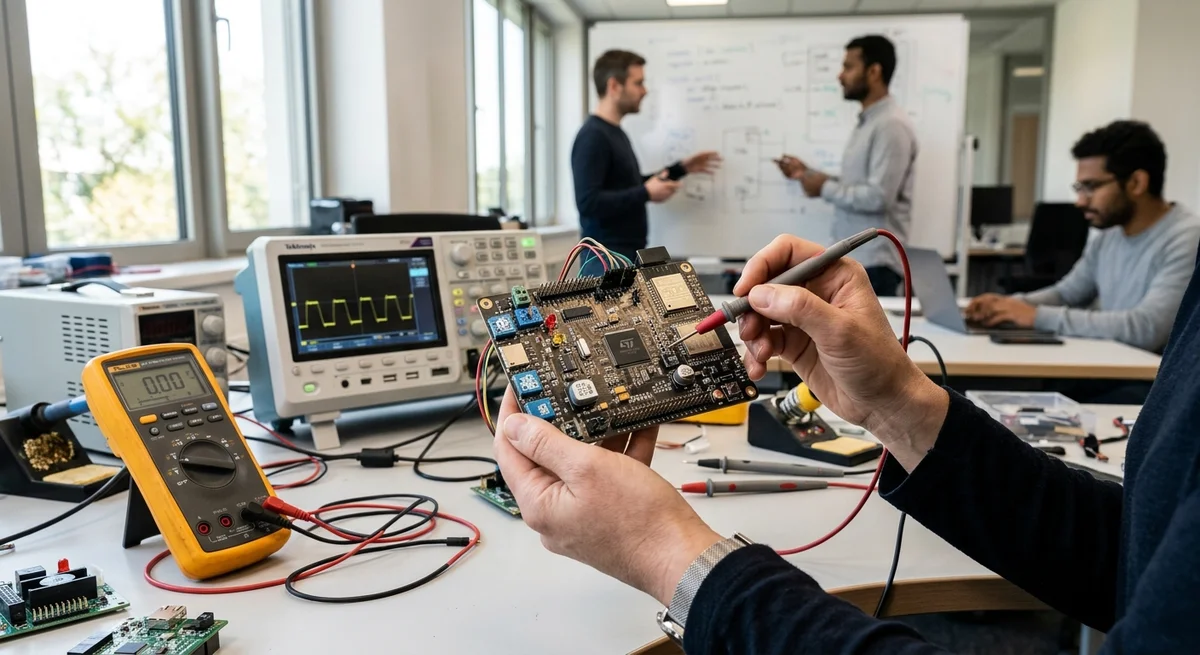
MathWorks announced a webinar on the complete workflow for creating and deploying AI models of virtual sensors that run directly on embedded processors—without cloud overhead and latency.
Why Virtual Sensors Are Needed
A virtual sensor is a neural network that computes a required measurement based on other sensors. For example, an air quality sensor calculated from pressure, humidity, and CO₂, or an equipment failure prediction system that analyzes vibration and temperature. In industry, such sensors have long been used physically—in thermal pipelines, hydraulic systems, and storage facilities. But in embedded systems, this is critical for different reasons: calculating in the cloud is expensive (the internet is unreliable, latency is unacceptable), and on a microcontroller, you must conserve every bit of memory and every milliampere of energy.
What MathWorks Demonstrates
The webinar reveals an end-to-end workflow that includes:
- Integration of AI models into Simulink for verification and simulation-based testing at the system level
- Formal neural network verification—a mathematical guarantee that the network operates within acceptable bounds
- Model compression (quantization, pruning) to save memory and accelerate execution
- C-code generation without dependencies on external frameworks
- PIL tests (processor-in-the-loop)—verification on the actual target processor
- Performance profiling and analysis of trade-offs between accuracy and speed
The entire cycle in a single environment—MATLAB and Simulink. No switching between tools, no loss of context.
Practical Challenges
The main problem: a neural network that works elegantly in a Jupyter notebook can fail on a microcontroller with 32 KB of memory and a 48 MHz processor. That's why MathWorks emphasizes formal verification—not just running tests, but proving that the network won't exceed the boundaries of safe behavior even in the worst case. The second bottleneck—how to compress the model so it fits in memory and runs fast enough, yet doesn't lose accuracy? There are techniques (quantization to int8, structural pruning, distillation), but without automation, it's manual labor.
Context: AI on Edge
This webinar is part of a major trend. Over the past 5 years, edge AI has moved from a niche to mainstream. Now not only large companies train models, but engineers who build washing machines, refrigerators, sensors, and pumps do as well. And they all face the same problem: how to run ML locally when the hardware is like that of the 2010s, but the requirements are those of 2025.
What This Means
Embedded AI is transitioning from hobbyist enthusiasm to production-grade engineering practices. If you have an IoT device, industrial equipment, or consumer electronics—in the coming years you'll need to embed AI models locally instead of sending everything to the cloud. MathWorks offers tooling that makes this an order of magnitude simpler—and most importantly, safer.
- Oct 28, 2026Nemotron 3.5 Bolt Squeezed Into 24 GB: 74B Model Hits 84 Tokens per Second
- Oct 28, 2026Security engineer builds an MCP server in 7 days that spooks an AI agent with vulnerabilities
- Oct 28, 2026Liquid AI releases LFM2.5-24B-A2B: an agent model with 2B active parameters
- Oct 28, 2026Thomson Reuters engineer runs an offline coding agent on Qwen3.5 9B in the Himalayas
Key Questions Answered
Why Virtual Sensors Are Needed?
A virtual sensor is a neural network that computes a required measurement based on other sensors. For example, an air quality sensor calculated from pressure, humidity, and CO₂, or an equipment failure prediction system that analyzes vibration and temperature. In industry, such sensors have long been used physically—in thermal pipelines, hydraulic systems, and storage facilities. But in embedded systems, this is critical for different reasons: calculating in the cloud is expensive (the internet is unreliable, latency is unacceptable), and on a microcontroller, you must cons
What MathWorks Demonstrates?
The webinar reveals an end-to-end workflow that includes: Integration of AI models into Simulink for verification and simulation-based testing at the system level Formal neural network verification—a mathematical guarantee that the network operates within acceptable bounds Model compression (quantization, pruning) to save memory and accelerate execution C-code generation without dependencies on external frameworks PIL tests (processor-in-the-loop)—verification on the actual target processor Performance profiling and analysis of trade-offs between accuracy and speed The enti
What are the key details on Practical Challenges?
The main problem: a neural network that works elegantly in a Jupyter notebook can fail on a microcontroller with 32 KB of memory and a 48 MHz processor. That's why MathWorks emphasizes formal verification—not just running tests, but proving that the network won't exceed the boundaries of safe behavior even in the worst case. The second bottleneck—how to compress the model so it fits in memory and runs fast enough, yet doesn't lose accuracy? There are techniques (quantization to int8, structural pruning, distillation), but without automation, it's manual labor.
Build & Ship Production AI Agents Without Boilerplate Code
Start your free 72-hour trial at Hamidun Academy (academy.hamidun.com) — interactive lessons on Claude Code & Cursor, live Tech Radar, and production agent templates.
The AI world, distilled — once a week
Seven stories that actually mattered, hand-picked. No noise, no reposts, no press releases.
Done! Check your inbox for a confirmation.