Shift startup offers free house cleaning in exchange for robot training videos
Shift startup offers to clean your home for free. The catch is simple: the company will film workers on video and use those clips to train cleaning robots. According to Shift's calculations, the value of video data offsets all service expenses.
AI-processed from The Verge; edited by Hamidun News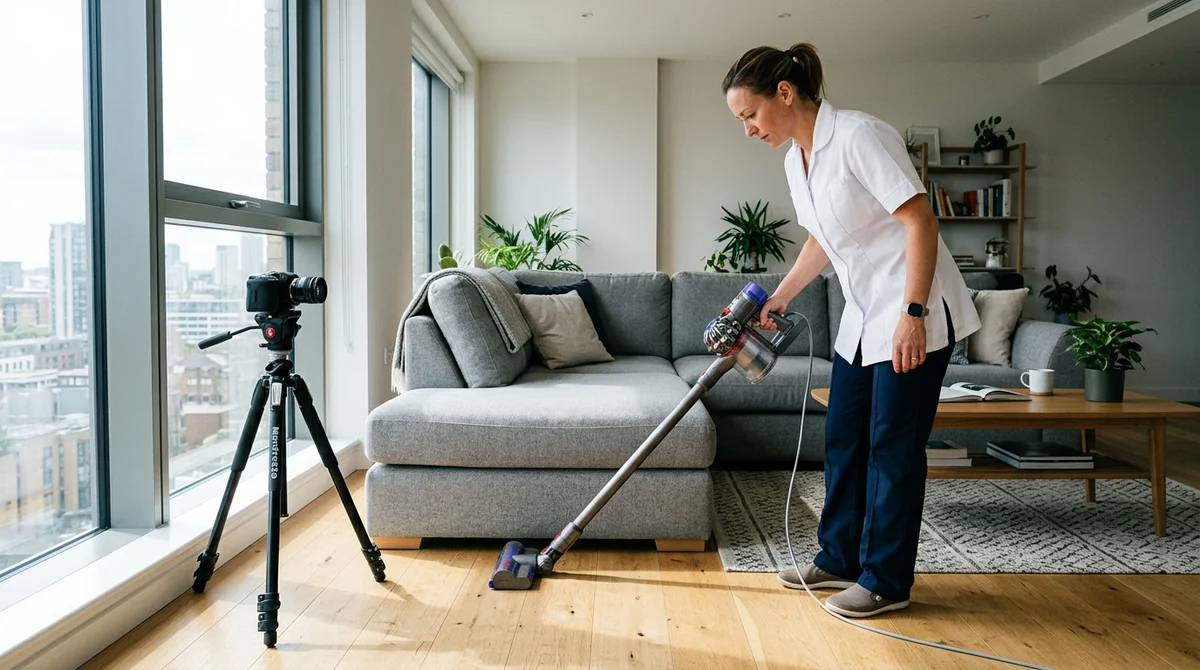
The Shift startup announced an unexpected approach to financing cleaning services: it comes to your home, cleans completely free of charge, but records every moment on video for training home robots.
How Shift's Business Works
The company sends a cleaner to your home in company uniform. They do everything properly: wash windows, vacuum carpets, dust surfaces, and tidy up rooms. But every movement is recorded on video camera. This video becomes training material for Shift's robotics projects. According to the startup founders' calculations, the value of video data is sufficient to completely finance the cleaning. On the company's website there is a pleasant formula: "You get a clean apartment. We get training data. Everyone wins." Shift announced the offer on social media on Thursday. Interestingly, the video demonstration shows a cleaner in a crisp white jumpsuit and an unusual hat — likely part of a system for better tracking movements during video recording.
Why Real-World Cleaning Data Is So Valuable
To train robots, you need exactly these kinds of videos: people performing tasks in real-world conditions, not in a laboratory environment. This is much harder to collect than synthetic data or recordings in controlled conditions. Every home is different: different furniture, different types of dirt, different room architecture. When a robot trains on this diversity, it better handles surprises in the real world. Without such data, home robots remain clumsy and ineffective. This explains why Shift is willing to clean apartments for almost nothing.
Are There Hidden Risks?
There are several catches:
- Video recording consent. The cleaner works on camera knowing they are being recorded, which may change their behavior. Natural data is often more valuable than data recorded under observation.
- The value of data may be overestimated. If the video turns out to be more complex to annotate or process, the economics of the model will break down.
- Privacy. Video recording in a home is a sensitive topic, even with consent.
For Shift itself, the main risk is that founders may overestimate the value of video data. If processing and annotation turn out to be more complex than expected, the business economics will break down.
What This Means
This is another example of data monetization in the age of large models. Instead of the traditional exchange of money for service, comes the model of data for service. If Shift succeeds at scale, it could inspire other services: food delivery, house-sitting, repairs — anything where people perform physical work in diverse environments. For workers this may be good, but it also means that professional activity becomes raw material for AI.
- Oct 28, 2026PyTorch 2.15 speeds up MoE models on Mac by 5–6.5x and adds FP8
- Oct 28, 2026OpenAI Releases GPT-6.1 Terra: Half the Price, Twice the Accuracy in Code
- Oct 28, 2026Meta open-sources Muse Spark Open: an 816B-parameter MoE with a 1M-token context
- Oct 28, 2026OpenAI Releases GPT-6.1 Terra: $1 per Million Input Tokens and Three Times Faster Than Astra
Key Questions Answered
Are There Hidden Risks?
There are several catches: Video recording consent. The cleaner works on camera knowing they are being recorded, which may change their behavior. Natural data is often more valuable than data recorded under observation. The value of data may be overestimated. If the video turns out to be more complex to annotate or process, the economics of the model will break down. Privacy. Video recording in a home is a sensitive topic, even with consent. For Shift itself, the main risk is that founders may overestimate the value of video data. If processing and annotation turn out to be
How Shift's Business Works?
The company sends a cleaner to your home in company uniform. They do everything properly: wash windows, vacuum carpets, dust surfaces, and tidy up rooms. But every movement is recorded on video camera. This video becomes training material for Shift's robotics projects. According to the startup founders' calculations, the value of video data is sufficient to completely finance the cleaning. On the company's website there is a pleasant formula: "You get a clean apartment. We get training data. Everyone wins." Shift announced the offer on social media on Thursday. Interestingl
Why Real-World Cleaning Data Is So Valuable?
To train robots, you need exactly these kinds of videos: people performing tasks in real-world conditions, not in a laboratory environment. This is much harder to collect than synthetic data or recordings in controlled conditions. Every home is different: different furniture, different types of dirt, different room architecture. When a robot trains on this diversity, it better handles surprises in the real world. Without such data, home robots remain clumsy and ineffective. This explains why Shift is willing to clean apartments for almost nothing.
Ship AI Faster with Founders, Engineers & Weekly Architecture Reviews
Inside Vibe Club (hamidun.com/club) — weekly live masterminds with Zhemal Khamidun, Tech Radar, full LMS access, and 370+ production Claude Code skills.
The AI world, distilled — once a week
Seven stories that actually mattered, hand-picked. No noise, no reposts, no press releases.
Done! Check your inbox for a confirmation.