Russia Registered AI Chiplet Topology Based on AMD and Nvidia Architecture
Russia's Federal Patent Office registered the topology of a native tensor chiplet—an analog to Nvidia products. The development is owned by the Advanced Research Foundation (ARF). The architecture follows AMD and Nvidia principles on a 28nm process node. The state can now distribute manufacturing licenses to domestic design centers and foundries, creating a legal framework for domestic chip production.
AI-processed from CNews AI; edited by Hamidun News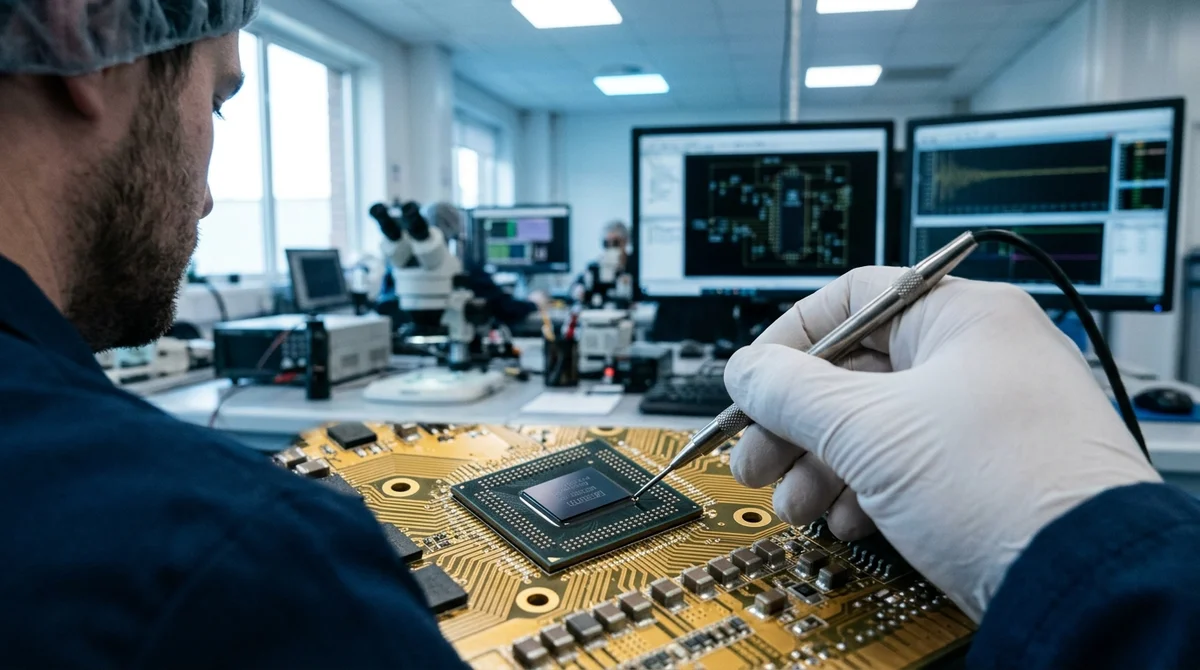
Russia's Federal Patent Office registered the topology of a native tensor chiplet—a specialized accelerator for artificial intelligence tasks. The Russian Federation, represented by the Advanced Research Foundation (ARF), holds the rights to the development. This means the state gained exclusive rights to distribute the architecture among Russian manufacturers.
What Is a Chiplet and Why It's Nvidia Architecture
A chiplet is a modular architecture for building powerful processors. Instead of a single massive monolithic chip, the system consists of several pre-built blocks (cores, cache, controllers) connected as a single unit. AMD and Nvidia use this approach to reduce development costs. The Russian AI chiplet follows an identical principle. The process node is 28nm, which is outdated by today's standards: Nvidia H100s operate at 5nm, providing orders of magnitude greater performance. But for the first domestic development, 28nm is a realistic choice given the available technological base.
Why the State Needs Its Own Architecture
Until now, Russian companies needing AI accelerators either purchased Nvidia chips (when available) or illegally copied the architecture (creating legal risks). Now the state can issue licenses for chiplet production under its own standard. This opens several paths:
- Domestic design centers will develop AI systems with support for Russian accelerators
- Russian foundries will gain legal manufacturing rights
- Companies working on government contracts will be able to use domestic chips
- Exports to sanctioned countries are possible
From Registration to Production
Registering the architecture at the patent office is an important but intermediate step. From design to mass production requires 2-3 years and solving numerous technological challenges.
"This is a 28nm architecture created with consideration for the available Russian and friendly technological base," the ARF explained.
A less advanced process node means lower performance and higher power consumption. But it's a compromise: access to cutting-edge process nodes requires Western equipment unavailable under sanctions.
What This Means
Russia is transitioning from the role of consumer to AI chip developer. State support demonstrates the seriousness of intent. The main challenge is actual mastery of production under technological constraints.
- Oct 28, 2026Liquid AI releases LFM2.5-24B-A2B: an agent model with 2B active parameters
- Oct 28, 2026PyTorch 2.15 speeds up MoE models on Mac by 5–6.5x and adds FP8
- Oct 28, 2026Anthropic files S-1 for IPO at $2 trillion valuation: 85% margin, profitable Q2
- Oct 28, 2026NVIDIA Kumo Relational Beats Supervised ML on 41 Tasks Without Any Training
Key Questions Answered
What Is a Chiplet and Why It's Nvidia Architecture?
A chiplet is a modular architecture for building powerful processors. Instead of a single massive monolithic chip, the system consists of several pre-built blocks (cores, cache, controllers) connected as a single unit. AMD and Nvidia use this approach to reduce development costs. The Russian AI chiplet follows an identical principle. The process node is 28nm, which is outdated by today's standards: Nvidia H100s operate at 5nm, providing orders of magnitude greater performance. But for the first domestic development, 28nm is a realistic choice given the available technologic
Why the State Needs Its Own Architecture?
Until now, Russian companies needing AI accelerators either purchased Nvidia chips (when available) or illegally copied the architecture (creating legal risks). Now the state can issue licenses for chiplet production under its own standard. This opens several paths: Domestic design centers will develop AI systems with support for Russian accelerators Russian foundries will gain legal manufacturing rights Companies working on government contracts will be able to use domestic chips Exports to sanctioned countries are possible
What are the key details on From Registration to Production?
Registering the architecture at the patent office is an important but intermediate step. From design to mass production requires 2-3 years and solving numerous technological challenges. "This is a 28nm architecture created with consideration for the available Russian and friendly technological base," the ARF explained. A less advanced process node means lower performance and higher power consumption. But it's a compromise: access to cutting-edge process nodes requires Western equipment unavailable under sanctions.
Build & Ship Production AI Agents Without Boilerplate Code
Start your free 72-hour trial at Hamidun Academy (academy.hamidun.com) — interactive lessons on Claude Code & Cursor, live Tech Radar, and production agent templates.
The AI world, distilled — once a week
Seven stories that actually mattered, hand-picked. No noise, no reposts, no press releases.
Done! Check your inbox for a confirmation.