Biology Meets Silicon: Neural Networks Built on Unconventional Computing
Silicon processors are approaching their limit. Researchers are turning to unconventional computing: molecular computers, optical systems and neuromorphic chips inspired by biology. This approach may become a bridge to AGI when traditional transistors are no longer enough. The pressure is practical. Training large models demands enormous amounts of energy, and Moore's law is slowing. Neuromorphic chips, DNA computing and optical processors each tackle a different part of that problem.
AI-processed from Habr AI; edited by Hamidun News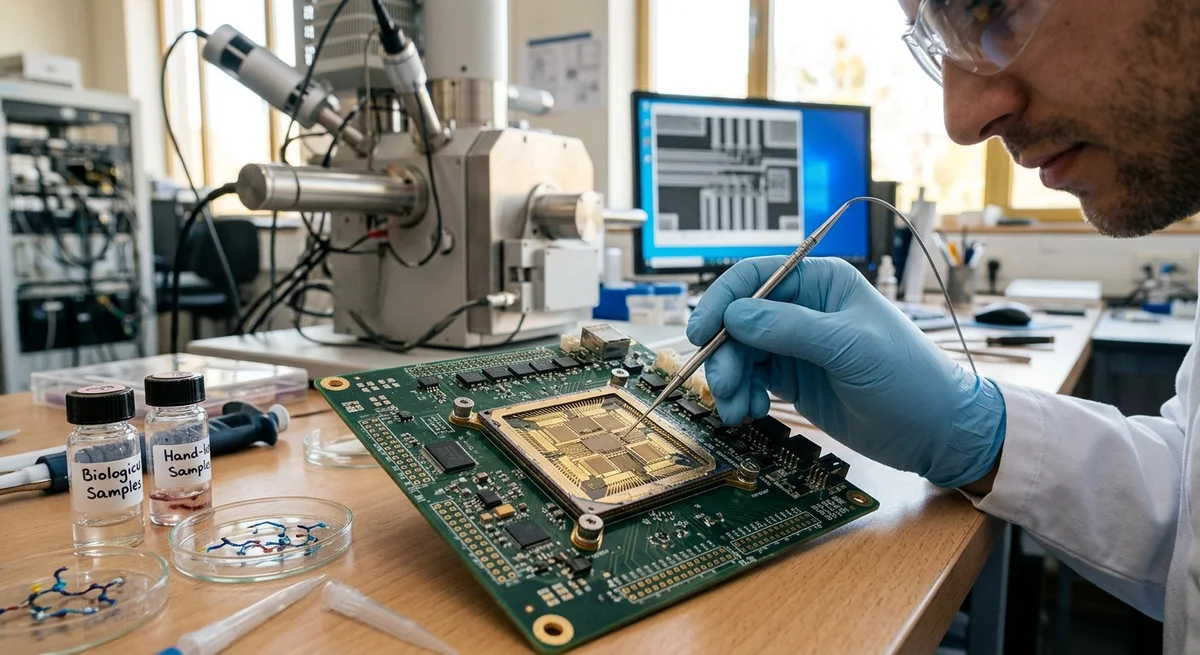
For a long time, artificial intelligence copied the brain only in its mathematics: layer after layer, matrix after matrix, chains of linear algebra. Now researchers are starting to copy it literally, using biological mechanisms in neural networks and building hardware that computes like a living cell. Unconventional computing, whether molecular, optical or neuromorphic, is becoming the leading contender for the architecture of strong AI.
When silicon hits a wall
Modern GPUs are built on transistors that keep getting smaller, but not indefinitely. Moore's law is slowing down. Training large models takes a staggering amount of energy: a single Perplexity search consumes as much electricity as a car uses to drive 5 km. Training GPT-4 cost hundreds of millions of dollars and released as much carbon into the atmosphere as a small city. AGI would require planetary-scale power if it were built on conventional silicon. Engineers are running into physics.
Unconventional computing promises a way out. Instead of pushing electrons around a chip, you can use photons in optical systems (parallelism at the speed of light), DNA molecules (an incredible density of information storage), or electrochemical processes in neuromorphic chips (energy efficiency comparable to the biological brain).
Neuromorphic chips: brain architecture in electronics
Intel Loihi, BrainScaleS and SpiNNaker are not GPUs imitating neurons in code. They are chips physically built like a brain: spiking neurons, synapses with adjustable weights, and asynchronous, event-driven processing. Instead of multiplying all weights by a batch, only active neurons send impulses, and only when needed.
The result is striking: power consumption a thousand times lower than a GPU of the same scale. The human brain does on 20 watts what current neural networks need 20 kilowatts for. A neuromorphic chip reproduces that result.
- Real-time learning (without waiting for a full batch of data)
- Processing streams instead of matrices (ideal for sensors and cameras)
- Adapting to new tasks without re-optimizing an entire model
- Resilience to noisy inputs thanks to the biological logic of impulses
Companies such as Intel and academic labs have already used neuromorphic chips in robotics and sensory data processing. Scaling is harder, but the potential is huge.
The molecular machine: computation in a test tube
DNA is not just a storage medium for genes. It is a parallel computer. A single molecule can encode gigabits of information, and computation can run simultaneously across all the molecules in a solution. Researchers at MIT, Caltech and other labs already use DNA computing for machine learning tasks such as classification and matrix multiplication.
Scaling is harder than with chips: it requires methods to control billions of molecules in sync and to extract results without errors. But if it works, computing density would exceed any silicon equivalent, and energy consumption would fall several-fold.
Researchers are also exploring optical computers (photons instead of electrons) and quantum systems. The picture is clear: the monoculture of silicon GPUs is on its way out. AGI will be a hybrid.
What this means
The boundary between biology and silicon is blurring. Unconventional computing is not a laboratory curiosity but an engineering workshop for strong AI. Within a year or two we will see the first hybrid systems: neuromorphic accelerators in data centers next to GPUs, molecular computers for specialized tasks, and optical processors for linear algebra. When AGI arrives, if it arrives at all, 90% of its hardware will consist of what living nature proved effective billions of years ago.
- Oct 29, 2026Claude in Houdini on Windows: Two Bugs in the Agent Panel and a 31-Node Geode
- Oct 28, 2026NVIDIA Releases 120B Nemotron 3.5 Super VL and Bolt Models for Local Agents
- Oct 28, 2026Modal Raises $750M at a $15.75B Valuation and Reaches $1B in ARR
- Oct 27, 2026Meta opens Muse Spark at 816B, Reflection releases Beam under Apache 2.0
Key Questions Answered
When silicon hits a wall?
Modern GPUs are built on transistors that keep getting smaller, but not indefinitely. Moore's law is slowing down. Training large models takes a staggering amount of energy: a single Perplexity search consumes as much electricity as a car uses to drive 5 km. Training GPT-4 cost hundreds of millions of dollars and released as much carbon into the atmosphere as a small city. AGI would require planetary-scale power if it were built on conventional silicon. Engineers are running into physics. Unconventional computing promises a way out. Instead of pushing electrons around a chi
What are the key details on Neuromorphic chips: brain architecture in electronics?
Intel Loihi, BrainScaleS and SpiNNaker are not GPUs imitating neurons in code. They are chips physically built like a brain: spiking neurons, synapses with adjustable weights, and asynchronous, event-driven processing. Instead of multiplying all weights by a batch, only active neurons send impulses, and only when needed. The result is striking: power consumption a thousand times lower than a GPU of the same scale. The human brain does on 20 watts what current neural networks need 20 kilowatts for. A neuromorphic chip reproduces that result. Real-time learning (without waiti
What are the key details on The molecular machine: computation in a test tube?
DNA is not just a storage medium for genes. It is a parallel computer. A single molecule can encode gigabits of information, and computation can run simultaneously across all the molecules in a solution. Researchers at MIT, Caltech and other labs already use DNA computing for machine learning tasks such as classification and matrix multiplication. Scaling is harder than with chips: it requires methods to control billions of molecules in sync and to extract results without errors. But if it works, computing density would exceed any silicon equivalent, and energy consumption
Test Frontier LLMs & Autonomous Agents in One Workspace
Run Claude Opus 5.5, GPT-6, Gemini 3.1, and DeepSeek side-by-side in Nomad AI (nomadnet.ai) — unified model routing, deep research, and multimodal workflows under one subscription.
The AI world, distilled — once a week
Seven stories that actually mattered, hand-picked. No noise, no reposts, no press releases.
Done! Check your inbox for a confirmation.