China's Official Trade Union Newspaper Calls for Worker Protection Against AI Displacement
In China, state-controlled newspaper Workers' Daily, the official organ of the All-China Federation of Trade Unions, openly called on regulators to protect workers' labor rights. The demand was driven by rapid AI adoption across manufacturing and service sectors. While Chinese authorities are examining potential risk mitigation measures, no specific solutions have yet been announced.
AI-processed from Bloomberg Tech; edited by Hamidun News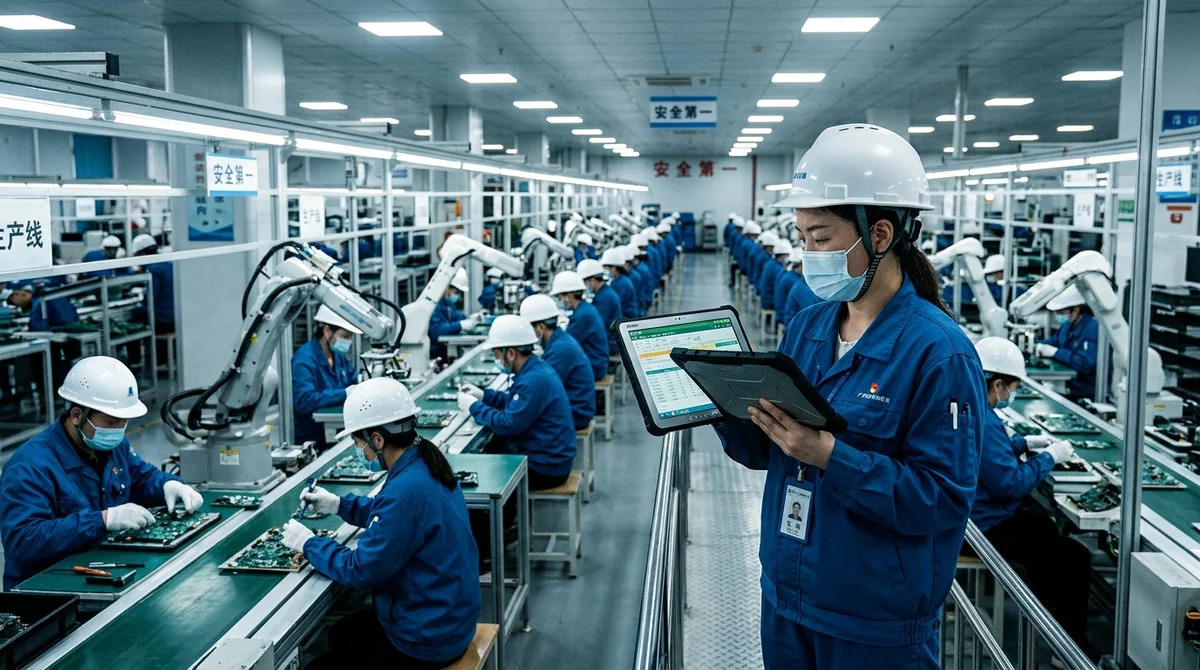
In China, the official trade union newspaper Workers' Daily publicly called on regulators for the first time to protect workers' labor rights amid rapid AI implementation in enterprises and offices across the country.
What Happened
Workers' Daily — the publication of the All-China Federation of Trade Unions, the world's largest trade union organization — published an editorial material with a direct demand to authorities: develop mechanisms to protect employment in the face of technological change. For China's official state media, which typically avoid direct criticism of the course toward accelerated technological development, such harsh language is an unusual step. The article appeared at a moment when AI systems are actively displacing human labor in industry, logistics, finance, and services. Algorithms are not just replacing individual employees, but entire departments — especially visible in manufacturing, where operator crews are giving way to roboticized lines with minimal human involvement.
Scale of Automation
The concerns are justified by real figures. China is the global leader in the pace of industrial robotization: over the past five years, the country has installed more industrial robots than Europe and North America combined. Meanwhile, AI penetrates industries where robots were previously absent — from legal services to medicine. The most vulnerable sectors:
- Manufacturing and assembly lines — robots completely replace operators
- Banking operations — algorithms process applications and analyze credit risks
- Retail and logistics — warehouses and delivery are automated at all levels
- Call centers — voice AI agents reduce operator staffing
- Legal and analytical services — language models perform tasks that previously required dozens of specialists
Against this backdrop, youth unemployment in China in 2025 reached record levels, turning the topic of labor displacement into a politically sensitive issue.
Government Position
Beijing consistently promotes AI leadership as a strategic priority: the state invests in development, supports startups, and has no intention of slowing down. However, the country's leadership also understands something else: mass unemployment is a direct threat to social stability, which China takes extremely seriously.
"Regulators need to study the risks AI poses to labor rights and develop appropriate protective measures," the editorial in
Workers' Daily states.
Beijing has not yet announced specific legislative initiatives. But the very fact that official state media openly raises this issue signals that the topic has moved from expert discussions to the level of state agenda.
What It Means
China vividly demonstrates the contradiction that all major economies will sooner or later face: technological competition cannot be stopped, but its social costs cannot be indefinitely ignored. The open call from state media to protect workers is a sign that pressure from below has become too obvious to suppress. The question now is whether regulators will manage to develop effective mechanisms before this tension breaks out beyond editorial pages.
Key Questions Answered
What Happened?
Workers' Daily — the publication of the All-China Federation of Trade Unions, the world's largest trade union organization — published an editorial material with a direct demand to authorities: develop mechanisms to protect employment in the face of technological change. For China's official state media, which typically avoid direct criticism of the course toward accelerated technological development, such harsh language is an unusual step. The article appeared at a moment when AI systems are actively displacing human labor in industry, logistics, finance, and services. Alg
What are the key details on Scale of Automation?
The concerns are justified by real figures. China is the global leader in the pace of industrial robotization: over the past five years, the country has installed more industrial robots than Europe and North America combined. Meanwhile, AI penetrates industries where robots were previously absent — from legal services to medicine. The most vulnerable sectors: Manufacturing and assembly lines — robots completely replace operators Banking operations — algorithms process applications and analyze credit risks Retail and logistics — warehouses and delivery are automated at all l
What are the key details on Government Position?
Beijing consistently promotes AI leadership as a strategic priority: the state invests in development, supports startups, and has no intention of slowing down. However, the country's leadership also understands something else: mass unemployment is a direct threat to social stability, which China takes extremely seriously. "Regulators need to study the risks AI poses to labor rights and develop appropriate protective measures," the editorial in Workers' Daily states. Beijing has not yet announced specific legislative initiatives. But the very fact that official state media o
Test Frontier LLMs & Autonomous Agents in One Workspace
Run Claude Opus 5.5, GPT-6, Gemini 3.1, and DeepSeek side-by-side in Nomad AI (nomadnet.ai) — unified model routing, deep research, and multimodal workflows under one subscription.
The AI world, distilled — once a week
Seven stories that actually mattered, hand-picked. No noise, no reposts, no press releases.
Done! Check your inbox for a confirmation.