Macron and Modi warn G7: the US could switch off AI at any moment
Presidents Macron and Modi raised the alarm at the G7: the US can cut off access to American AI at any moment, without warning and without appeal. That fear became real after an Anthropic outage hit users around the world. AI sovereignty is no longer a theoretical question. For the first time, governments are publicly calling dependence on American platforms a national security threat.
AI-processed from TechCrunch; edited by Hamidun News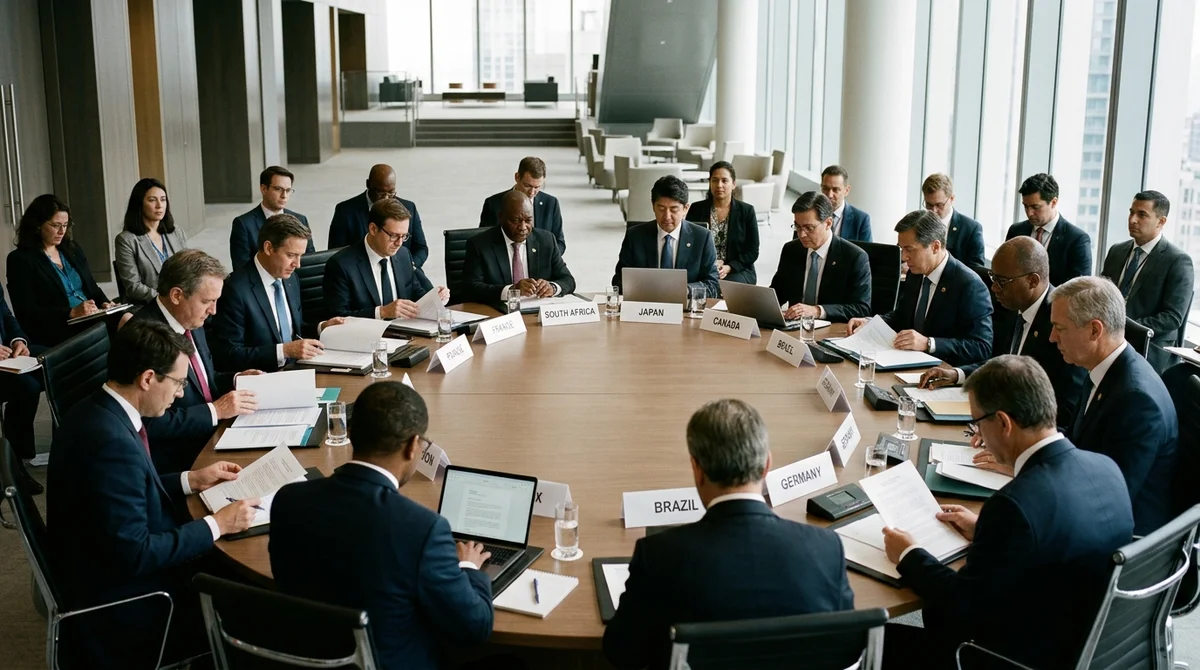
At the G7 summit, the leaders of France and India publicly warned that dependence on American AI platforms is not an abstract geopolitical risk. It is a real vulnerability that a single decision in Washington could trigger. An Anthropic service outage during the same period only proved their point.
What was said at the G7
Emmanuel Macron and Narendra Modi raised the same issue on the sidelines of the summit: no country that relies on American AI tools can be sure those tools will keep working. A political decision in Washington, a shift in regulatory course, or a technical failure would be enough to knock out a whole country's critical infrastructure. This is not a theoretical scenario. The Biden and Trump administrations have already used export controls to restrict access to NVIDIA chips, putting dozens of countries on sanctions lists. Restrictions on AI services are the next logical step, and no one in Washington has officially ruled them out.
"We need access to the best AI.
But we cannot afford a situation where one call from Washington cuts off our access to the tools our economy depends on."
Why the
Anthropic blackout became a symbol When Anthropic's services went down for several hours, it was an ordinary technical failure, not a political act. But in the context of the G7 discussion, it took on a political dimension: this is exactly what a world looks like when critical AI systems are run by one corporation from one country. A corporate outage and a government shutdown are different in nature.
But for a user on the outside, the result is identical: the service is unavailable, the data is out of reach, and the work doesn't get done. For governments integrating AI into public administration, that means entire departments grind to a halt. This is the argument sovereign AI advocates now make: there's no need to wait for political will when it is already happening technically, by accident.
Sovereign AI: from words to money
The term "sovereign AI" entered the agenda after 2022, but for a long time it stayed at the level of declarations. Now budgets have started to move: France has invested more than €2 billion in national AI labs and in developing Mistral as a European alternative to GPT India launched the IndiaAI program with a budget of $1.25 billion and is building Bhashini, a platform for working with local languages The EU adopted the AI Act, partly aimed at reducing dependence on American providers Saudi Arabia is building a 500 MW AI cluster together with NVIDIA, with a provision for national control over data * China already operates, de facto, in an isolated AI space with its own foundation models The paradox is that most of these projects still depend on American chips, frameworks, and base architectures.
Full independence is a long-horizon goal, not something for the coming quarters. But even partial diversification reduces the risks.
What this means AI sovereignty is becoming as much a part of the
foreign policy agenda as energy independence became after the 2022 crisis. Governments are moving from words to concrete budgets. For American AI companies, this is a new reality: they will have to offer guarantees of availability, local data storage, and independent governance. Otherwise, governments will choose alternatives that are less advanced but easier to control.
- Nov 2, 2026Karpathy builds a YouTube clone with 6454 videos from Hacker News recommendations in two hours
- Nov 2, 2026Karpathy used Claude to build HackerTube from 6,454 videos recommended on Hacker News
- Nov 2, 2026Arca gives AI agents finance tasks lasting up to 10 days, but leaves the trades to humans
- Nov 2, 2026Anthropic needs to grow revenue 32% a year to cover $850 billion in contracts
Test Frontier LLMs & Autonomous Agents in One Workspace
Run Claude Opus 5.5, GPT-6, Gemini 3.1, and DeepSeek side-by-side in Nomad AI (nomadnet.ai) — unified model routing, deep research, and multimodal workflows under one subscription.
The AI world, distilled — once a week
Seven stories that actually mattered, hand-picked. No noise, no reposts, no press releases.
Done! Check your inbox for a confirmation.