MIT builds a chip that lets tiny robots map in 3D on the fly
MIT researchers have built a chip that lets tiny robots create real-time 3D maps of their surroundings onboard, with no link to an external computer. The algorithm and the hardware accelerator were designed together, which sharply cut memory and energy use. That opens the way to autonomous mini-robots for search and rescue, medicine and industrial inspection.
AI-processed from MIT News; edited by Hamidun News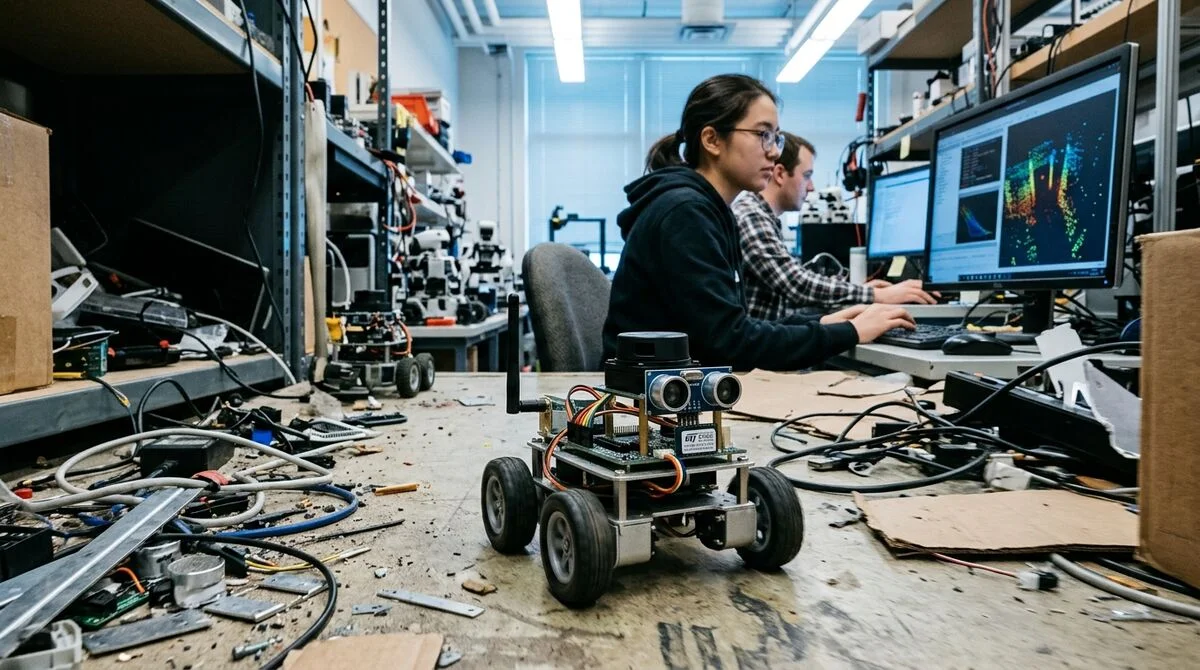
MIT researchers have unveiled a new chip that can turn tiny robots into fully autonomous navigators. The device combines a dedicated hardware module with an optimized algorithm; together they build real-time 3D maps of the environment while using minimal memory and energy.
The problem: a small robot in a complex environment
Engineers like small robots for an obvious reason: they can squeeze into places where a person or a large machine cannot go. But they face a fundamental limit: a compact body holds only a miniature battery and a low-power chip. Classic navigation algorithms such as SLAM (Simultaneous Localization and Mapping) demand heavy computation. Building a 3D map of an unfamiliar space while tracking your own position within it takes gigabytes of memory and several watts of power in a standard implementation. For a device the size of a beetle, that is out of reach.
Standard SLAM implementations also store the map as dense 3D arrays. The data volume grows quickly with the size of the explored space, which makes them fundamentally unsuited to embedded systems with limited memory.
The usual workaround is to send raw sensor data to an external computer and receive the finished map back. That works in a lab, but fails where there is no connection: under rubble, in a narrow pipeline, inside the human body.
Algorithm and hardware as a single solution
The MIT team applied a hardware-software co-design approach: the mapping algorithm and the hardware accelerator were developed together from scratch. The result is a chip in which every operation is optimized for specific hardware rather than for a general-purpose processor.
- The algorithm was rewritten to minimize memory accesses and uses a compact incremental map representation
- The hardware module processes the most resource-intensive stages in parallel
- The 3D map is built onboard, with no data sent out
- Power consumption is cut to a level suitable for tiny batteries
The approach is not new in microelectronics as a whole, but it is rarely used for robotic navigation. Most teams either improve the algorithm or build specialized hardware. Doing both for a single task is harder, yet it is exactly what yields a multiple-fold efficiency gain.
The MIT researchers presented the architecture details in an academic publication, although specific accuracy and speed figures on benchmark scenarios have not yet been made publicly available.
Where you need a map without a server
There are several practical uses, and they share one trait: environments with no link to an operator and no room for cables.
- Search and rescue — robots under rubble after earthquakes, where there is no GPS and no stable radio signal
- Medicine — surgical probes and targeted drug-delivery systems that work inside the body without a control cable
- Industrial inspection — pipelines, air ducts and reactor cavities that humans physically cannot reach
- Agriculture — mini-drones for crop monitoring or pollination in enclosed greenhouses
The medical use is of particular interest: autonomous probes that do not need constant control over a cable could substantially simplify minimally invasive surgical procedures. In all the other cases, the key capability is the same: making navigation decisions independently, without external computing infrastructure.
What this means
The MIT chip removes a trade-off that robotics has long accepted: either a large machine with a powerful onboard computer, or a compact one that depends on external infrastructure. If a module like this enters developers' standard toolkit, tiny autonomous devices will gain access to environments that were previously physically closed to them.
- Nov 2, 2026Karpathy builds a YouTube clone with 6454 videos from Hacker News recommendations in two hours
- Nov 2, 2026Karpathy used Claude to build HackerTube from 6,454 videos recommended on Hacker News
- Nov 2, 2026Arca gives AI agents finance tasks lasting up to 10 days, but leaves the trades to humans
- Nov 2, 2026DeepSeek open-sources Super-agent prototype: p95 task completion time of 15.7 minutes vs. 29.5
Key Questions Answered
What are the key details on The problem: a small robot in a complex environment?
Engineers like small robots for an obvious reason: they can squeeze into places where a person or a large machine cannot go. But they face a fundamental limit: a compact body holds only a miniature battery and a low-power chip. Classic navigation algorithms such as SLAM (Simultaneous Localization and Mapping) demand heavy computation. Building a 3D map of an unfamiliar space while tracking your own position within it takes gigabytes of memory and several watts of power in a standard implementation. For a device the size of a beetle, that is out of reach. Standard SLAM imple
What are the key details on Algorithm and hardware as a single solution?
The MIT team applied a hardware-software co-design approach: the mapping algorithm and the hardware accelerator were developed together from scratch. The result is a chip in which every operation is optimized for specific hardware rather than for a general-purpose processor. The algorithm was rewritten to minimize memory accesses and uses a compact incremental map representation The hardware module processes the most resource-intensive stages in parallel The 3D map is built onboard, with no data sent out Power consumption is cut to a level suitable for tiny batteries The ap
Where you need a map without a server?
There are several practical uses, and they share one trait: environments with no link to an operator and no room for cables. Search and rescue — robots under rubble after earthquakes, where there is no GPS and no stable radio signal Medicine — surgical probes and targeted drug-delivery systems that work inside the body without a control cable Industrial inspection — pipelines, air ducts and reactor cavities that humans physically cannot reach Agriculture — mini-drones for crop monitoring or pollination in enclosed greenhouses The medical use is of particular interest: auton
Test Frontier LLMs & Autonomous Agents in One Workspace
Run Claude Opus 5.5, GPT-6, Gemini 3.1, and DeepSeek side-by-side in Nomad AI (nomadnet.ai) — unified model routing, deep research, and multimodal workflows under one subscription.
The AI world, distilled — once a week
Seven stories that actually mattered, hand-picked. No noise, no reposts, no press releases.
Done! Check your inbox for a confirmation.