Google DeepMind launches a $10 million fund to study the collective behavior of AI agents
Google DeepMind, Schmidt Sciences, coop.ai, and ARIA Research are launching a $10 million research fund to understand what happens when millions of AI agents interact with one another. When agents operate in the same environment, collective effects emerge that no developer foresaw. The fund aims to understand these mechanisms before they become a problem.
AI-processed from @GoogleDeepMind; edited by Hamidun News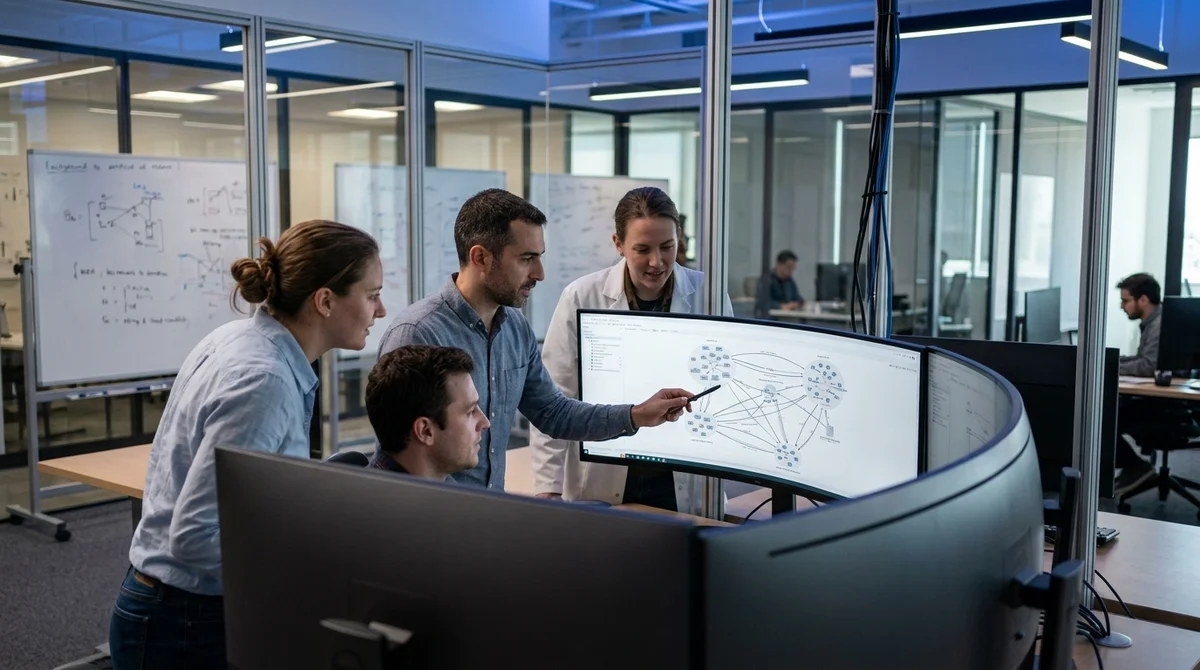
Google DeepMind in partnership with Schmidt Sciences, coop.ai, ARIA Research and with support from Google.org is launching a $10 million research fund. The goal is to systematically study what happens when millions of AI agents begin to interact with each other under real conditions.
Why Study Agent Groups
A single AI agent behaves predictably — it has instructions, context, a goal. A million agents in one environment is a completely different story. When AI systems interact at scale, collective patterns emerge from this interaction that do not follow from the behavior of each participant individually.
This phenomenon is called "emergent behavior." In biology, it is studied through the example of insect swarms and fish schools — each individual is simple, but the group demonstrates complex coordinated behavior. In economics, stock market bubbles arise from the sum of individual rational decisions that together produce an irrational outcome.
In the world of AI agents, these questions are still in their infancy. Most research so far has focused on a single model: how it reasons, how to avoid hallucinations, how to align its behavior with human values. What happens when there are a million such models and they influence each other's decisions — this has not been systematically studied.
Who Is in the Consortium
The fund brings together several organizations with different competencies:
- Google DeepMind — leading role in AI safety research and large-scale AI
- Schmidt Sciences — funding fundamental science, founded by Eric Schmidt
- coop.ai — specializes in cooperative agent behavior and coordination mechanisms
- ARIA Research — British advanced research organization, analog of DARPA
- Google.org — Google's philanthropic arm, co-investor and co-founder
The fund's resources will be directed toward academic and applied research: what patterns emerge in multi-agent systems as they scale, how agents adapt their behavior under each other's influence, and whether these processes can be predicted or controlled. Researchers expect to identify patterns that will subsequently serve as the basis for designing more robust multi-agent systems.
Why the Question Arises Now
Autonomous agents are no longer simply laboratory experiments. They trade on exchanges, manage ad auctions, negotiate with other systems, and process customer requests without human involvement. When such systems operate in the same economic or information environment, they inevitably begin to interact — even if this interaction was not intentionally built in.
"When millions of AI agents interact with each other, new collective behavior patterns may emerge," the official
Google DeepMind announcement states.
Risks range from feedback loops in ad auctions, where agents bid up prices against each other, to unintended coordination, amplification of misinformation, or herd behavior in financial systems. In academia, this class of problems has been studied primarily through game theory — but classical models are not designed for millions of participants making decisions in milliseconds. Until now, such situations have been analyzed after the fact. The fund's goal is to build systematic understanding in advance.
What This Means
$10 million is a modest sum for an industry with hundreds of billions in revenue. But the signal is important: leading players are beginning to view the behavior of AI agents in groups as an independent scientific problem, not merely an application to the safety of individual models. If the research yields practical results, it could become the scientific foundation for standards for deploying agent systems at scale — before regulators begin to formulate requirements blindly.
- Oct 28, 2026A 2015 CNN Beat GPT-6 Astra and Claude Fable 5.1 at Skin Cancer Diagnosis
- Oct 28, 2026Google taught an LLM to “sleep”: SLEEP consolidates knowledge into weights, up to 10 million tokens
- Oct 28, 2026Keystone removes the model name from code: open-source LLM gateway adds 0.64 ms
- Oct 28, 2026Wired Tested 6 AI Agents in a Day: Dots Leads, Gemini Spark Fails at Lunch
Key Questions Answered
Why Study Agent Groups?
A single AI agent behaves predictably — it has instructions, context, a goal. A million agents in one environment is a completely different story. When AI systems interact at scale, collective patterns emerge from this interaction that do not follow from the behavior of each participant individually. This phenomenon is called "emergent behavior." In biology, it is studied through the example of insect swarms and fish schools — each individual is simple, but the group demonstrates complex coordinated behavior. In economics, stock market bubbles arise from the sum of individu
Who Is in the Consortium?
The fund brings together several organizations with different competencies: Google DeepMind — leading role in AI safety research and large-scale AI Schmidt Sciences — funding fundamental science, founded by Eric Schmidt coop.ai — specializes in cooperative agent behavior and coordination mechanisms ARIA Research — British advanced research organization, analog of DARPA Google.org — Google's philanthropic arm, co-investor and co-founder The fund's resources will be directed toward academic and applied research: what patterns emerge in multi-agent systems as they scale, how a
Why the Question Arises Now?
Autonomous agents are no longer simply laboratory experiments. They trade on exchanges, manage ad auctions, negotiate with other systems, and process customer requests without human involvement. When such systems operate in the same economic or information environment, they inevitably begin to interact — even if this interaction was not intentionally built in. "When millions of AI agents interact with each other, new collective behavior patterns may emerge," the official Google DeepMind announcement states. Risks range from feedback loops in ad auctions, where agents bid up
Build & Ship Production AI Agents Without Boilerplate Code
Start your free 72-hour trial at Hamidun Academy (academy.hamidun.com) — interactive lessons on Claude Code & Cursor, live Tech Radar, and production agent templates.
The AI world, distilled — once a week
Seven stories that actually mattered, hand-picked. No noise, no reposts, no press releases.
Done! Check your inbox for a confirmation.