Google DeepMind releases DiffusionGemma — a diffusion-based LLM 4x faster than other Gemma 4 models
Google DeepMind announced DiffusionGemma, a new class of language model that uses diffusion instead of autoregression. It runs 4x faster than the other models in the Gemma 4 family. Demis Hassabis personally congratulated the team and described it as lightning-fast — a signal to the entire industry.
AI-processed from @demishassabis; edited by Hamidun News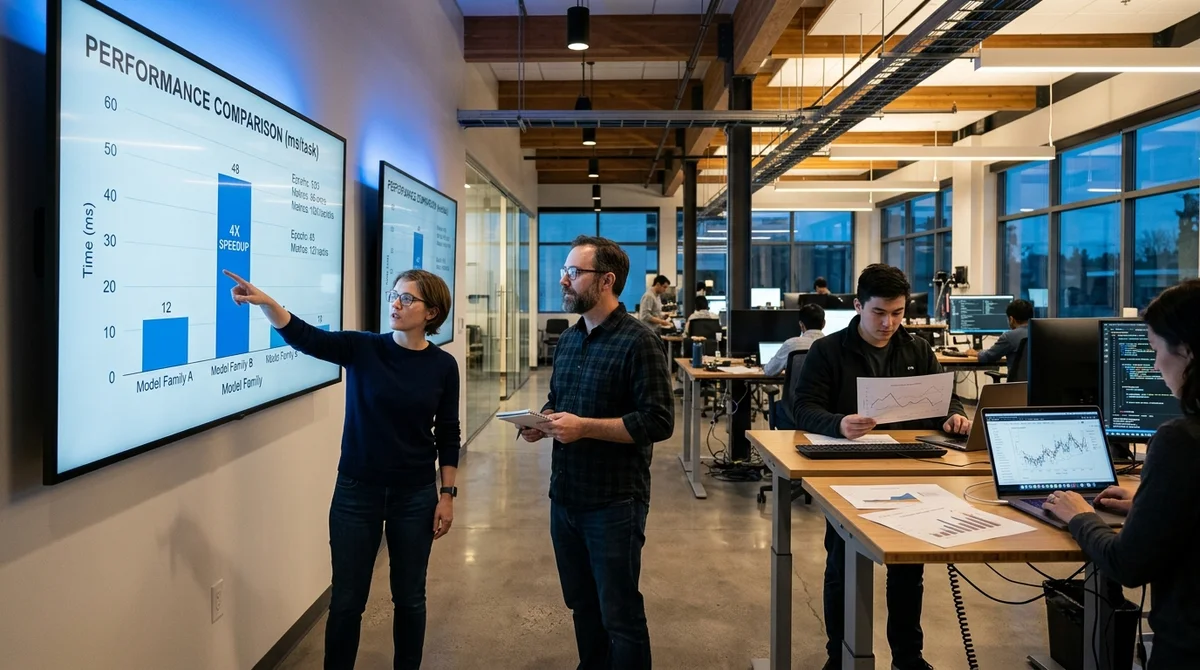
Google DeepMind has introduced DiffusionGemma — a language model of a new class that applies the diffusion principle of text generation instead of the standard autoregressive approach. According to the team, the model runs 4 times faster than any other model from the Gemma 4 family while maintaining comparable quality.
How Diffusion-Based LLM Works
Classical language models — GPT, Llama, Gemma — generate text sequentially: token by token, left to right. To generate 500 tokens requires 500 consecutive inference steps. This is a fundamental architectural limitation: each subsequent token depends on all previous ones, so parallelism is impossible by the very nature of autoregression.
The diffusion approach works differently. The same idea underlying Stable Diffusion and DALL-E for images is now applied to text: the model learns to restore the original text from random noise, gradually refining the entire sequence as a whole — not left to right, but iteratively, in parallel across all positions simultaneously.
- Autoregression: 500 tokens require 500 consecutive steps
- Diffusion: 500 tokens are processed in 10–50 steps regardless of length
- Speed gains are non-linear — the longer the text, the more pronounced the advantage
Many teams have attempted to master diffusion for text generation since 2021. The main problem has been quality: diffusion-based text models long underperformed autoregressive ones, with texts losing coherence and precision of formulation. Based on Hasabis's statement, DiffusionGemma has overcome this barrier.
Demis Hasabis Announced It Personally
The CEO of Google DeepMind announced the result himself — this is unusual. Executives of this level typically promote entire products or strategic directions but rarely single out specific architectural solutions as a separate occasion for celebration. Hasabis personally congratulated researcher Brian O'Donoghue and the entire team, calling the development 'lightning-fast'.
"An excellent innovation in text diffusion.
DiffusionGemma is lightning-fast — 4 times faster than other Gemma 4 models. Can't wait to see what people will build with it!" — Demis Hasabis
Important context: this is not a comparison with outdated benchmarks, but with the current Gemma 4 family, which itself is considered one of the most efficient in the class of open models. A fourfold increase over such a baseline is a significant architectural achievement.
The Economics of Inference Is Changing
Generation speed determines both the cost of APIs and the latency of the end product. If DiffusionGemma generates 4 times faster at comparable quality, this opens up a range of practical opportunities:
- Reduced cost of inference — less GPU time per response
- Long contexts without exponential growth in latency
- Competitiveness in latency-sensitive scenarios: chatbots, autocompletion, agent pipelines
- Potential for unification with diffusion-based image and audio generation
Multimodal synergy is particularly interesting: if text diffusion is combined with already mature approaches for images and audio, a single architecture emerges that processes all modalities by one principle. Google is already moving in this direction with the Gemini series — DiffusionGemma appears to be the first step toward full multimodal diffusion.
What This Means
Diffusion-based LLMs have ceased to be an academic experiment. When the CEO of one of the world's largest AI labs personally announces an architectural breakthrough, the market responds. If DiffusionGemma's speed metrics are confirmed in independent tests, this could reshape pricing in the LLM inference market and force competitors to accelerate their own diffusion research. For developers who haven't yet explored this architecture — now is the time.
- Oct 28, 2026Google выпустила Gemini 4 Argon: $2 за млн токенов и №1 в Vals Index
- Oct 28, 2026Wired Tested 6 AI Agents in a Day: Dots Leads, Gemini Spark Fails at Lunch
- Oct 28, 2026Anthropic files S-1 for IPO at $2 trillion valuation: 85% margin, profitable Q2
- Oct 28, 2026Meta releases Muse Spark Open: 816B parameters and the lead among US open-weight models
Key Questions Answered
How Diffusion-Based LLM Works?
Classical language models — GPT, Llama, Gemma — generate text sequentially: token by token, left to right. To generate 500 tokens requires 500 consecutive inference steps. This is a fundamental architectural limitation: each subsequent token depends on all previous ones, so parallelism is impossible by the very nature of autoregression. The diffusion approach works differently. The same idea underlying Stable Diffusion and DALL-E for images is now applied to text: the model learns to restore the original text from random noise, gradually refining the entire sequence as a wh
What are the key details on Demis Hasabis Announced It Personally?
The CEO of Google DeepMind announced the result himself — this is unusual. Executives of this level typically promote entire products or strategic directions but rarely single out specific architectural solutions as a separate occasion for celebration. Hasabis personally congratulated researcher Brian O'Donoghue and the entire team, calling the development 'lightning-fast'. "An excellent innovation in text diffusion. DiffusionGemma is lightning-fast — 4 times faster than other Gemma 4 models. Can't wait to see what people will build with it!" — Demis Hasabis Important conte
What are the key details on The Economics of Inference Is Changing?
Generation speed determines both the cost of APIs and the latency of the end product. If DiffusionGemma generates 4 times faster at comparable quality, this opens up a range of practical opportunities: Reduced cost of inference — less GPU time per response Long contexts without exponential growth in latency Competitiveness in latency-sensitive scenarios: chatbots, autocompletion, agent pipelines Potential for unification with diffusion-based image and audio generation Multimodal synergy is particularly interesting: if text diffusion is combined with already mature approache
Test Frontier LLMs & Autonomous Agents in One Workspace
Run Claude Opus 5.5, GPT-6, Gemini 3.1, and DeepSeek side-by-side in Nomad AI (nomadnet.ai) — unified model routing, deep research, and multimodal workflows under one subscription.
The AI world, distilled — once a week
Seven stories that actually mattered, hand-picked. No noise, no reposts, no press releases.
Done! Check your inbox for a confirmation.