SK Hynix Leveraged ETF Has Grown So Large It's Shaking the Entire South Korean Market
Bloomberg analysts warn: a leveraged ETF tied to memory producer SK Hynix's shares has grown so quickly and significantly that it now amplifies volatility not only of the stock itself but of South Korea's entire Kospi index. An instrument designed for short-term speculation has become one of the key drivers of market fluctuations in the country.
AI-processed from Bloomberg Tech; edited by Hamidun News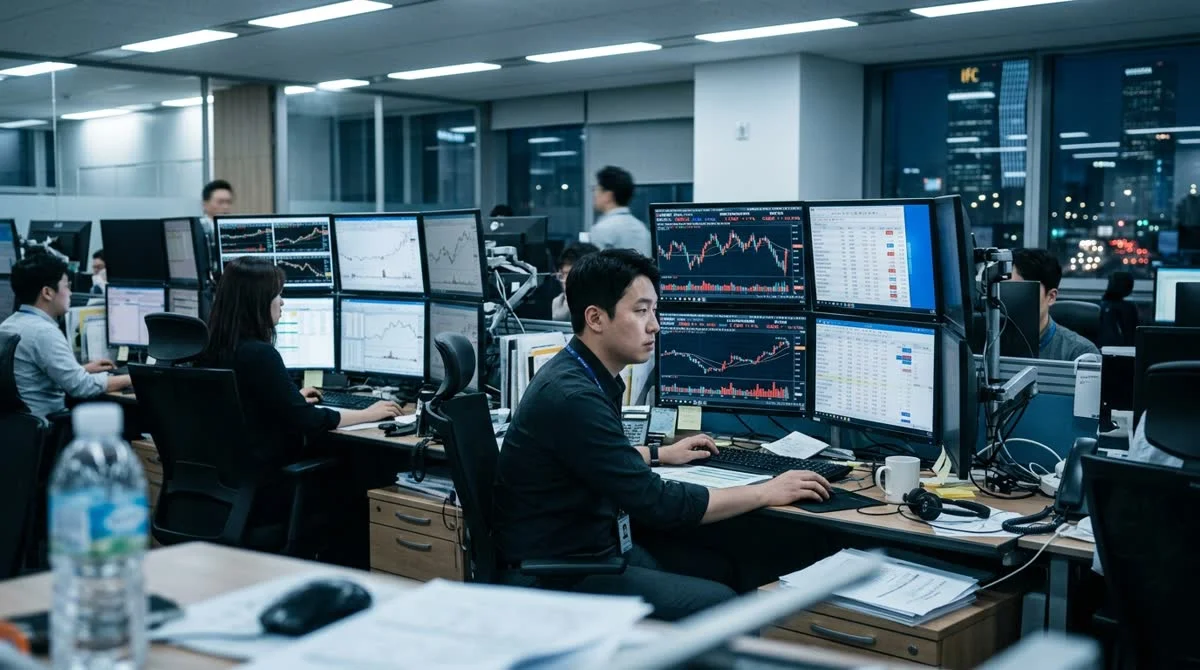
A leveraged ETF linked to South Korean chip memory producer SK Hynix shares has grown so quickly that, according to Bloomberg analysts' estimates, it has begun systematically amplifying volatility of both the company's stock itself and the entire Kospi stock index — Bloomberg reported this on July 2, 2026.
How the mechanism for amplifying fluctuations works
A leveraged ETF is an exchange-traded investment fund that uses borrowed funds to multiply the daily returns of the underlying asset. In the case of the SK Hynix fund, a leverage ratio of 2x or 3x is applied: if the stock rises by 1%, the fund rises by 2–3%, and vice versa. The key problem is in daily rebalancing.
To maintain the specified ratio, managers are obliged to adjust positions daily: buy more of the underlying asset when it rises, sell when it falls. This creates a self-reinforcing loop: SK Hynix share growth leads to even larger purchases from the ETF, and a decline leads to additional sales. When the fund is small, the effect is imperceptible.
But when it reaches a significant size, its daily operations are felt across the entire market. This is exactly what happened with the SK Hynix ETF: an instrument originally developed for short-term speculation by individual investors has become a systemically important player in the Korean stock market.
Why SK Hynix ended up at the center of the situation
SK Hynix is the world's second-largest producer of DRAM and NAND memory chips. In the last two years, the company has found itself at the epicenter of the AI supercycle: it produces High Bandwidth Memory (HBM) — a specialized type of memory necessary for the operation of top AI accelerators, including Nvidia H100 and H200. When excitement around AI infrastructure sharply intensified, SK Hynix shares rose, which attracted a large inflow of funds to related instruments — including leveraged ETFs.
Fund growth turned out to be rapid and disproportionate. Investors seeking to get amplified exposure to the AI boom through SK Hynix shares directed significant capital into it. Reaching critical mass, the ETF became an independent factor of volatility — the fund began to influence the dynamics of the stock it tracks itself.
- SK Hynix is among the largest issuers in Kospi — movements in its shares are felt across the entire index
- Rebalancing mechanism: when a stock falls 1%, a 3x leveraged ETF loses 3%, then sells the underlying asset, further amplifying the decline
- The AI supercycle drove up the company's shares, which increased the inflow of capital into the leveraged ETF
- Bloomberg analysts are recording a systemic effect usually associated with large derivative positions, not retail ETFs
What this means
The situation with the SK Hynix leveraged ETF is a vivid example of how financial instruments created for a narrow circle of speculators, when scaled up, become a source of systemic risk. For investors in Korean assets, this means increased caution: sharp movements in Kospi may reflect not fundamental changes in the country's economy, but mechanical operations of one or two large funds. The question of permissible limits on the size of leveraged instruments is becoming increasingly relevant for South Korean regulators.
- Oct 28, 2026Liquid AI releases LFM2.5-24B-A2B: an agent model with 2B active parameters
- Oct 28, 2026PyTorch 2.15 speeds up MoE models on Mac by 5–6.5x and adds FP8
- Oct 28, 2026Anthropic files S-1 for IPO at $2 trillion valuation: 85% margin, profitable Q2
- Oct 28, 2026NVIDIA Kumo Relational Beats Supervised ML on 41 Tasks Without Any Training
Key Questions Answered
How the mechanism for amplifying fluctuations works?
A leveraged ETF is an exchange-traded investment fund that uses borrowed funds to multiply the daily returns of the underlying asset. In the case of the SK Hynix fund, a leverage ratio of 2x or 3x is applied: if the stock rises by 1%, the fund rises by 2–3%, and vice versa. The key problem is in daily rebalancing. To maintain the specified ratio, managers are obliged to adjust positions daily: buy more of the underlying asset when it rises, sell when it falls. This creates a self-reinforcing loop: SK Hynix share growth leads to even larger purchases from the ETF, and a decl
Why SK Hynix ended up at the center of the situation?
SK Hynix is the world's second-largest producer of DRAM and NAND memory chips. In the last two years, the company has found itself at the epicenter of the AI supercycle: it produces High Bandwidth Memory (HBM) — a specialized type of memory necessary for the operation of top AI accelerators, including Nvidia H100 and H200. When excitement around AI infrastructure sharply intensified, SK Hynix shares rose, which attracted a large inflow of funds to related instruments — including leveraged ETFs. Fund growth turned out to be rapid and disproportionate. Investors seeking to ge
What this means?
The situation with the SK Hynix leveraged ETF is a vivid example of how financial instruments created for a narrow circle of speculators, when scaled up, become a source of systemic risk. For investors in Korean assets, this means increased caution: sharp movements in Kospi may reflect not fundamental changes in the country's economy, but mechanical operations of one or two large funds. The question of permissible limits on the size of leveraged instruments is becoming increasingly relevant for South Korean regulators.
Test Frontier LLMs & Autonomous Agents in One Workspace
Run Claude Opus 5.5, GPT-6, Gemini 3.1, and DeepSeek side-by-side in Nomad AI (nomadnet.ai) — unified model routing, deep research, and multimodal workflows under one subscription.
The AI world, distilled — once a week
Seven stories that actually mattered, hand-picked. No noise, no reposts, no press releases.
Done! Check your inbox for a confirmation.