Meta unveils Brain2Qwerty 2.0, which reads brain signals during typing without surgery
On June 30, 2026, Meta showed Brain2Qwerty 2.0, a system that turns brain signals into text without surgery. External sensors record neural activity while a person types, and an algorithm decodes whole sentences, a first for a non-invasive interface. The central paradox: the system is trained on typing, which is exactly what its target users cannot do. *Meta is designated an extremist organization and banned in Russia.
AI-processed from TNW; edited by Hamidun News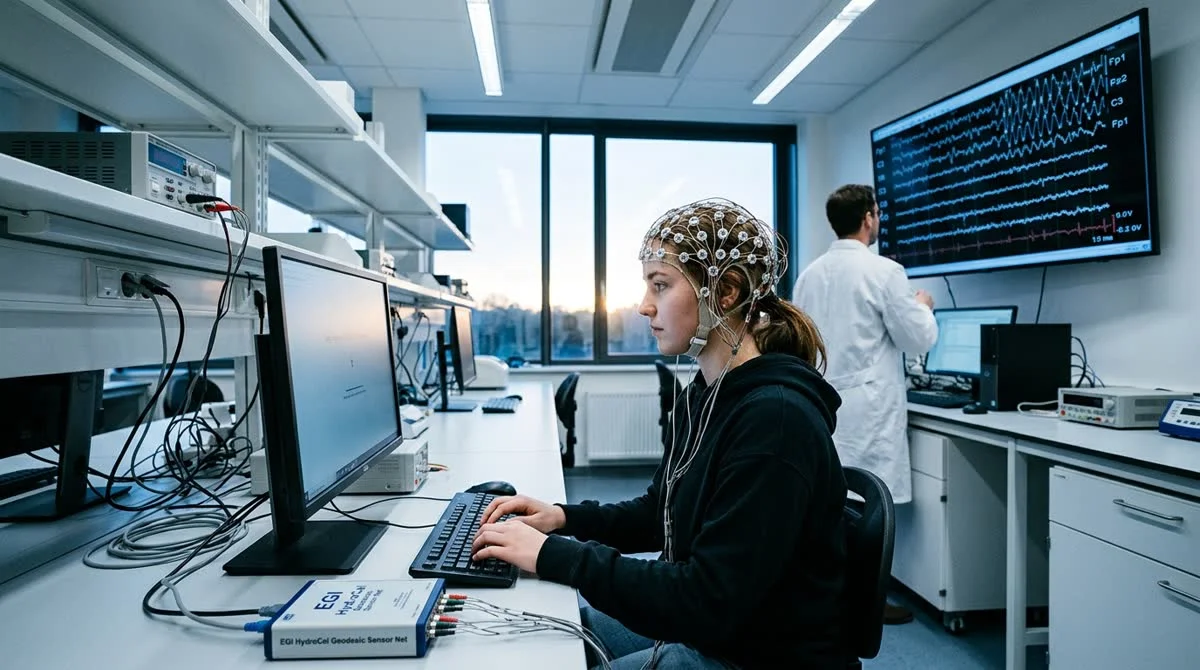
On June 30, 2026, Meta unveiled the second version of Brain2Qwerty, a system that decodes brain signals at the moment of typing and converts them into whole sentences without any surgical procedure. The key technical achievement: this level of decoding accuracy has been reached for the first time in a fully non-invasive way, with all sensors attached outside the skull.
How the system works
Brain2Qwerty 2.0 works without implants or surgery. Sensors attached to the surface of the head record the brain's electrical activity while the user types. Meta's specialized algorithms process these signals, match them to the neural patterns associated with specific keys, and convert the sequence of patterns into readable sentences.
The first version of Brain2Qwerty worked at the level of individual characters, trying to guess one letter at a time. The second version moves to the level of complete sentences: the system analyzes sequences of signals as a whole and reconstructs meaningful text as a single unit of output. This fundamentally changes the accuracy and practical usefulness of the brain-computer interface.
Key parameters of Brain2Qwerty 2.0:
- Announcement date: June 30, 2026
- Fully non-invasive technology: sensors sit outside the skull, no surgery needed
- New decoding level: whole sentences (the previous version worked with individual characters)
- Developer: Meta AI Research
- Target audience: people with motor impairments who have lost the ability to type
Why can't the system be trained without typing?
The fundamental problem with Brain2Qwerty 2.0 is a paradoxical one. The system is not universal: it is trained individually for each user by analyzing their brain signals while they type. The user must type a large enough volume of text for the algorithm to build a personal neural profile.
This is exactly what the people who need a brain-computer interface most cannot do. People with amyotrophic lateral sclerosis (ALS), the aftermath of a stroke, or severe spinal injuries have physically lost the ability to type, which is precisely why they need this technology. The interface is needed by those who cannot train it, a classic problem of first-generation BCI systems.
Meta has not yet announced an approach to solving this problem. In academic circles, alternatives are being discussed: pretraining on data from healthy subjects, and motor imagery, in which a person mentally pictures a hand movement without physically making it.
Who competes with Meta in brain-computer interfaces?
Several major players work in this segment, with fundamentally different approaches. Neuralink uses invasive chips with high spatial precision and has already conducted its first clinical trials in humans. Synchron works with a stent inserted through the blood vessels of the brain, a less risky option but one that still requires a medical procedure. Meta is the only large technology company betting on fully external sensors.
If the non-invasive approach reaches the required accuracy, it opens a very different market trajectory: a product without surgery does not need approval as a medical implant and could, in theory, reach the consumer market significantly faster than competitors' solutions.
What this means
Meta has shown that a non-invasive brain-computer interface that decodes sentences is real technology, not an exotic idea. The next key question is whether a method can be developed to train the system without keyboard input. Until that happens, Brain2Qwerty remains an impressive academic achievement. If the problem is solved, the technology could genuinely change the lives of people with motor impairments.
*Meta is designated an extremist organization and banned in Russia.
- Nov 1, 2026MoneyGate safety layer blocked all 42 fraudulent requests to local AI models
- Oct 31, 2026Open-source LLM gateway KTMS 1.0 plugs your own GPUs into the cloud and survives outages
- Oct 31, 202622B-Parameter LTX-2.5 Runs on a 10 GB RTX 3080, but Takes 5 Minutes per Shot
- Oct 29, 2026T-Tech Introduces LIMe, a Method That Trains Language Models With 15% Less Compute
Key Questions Answered
Why can't the system be trained without typing?
The fundamental problem with Brain2Qwerty 2.0 is a paradoxical one. The system is not universal: it is trained individually for each user by analyzing their brain signals while they type. The user must type a large enough volume of text for the algorithm to build a personal neural profile. This is exactly what the people who need a brain-computer interface most cannot do. People with amyotrophic lateral sclerosis (ALS), the aftermath of a stroke, or severe spinal injuries have physically lost the ability to type, which is precisely why they need this technology. The interfa
Who competes with Meta in brain-computer interfaces?
Several major players work in this segment, with fundamentally different approaches. Neuralink uses invasive chips with high spatial precision and has already conducted its first clinical trials in humans. Synchron works with a stent inserted through the blood vessels of the brain, a less risky option but one that still requires a medical procedure. Meta is the only large technology company betting on fully external sensors. If the non-invasive approach reaches the required accuracy, it opens a very different market trajectory: a product without surgery does not need approv
How the system works?
Brain2Qwerty 2.0 works without implants or surgery. Sensors attached to the surface of the head record the brain's electrical activity while the user types. Meta's specialized algorithms process these signals, match them to the neural patterns associated with specific keys, and convert the sequence of patterns into readable sentences. The first version of Brain2Qwerty worked at the level of individual characters, trying to guess one letter at a time. The second version moves to the level of complete sentences: the system analyzes sequences of signals as a whole and reconstr
Ship AI Faster with Founders, Engineers & Weekly Architecture Reviews
Inside Vibe Club (hamidun.com/club) — weekly live masterminds with Zhemal Khamidun, Tech Radar, full LMS access, and 370+ production Claude Code skills.
The AI world, distilled — once a week
Seven stories that actually mattered, hand-picked. No noise, no reposts, no press releases.
Done! Check your inbox for a confirmation.