Nvidia pushes Kyber server rack to 2028 over a single board
Nvidia is delaying its Kyber server rack to 2028. It was due in 2027 alongside the Rubin Ultra chips. The cause: a single board inside the system has blocked the entire production schedule. Kyber is not a chip but a rack holding 144 accelerators, and it is key infrastructure for hyperscalers such as Microsoft, Google and Amazon.
AI-processed from TNW; edited by Hamidun News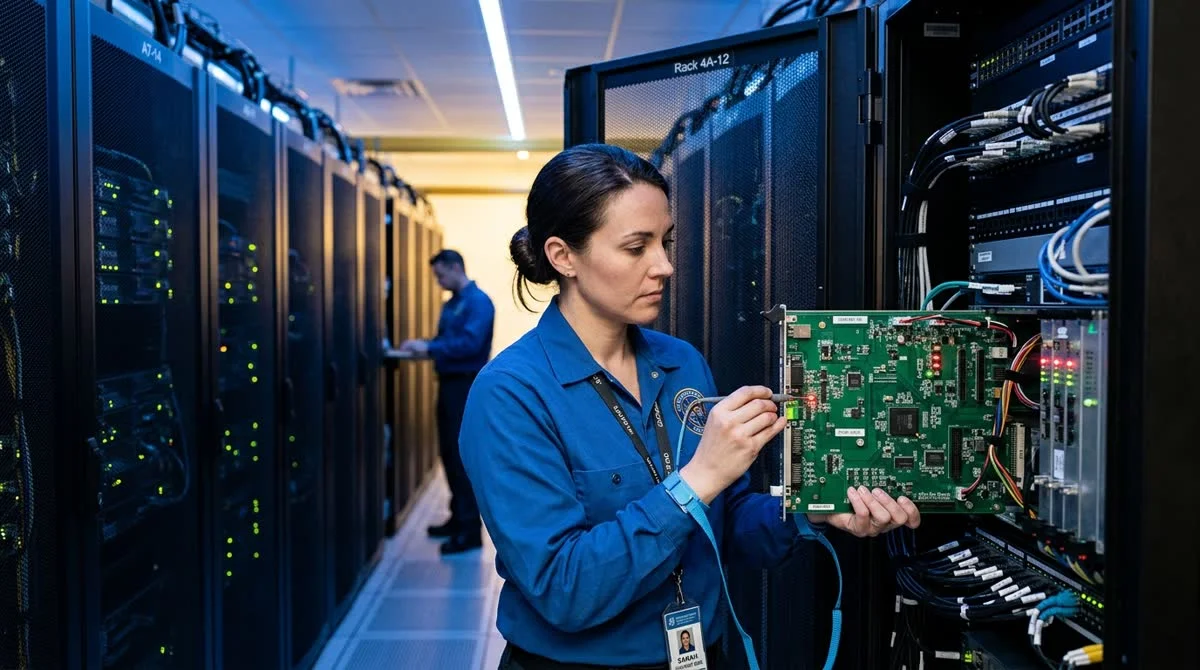
Nvidia has pushed its Kyber server rack to 2028, and a single board inside the system is to blame. Kyber was originally planned for 2027, when the rack was due to arrive alongside next-generation Rubin Ultra chips. The analyst firm SemiAnalysis was the first to report the delay, and CNBC picked up the story.
What Kyber is, and why it matters more than an ordinary GPU
The general public is still barely familiar with the Kyber name, unlike Blackwell or Rubin Ultra, which Nvidia actively promotes as flagship accelerators. Kyber is not a processor and not a GPU. It is a server rack: an industrial cabinet that houses 144 Rubin Ultra accelerators linked by high-speed interconnects.
In scale and significance, such a system is an entirely different class of product. Thousands of companies of all sizes buy individual Nvidia GPUs. The Kyber rack is an infrastructure solution aimed primarily at hyperscalers: Microsoft Azure, Google Cloud, Amazon AWS and Meta, which build data centers out of hundreds or thousands of such racks to train the largest AI models. A delay at the rack level means access to next-generation compute infrastructure is pushed back for the entire industry at once.
Why one board stalled the whole rack
According to SemiAnalysis, a specific board inside the rack caused the schedule slip. The exact type of component, its manufacturer and the nature of the fault have not been disclosed publicly. All that is known from public information is that the problem was isolated, but fixing it took long enough to shift the entire production schedule to the right.
Highly complex server systems are especially vulnerable to such "points of failure." The final product, a rack of 144 accelerators, is assembled from thousands of components supplied by many manufacturers. One unreliable element can stall final assembly of an entire batch. Something similar has happened with Kyber's predecessor: with the first Blackwell rack shipments, some customers ran into overheating problems, which required a redesign.
Switching suppliers is not a quick fix either, even when an alternative exists on the market. Integrating a new component into already agreed production chains requires additional engineering sign-offs, testing and validation, which by itself takes months.
Key facts:
- The delay was uncovered and published by the analyst firm SemiAnalysis
- Kyber is designed for 144 Rubin Ultra accelerators
- The timeline moved from 2027 to 2028
- The cause was a single board, the only component involved in the rack
What this means
A one-year slip for Kyber is not just unwelcome news for Nvidia shareholders. For the company it is a strategic risk at a time when competitors are picking up speed: AMD is pushing its MI300/MI350 accelerator series, Google, Amazon and Microsoft are developing their own AI chips (TPU, Trainium and Maia), and startups such as Cerebras and Groq offer unconventional low-latency architectures.
Nvidia still holds a share above 80% of the AI accelerator market, but repeated supply disruptions could accelerate diversification among its largest buyers. For hyperscalers planning capital spending several years ahead, predictable delivery dates matter no less than the technical specifications of the chips themselves.
*Meta has been designated an extremist organization and is banned in Russia.
- Nov 1, 2026Local models lose to Opus and Codex: 0.21 on a MacBook versus 1.00 for Codex
- Nov 1, 2026Habr author fine-tunes YOLOv8l on dental X-rays and pushes mAP50 to 0.642
- Nov 1, 2026Voice bots built on LLMs turn to Jev, a fast classifier, for decisions in 200–500 ms
- Nov 1, 2026MoneyGate safety layer blocked all 42 fraudulent requests to local AI models
Key Questions Answered
What Kyber is, and why it matters more than an ordinary GPU?
The general public is still barely familiar with the Kyber name, unlike Blackwell or Rubin Ultra, which Nvidia actively promotes as flagship accelerators. Kyber is not a processor and not a GPU. It is a server rack: an industrial cabinet that houses 144 Rubin Ultra accelerators linked by high-speed interconnects. In scale and significance, such a system is an entirely different class of product. Thousands of companies of all sizes buy individual Nvidia GPUs. The Kyber rack is an infrastructure solution aimed primarily at hyperscalers: Microsoft Azure, Google Cloud, Amazon A
Why one board stalled the whole rack?
According to SemiAnalysis, a specific board inside the rack caused the schedule slip. The exact type of component, its manufacturer and the nature of the fault have not been disclosed publicly. All that is known from public information is that the problem was isolated, but fixing it took long enough to shift the entire production schedule to the right. Highly complex server systems are especially vulnerable to such "points of failure." The final product, a rack of 144 accelerators, is assembled from thousands of components supplied by many manufacturers. One unreliable elem
What this means?
A one-year slip for Kyber is not just unwelcome news for Nvidia shareholders. For the company it is a strategic risk at a time when competitors are picking up speed: AMD is pushing its MI300/MI350 accelerator series, Google, Amazon and Microsoft are developing their own AI chips (TPU, Trainium and Maia), and startups such as Cerebras and Groq offer unconventional low-latency architectures. Nvidia still holds a share above 80% of the AI accelerator market, but repeated supply disruptions could accelerate diversification among its largest buyers. For hyperscalers planning cap
Test Frontier LLMs & Autonomous Agents in One Workspace
Run Claude Opus 5.5, GPT-6, Gemini 3.1, and DeepSeek side-by-side in Nomad AI (nomadnet.ai) — unified model routing, deep research, and multimodal workflows under one subscription.
The AI world, distilled — once a week
Seven stories that actually mattered, hand-picked. No noise, no reposts, no press releases.
Done! Check your inbox for a confirmation.