Chinese Companies Ready to Allocate Up to 46% of AI Chip Budget to Local Suppliers Instead of Nvidia
According to Bloomberg, Chinese companies intend to direct up to 46% of their AI accelerator budget to local manufacturers over the next 12 months. This occurs against the backdrop of U.S. restrictions on importing Nvidia H200 and H100 chips into China. Import substitution in China is transforming from a forced measure into a long-term procurement strategy for the country's largest tech players.
AI-processed from 3DNews AI; edited by Hamidun News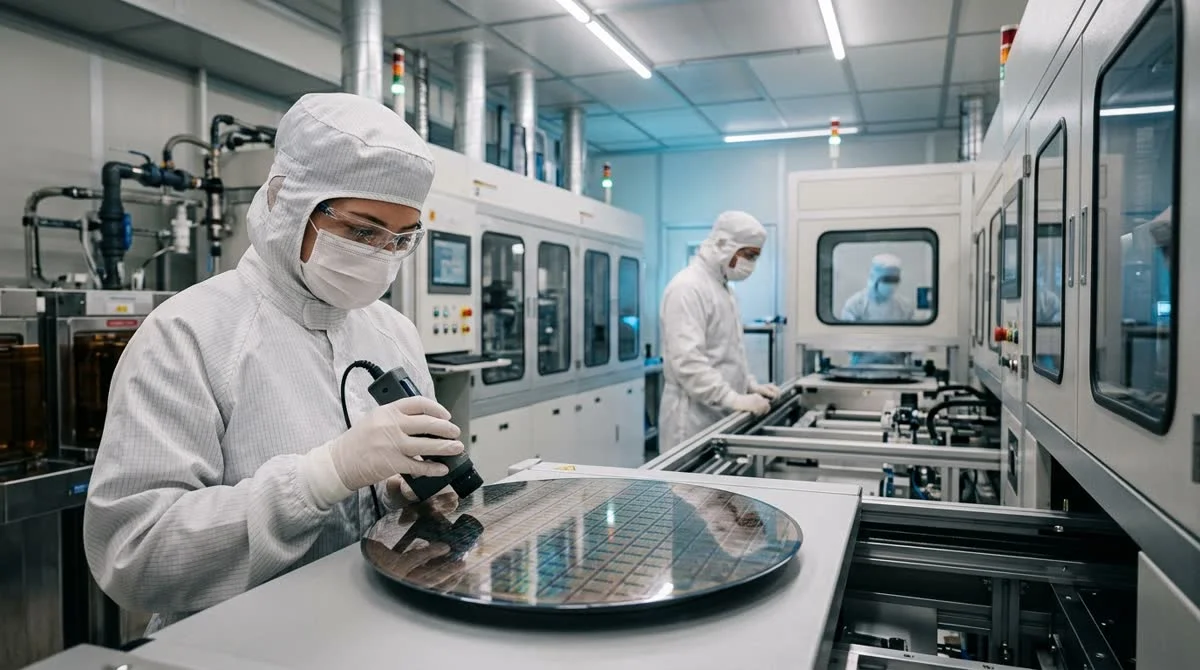
According to Bloomberg, Chinese companies intend to allocate up to 46% of their budget for purchasing AI accelerators from domestic manufacturers over the next 12 months — a record-breaking rate of Nvidia substitution in one of the world's largest markets for computing chips for artificial intelligence.
Why is it almost half the budget
Several years ago, Chinese technology companies — cloud providers, internet conglomerates, AI startups — were primarily oriented toward American equipment. Nvidia's H100 and H200 accelerators set the industry standard both in performance and richness of software ecosystem: CUDA, cuDNN, and TensorRT were de facto infrastructure for training large language models.
The situation was changed by successive rounds of American export restrictions. First, A100 and H100 chips were banned, then specially developed "stripped-down" versions for the Chinese market — A800 and H800. When in 2023–2024 restrictions extended to the flagship H200, China found itself practically cut off from Nvidia's top accelerators. This external pressure transformed import substitution from a political slogan into a real purchasing priority.
Who will fill the freed niche
Among the main contenders for the redistributed budgets are several Chinese AI accelerator developers, each of which has occupied its own niche.
- Huawei — the Ascend line (910B, 910C) is positioned as an alternative to Nvidia's H100 for large training clusters
- Cambricon — specialized neural network processors (NPU) for cloud inference
- Moore Threads — GPU accelerators with a focus on CUDA ecosystem compatibility
- Biren Technology and Enflame — players scaling up capacity with support from state funds
By performance, none of them yet reaches full parity with Nvidia. However, in corporate procurement this is not the only criterion: guaranteed supply without sanctions risk, price subsidies, and compatibility with the local software stack make domestic manufacturers increasingly competitive at industrial procurement volumes.
What does the 46% figure mean
The 46% figure does not mean that Nvidia completely loses the Chinese market. The company continues to sell chips allowed under current restrictions in China — in particular, the H20, developed with specially reduced characteristics. Nevertheless, the intention to direct almost half of the chip budget to domestic manufacturers signals a systemic shift: import substitution ceases to be a forced measure and becomes a conscious long-term strategy.
Notably, Bloomberg obtained these data through direct survey of companies — which gives the figures the character of real business intentions rather than public rhetoric. In parallel, the shift accelerates the development of the entire accompanying ecosystem: accelerator manufacturers increase investments in compilers, frameworks, and cloud platforms capable of competing with CUDA on domestic hardware.
"This is a structural shift, not a situational response to a single quarterly report,"
Bloomberg conveys the position of analysts familiar with market dynamics.
What this means
If Bloomberg's forecasts materialize, by mid-2027 the Chinese AI accelerator market will become substantially less dependent on a single American supplier. For Nvidia — this is pressure on the third largest sales market. For the global industry — a signal that a competitive alternative to the established GPU monopoly can form faster than Western analysts assumed. At the same time, the success of the Chinese chip stack can pave the way for technology exports to other markets seeking alternatives to Western semiconductor infrastructure.
- Oct 28, 2026Liquid AI releases LFM2.5-24B-A2B: an agent model with 2B active parameters
- Oct 28, 2026PyTorch 2.15 speeds up MoE models on Mac by 5–6.5x and adds FP8
- Oct 28, 2026Anthropic files S-1 for IPO at $2 trillion valuation: 85% margin, profitable Q2
- Oct 28, 2026NVIDIA Kumo Relational Beats Supervised ML on 41 Tasks Without Any Training
Key Questions Answered
Why is it almost half the budget?
Several years ago, Chinese technology companies — cloud providers, internet conglomerates, AI startups — were primarily oriented toward American equipment. Nvidia's H100 and H200 accelerators set the industry standard both in performance and richness of software ecosystem: CUDA, cuDNN, and TensorRT were de facto infrastructure for training large language models. The situation was changed by successive rounds of American export restrictions. First, A100 and H100 chips were banned, then specially developed "stripped-down" versions for the Chinese market — A800 and H800. When
Who will fill the freed niche?
Among the main contenders for the redistributed budgets are several Chinese AI accelerator developers, each of which has occupied its own niche. Huawei — the Ascend line (910B, 910C) is positioned as an alternative to Nvidia's H100 for large training clusters Cambricon — specialized neural network processors (NPU) for cloud inference Moore Threads — GPU accelerators with a focus on CUDA ecosystem compatibility Biren Technology and Enflame — players scaling up capacity with support from state funds By performance, none of them yet reaches full parity with Nvidia. However, in
What does the 46% figure mean?
The 46% figure does not mean that Nvidia completely loses the Chinese market. The company continues to sell chips allowed under current restrictions in China — in particular, the H20, developed with specially reduced characteristics. Nevertheless, the intention to direct almost half of the chip budget to domestic manufacturers signals a systemic shift: import substitution ceases to be a forced measure and becomes a conscious long-term strategy. Notably, Bloomberg obtained these data through direct survey of companies — which gives the figures the character of real business
Ship AI Faster with Founders, Engineers & Weekly Architecture Reviews
Inside Vibe Club (hamidun.com/club) — weekly live masterminds with Zhemal Khamidun, Tech Radar, full LMS access, and 370+ production Claude Code skills.
The AI world, distilled — once a week
Seven stories that actually mattered, hand-picked. No noise, no reposts, no press releases.
Done! Check your inbox for a confirmation.