DeepSeek is developing its own AI chip
DeepSeek has been secretly working on its own AI inference chip for about a year, Reuters sources report. The company is consulting potential semiconductor manufacturing partners and hiring chip design engineers without public announcements. The goal is to reduce its dependence on American Nvidia accelerators under tight sanctions restrictions.
AI-processed from 3DNews AI; edited by Hamidun News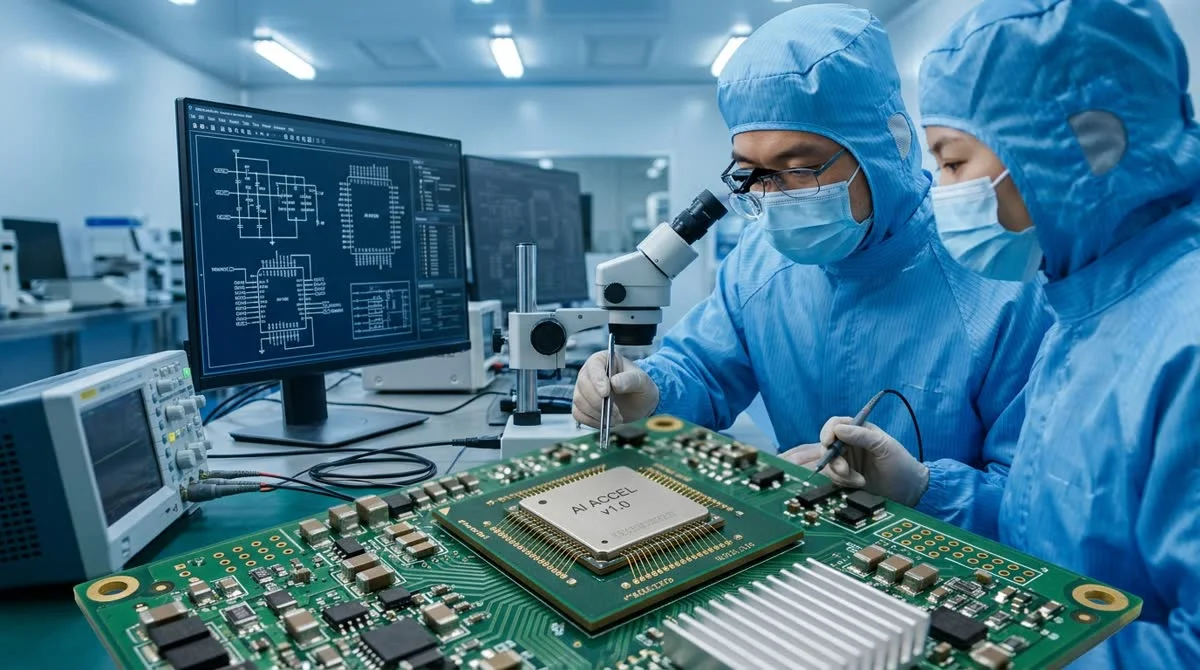
According to Reuters (July 2026), DeepSeek has been secretly developing its own inference accelerator for about a year, aiming to build independence from American microchips.
Why does DeepSeek want its own chip?
The main driver is American export controls. Since 2022–2023, Washington has progressively banned shipments of advanced GPUs to China: first the A100 and H100 series, then the H800 and A800, introduced as "restricted" versions for the Chinese market. As a result, Chinese AI companies have to work with less computing power than their Western competitors.
DeepSeek became known for squeezing competitive results out of limited resources: in January 2025, its R1 model sparked wide discussion by delivering results on par with Western leaders at significantly lower computing cost. But running a commercial AI service at scale, with millions of user requests per day, requires hardware optimized specifically for continuous inference. A chip of its own would let the company cut the cost of processing requests and remove its dependence on an unstable supply chain.
What is known about the project?
There are few specifics, because DeepSeek is deliberately keeping quiet. According to Reuters sources:
- The project started about a year ago, presumably in mid-2025
- The company is in talks with potential partners for semiconductor manufacturing and packaging
- In parallel, it is recruiting chip design engineers in a targeted way, without public job postings
- The development focuses on an inference accelerator, not on one for training models
The distinction matters: DeepSeek trains its models on its own computing resources, so that problem is already solved. The bottleneck is commercial inference, meaning continuous real-time processing of requests. Every token costs money: with millions of users a day, savings on hardware directly determine the service's profitability and its price competitiveness.
Developing a specialized chip is a task of a fundamentally different scale than writing model code. It requires VLSI design expertise, close partnerships with chip foundries and substantial capital investment.
Who has already gone down this path?
Building in-house inference accelerators has long been standard among large AI players:
- Google: TPU since 2016
- Amazon: Inferentia for AWS since 2019
- Meta: MTIA (Meta Training and Inference Accelerator)
- Microsoft: Maia 100, announced in 2023
Among Chinese companies, Baidu is pushing its own Kunlun processor, and Huawei its Ascend line. If DeepSeek takes the project to volume production, it will join this group, but under incomparably tighter constraints on both access to technology and manufacturing capacity.
What this means
DeepSeek's secret chip effort is another sign of a lasting trend: American sanctions are pushing China's AI sector toward vertical integration, from algorithms down to its own silicon. If the project succeeds, it will not only strengthen DeepSeek's independence from Western hardware but also add a new player to the AI accelerator market, where Nvidia currently dominates.
*Meta is recognized as an extremist organization and banned in Russia.
Key Questions Answered
Why does DeepSeek want its own chip?
The main driver is American export controls. Since 2022–2023, Washington has progressively banned shipments of advanced GPUs to China: first the A100 and H100 series, then the H800 and A800, introduced as "restricted" versions for the Chinese market. As a result, Chinese AI companies have to work with less computing power than their Western competitors. DeepSeek became known for squeezing competitive results out of limited resources: in January 2025, its R1 model sparked wide discussion by delivering results on par with Western leaders at significantly lower computing cost.
What is known about the project?
There are few specifics, because DeepSeek is deliberately keeping quiet. According to Reuters sources: The project started about a year ago, presumably in mid-2025 The company is in talks with potential partners for semiconductor manufacturing and packaging In parallel, it is recruiting chip design engineers in a targeted way, without public job postings The development focuses on an inference accelerator, not on one for training models The distinction matters: DeepSeek trains its models on its own computing resources, so that problem is already solved. The bottleneck is co
Who has already gone down this path?
Building in-house inference accelerators has long been standard among large AI players: Google: TPU since 2016 Amazon: Inferentia for AWS since 2019 Meta: MTIA (Meta Training and Inference Accelerator) Microsoft: Maia 100, announced in 2023 Among Chinese companies, Baidu is pushing its own Kunlun processor, and Huawei its Ascend line. If DeepSeek takes the project to volume production, it will join this group, but under incomparably tighter constraints on both access to technology and manufacturing capacity.
Test Frontier LLMs & Autonomous Agents in One Workspace
Run Claude Opus 5.5, GPT-6, Gemini 3.1, and DeepSeek side-by-side in Nomad AI (nomadnet.ai) — unified model routing, deep research, and multimodal workflows under one subscription.
The AI world, distilled — once a week
Seven stories that actually mattered, hand-picked. No noise, no reposts, no press releases.
Done! Check your inbox for a confirmation.