AI Video Generators Compared: Sora 2, Veo 3.1, Kling and Grok
Habr's authors compared five top AI video generators — Veo 3.1, Kling v3 Omni, Sora 2 Pro, LTX-2.3 Pro and Grok Imagine Video 1.5 — across seven identical scenarios: a medieval knight, a juggler, a panicking cat and Will Smith eating spaghetti. Same prompts, same settings, equal conditions: an even-handed stress test as of mid-2026.
AI-processed from Habr AI; edited by Hamidun News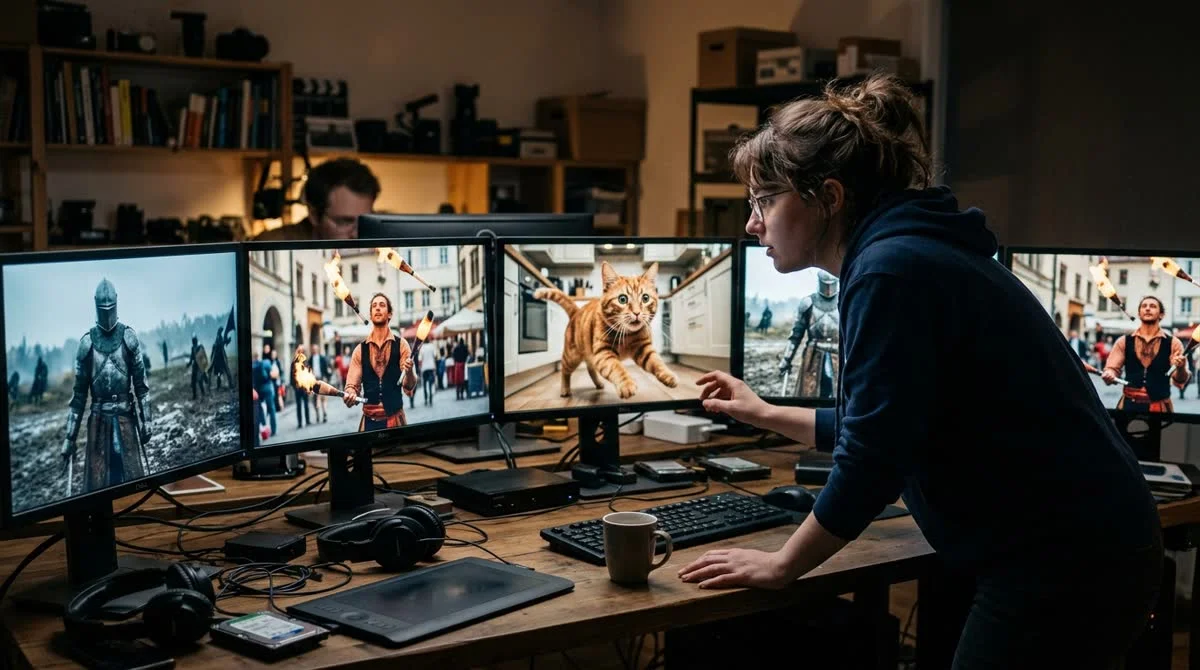
Habr's authors tested five of the best AI video models — Veo 3.1, Kling v3 Omni, Sora 2 Pro, LTX-2.3 Pro and Grok Imagine Video 1.5 — running each through seven identical scenarios with the same prompts and settings.
What was in the test
The comparison includes five tools from different ecosystems:
- Veo 3.1 — Google DeepMind's latest video model, the third generation of the line
- Kling v3 Omni — the flagship of Chinese studio Kuaishou
- Sora 2 Pro — OpenAI's advanced generator, building on the original 2024 Sora
- LTX-2.3 Pro — an open-source solution from Lightricks, a notable alternative to closed models
- Grok Imagine Video 1.5 — a video model from the xAI ecosystem, integrated into the Grok platform
The lineup covers different market niches: American AI labs, Chinese studios and open source, without tilting toward any one player.
How the methodology works
The key principle of the test is strict reproducibility. Each model received the same prompt with the same parameters: resolution, duration and basic generation settings. There are seven scenarios of increasing difficulty.
They include a medieval knight in motion, a juggler with props, a panicking cat, and a classic stress test: Will Smith greedily eating spaghetti. The last scenario became a meme in the AI community: early models produced blatantly failed results here, with deformed hands and unnatural physics.
The set deliberately covers the historically weak spots of generative video: the physics of hand and finger movement, facial expressions, interaction with objects and realistic space.
Why the comparison matters now
As recently as 2024, AI video was easy to spot by its telltale artifacts: drifting faces, extra fingers, jerky movement. In a year and a half to two years, the market has gone from curiosities to tools that are genuinely used in marketing, film and advertising.
"In past years, you could spot a neural-network video by its characteristic flaws.
How are things in mid-2026?" — this is how the authors frame the central question of the test.
Today users face a different challenge: not "telling it apart from the real thing" but "choosing the right tool from dozens available." Each model promotes its own benchmarks and promo reels, and an independent test under equal conditions remains rare.
What this means
A comparison on identical prompts is one of the fairest evaluation formats: manufacturers' marketing claims are not taken into account. The results are useful for anyone choosing a tool for specific tasks such as marketing clips, prototypes of visual scenes or social media content. The AI video market has definitively left the demo phase; it is now a practical choice with real stakes.
Which AI video generators were tested?
Veo 3.1 (Google DeepMind), Kling v3 Omni (Kuaishou), Sora 2 Pro (OpenAI), LTX-2.3 Pro and Grok Imagine Video 1.5.
Which AI video generator is best?
In Habr's test, five tools were compared: Veo 3.1 (Google DeepMind), Kling v3 Omni (Kuaishou), Sora 2 Pro (OpenAI), LTX-2.3 Pro and Grok Imagine Video 1.5. Each model went through seven identical scenarios for an objective comparison.
- Nov 1, 2026Kimi набрала 96,2% в тесте на аналитику по базе 1С и стала запасом на случай блокировки Claude
- Nov 1, 2026OpenAI Rewrites GPT Behavior Rules: Five Values and a Chain of Command
- Nov 1, 2026Google admits AI Mode cuts search revenue, shares fall 15%
- Oct 31, 2026Author puts his script before an AI jury: the verdict cost 850 thousand tokens
Key Questions Answered
Which AI video generators were tested?
Veo 3.1 (Google DeepMind), Kling v3 Omni (Kuaishou), Sora 2 Pro (OpenAI), LTX-2.3 Pro and Grok Imagine Video 1.5.
Which AI video generator is best?
In Habr's test, five tools were compared: Veo 3.1 (Google DeepMind), Kling v3 Omni (Kuaishou), Sora 2 Pro (OpenAI), LTX-2.3 Pro and Grok Imagine Video 1.5. Each model went through seven identical scenarios for an objective comparison.
What was in the test?
The comparison includes five tools from different ecosystems: Veo 3.1 — Google DeepMind's latest video model, the third generation of the line Kling v3 Omni — the flagship of Chinese studio Kuaishou Sora 2 Pro — OpenAI's advanced generator, building on the original 2024 Sora LTX-2.3 Pro — an open-source solution from Lightricks, a notable alternative to closed models Grok Imagine Video 1.5 — a video model from the xAI ecosystem, integrated into the Grok platform The lineup covers different market niches: American AI labs, Chinese studios and open source, without tilting tow
Test Frontier LLMs & Autonomous Agents in One Workspace
Run Claude Opus 5.5, GPT-6, Gemini 3.1, and DeepSeek side-by-side in Nomad AI (nomadnet.ai) — unified model routing, deep research, and multimodal workflows under one subscription.
The AI world, distilled — once a week
Seven stories that actually mattered, hand-picked. No noise, no reposts, no press releases.
Done! Check your inbox for a confirmation.