Tesla Cybercab: When a "Fully Self-Driving" Car Needs a Babysitter on Its Tail
Elon Musk is playing with words again. At the Robotaxi presentation, he insisted there is no human inside the Cybercab, and never will be. Technically that is true, but reality turned out to be more ironic: behind each Tesla test driverless vehicle on the road, a "chase car" with operators is said to follow. That undermines the very idea of autonomy and efficiency. Instead of one driver in the taxi, we get a whole team in a separate car. The company apparently still does not trust its FSD enough to let it roam free without a safety net driving ten meters behind. This is not only expensive, but also casts doubt on how close the promised future really is.
AI-processed from Futurism; edited by Hamidun News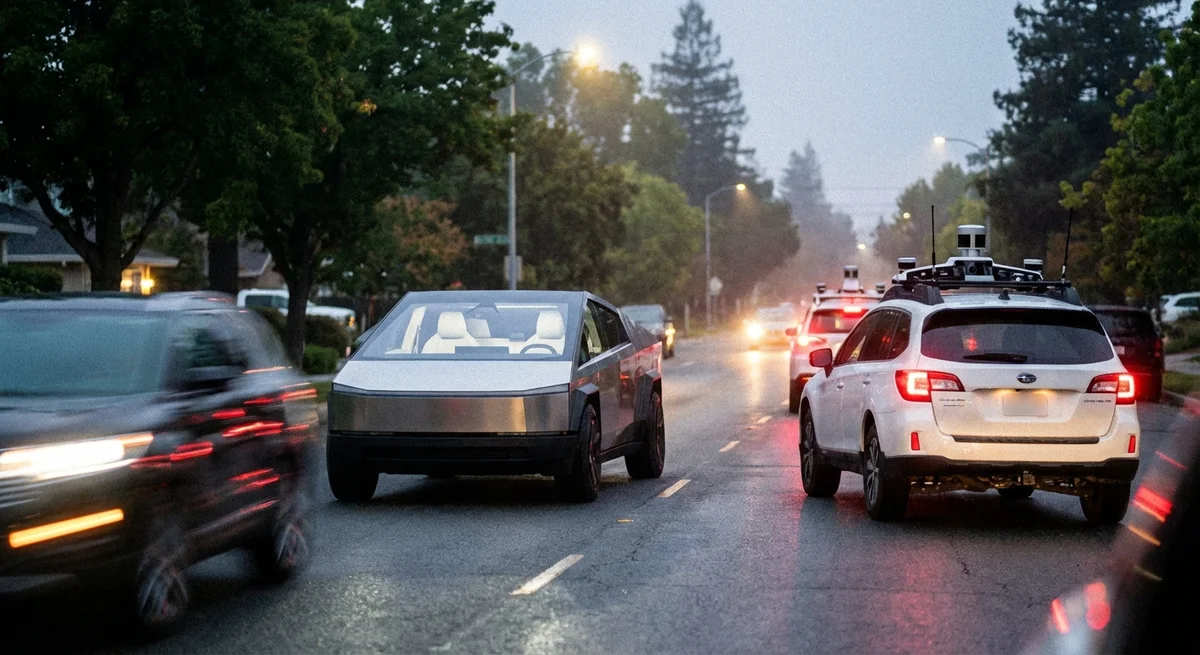
Elon Musk is a recognized master of illusion and grand gestures. When he rolled a golden Cybercab onto the stage at the Warner Bros. studio, the world saw a future with no place for steering wheels, pedals and, most importantly, drivers. "There's nobody in the car," he declared proudly, pointing at the empty cabin. And he wasn't lying. Technically, there really was nobody inside. But as is often the case with Tesla's promises, the devil is in the details, and here, in the rearview mirror. Recent reports and eyewitness accounts suggest that behind every "autonomous" Tesla prototype cruising the streets, an ordinary car with live people inside quietly follows.
It resembles the awkward moment when a child rides a two-wheeled bike for the first time and the father runs behind, ready to catch them at any second. Except that in Tesla's case, this "father" is a team of highly paid engineers and safety operators packed into a gasoline-powered chase sedan. Consider the context: Tesla has sold its Full Self-Driving (FSD) package for years, and despite its ambitious name, it still requires constant human attention. The move to Robotaxi is Musk's attempt at a quantum leap from level two autonomy straight to level five, skipping every intermediate stage. But regulators and the harsh reality of road traffic are unforgiving.
Why does this matter right now? Because the entire economics of robotaxis that Musk paints for investors rests on radically cutting costs by removing human labor. If one driverless car still needs a human, and here an entire car full of staff, the business model turns into a pumpkin. This is not a scalable technology of the future but a very expensive and unwieldy performance. Musk promises a fare on par with a bus ticket, but so far every mile driven by the Cybercab costs the company several times more than an ordinary Uber ride.
Skeptics may object that this is just a necessary testing phase. Optimists will add that the company is thereby collecting unique data to train its neural networks in real, not simulated, conditions. But the irony is that Tesla has always positioned itself as a leader ahead of everyone thanks to "pure" vision and the power of its algorithms. A physical "tail" of safety staff suggests the engineers have far less real confidence in the system than the marketing department does. That sets a dangerous precedent: instead of a finished product, we are shown an imitation of it, in the hope that the algorithms will "learn on the way."
In the autonomous transport industry, trust is the most expensive and scarce currency. Competitors such as Waymo have already been through the painful stages and now operate driverless cars in several states, relying on remote monitoring. Tesla's decision to use physical chase cars looks like a technological step backward. It is not only inefficient but also raises questions about how well Tesla's vision can handle the chaos of city streets without outside hints. If you cannot release a car alone onto an empty road in Palo Alto, how do you plan to launch a mass service in metropolises?
Ultimately, the story of the chase cars highlights the huge gap between demo videos and reality. We all want to believe in the future from science-fiction films, but for now that future needs gasoline for the chase car. Musk has once again proved he can sell a dream, but the price of that dream includes hidden costs that are not discussed at presentations. Until the Cybercab learns to shed its "tail," it will remain an expensive attraction rather than a revolution in transport.
Key question: Will Tesla ever be able to get rid of the "safety" car, or is the Cybercab doomed to an eternal escort?
- Nov 2, 2026Karpathy builds a YouTube clone with 6454 videos from Hacker News recommendations in two hours
- Nov 2, 2026Karpathy used Claude to build HackerTube from 6,454 videos recommended on Hacker News
- Nov 2, 2026Arca gives AI agents finance tasks lasting up to 10 days, but leaves the trades to humans
- Nov 2, 2026DeepSeek open-sources Super-agent prototype: p95 task completion time of 15.7 minutes vs. 29.5
Test Frontier LLMs & Autonomous Agents in One Workspace
Run Claude Opus 5.5, GPT-6, Gemini 3.1, and DeepSeek side-by-side in Nomad AI (nomadnet.ai) — unified model routing, deep research, and multimodal workflows under one subscription.
The AI world, distilled — once a week
Seven stories that actually mattered, hand-picked. No noise, no reposts, no press releases.
Done! Check your inbox for a confirmation.