Robot vs. train: why autonomous delivery buckles under real-world conditions
Another autonomous courier has lost a fight with physics. A video has surfaced online showing a delivery robot stuck on a railway crossing, then literally breaking apart under the wheels of a train. The good news: there was no food inside. The bad news: it is a vivid demonstration of how modern navigation systems falter in front of mundane obstacles. While companies dream of conquering the "last mile" market, their robots cannot cope with 19th-century infrastructure. This is not just a curiosity but a systemic problem of safety and real-time risk assessment.
AI-processed from Futurism; edited by Hamidun News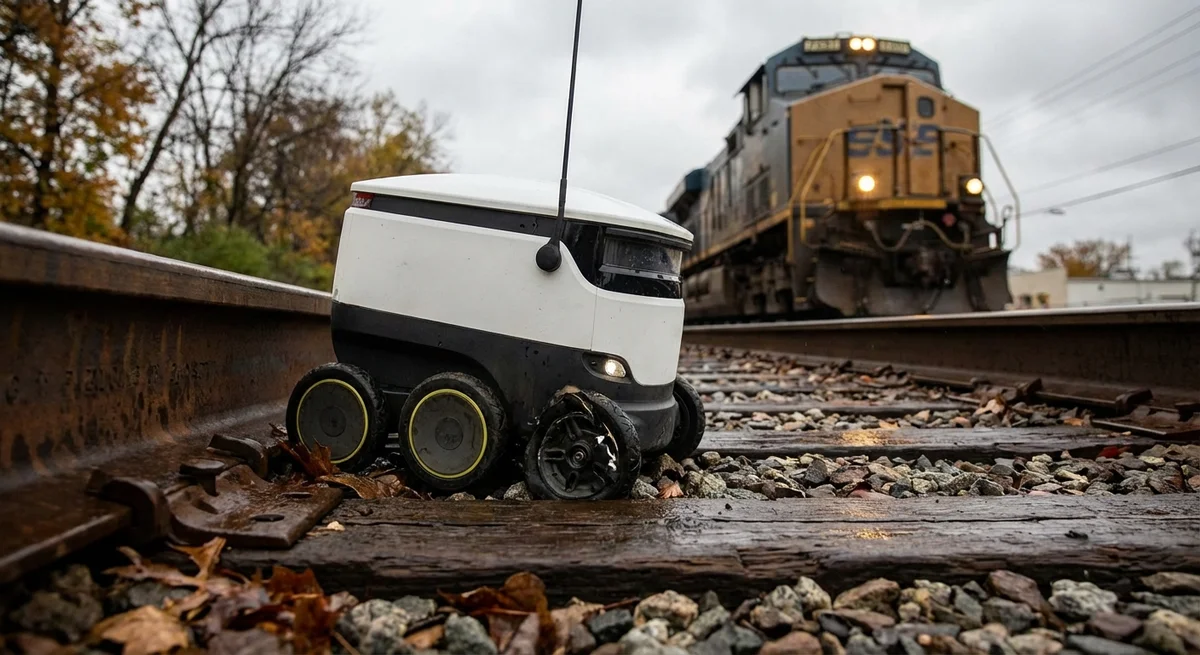
Picture the scene: a high-tech device packed with lidars, cameras and sophisticated machine-vision algorithms freezes helplessly in the middle of a railway crossing. A moment later, a multi-ton steel train turns this symbol of progress into a cloud of plastic debris. This is not a scene from a Hollywood blockbuster about a machine uprising, but the harsh reality in which autonomous delivery is trying to survive on the streets of ordinary cities. The video of a locomotive destroying a courier robot spread quickly online, prompting an ironic smile from some and serious questions about the safety of the entire autonomous-systems industry from others.
We have grown used to hearing that robots are about to transform logistics, making food and parcel delivery nearly free. Startups such as Starship Technologies and Serve Robotics have spent years getting us used to the idea that small six-wheeled boxes on sidewalks are the new normal. Yet every incident like this reminds us that the so-called last mile remains the hardest and least predictable stage of automation. The problem is not that the robot failed to see the approaching train, but that its software could not adequately assess the risk and leave the danger zone in time.
Why does this happen in an era when AI beats humans at chess and writes code? Developers often train algorithms in sanitized conditions or in advanced simulations. In reality, a robot faces dirt, uneven asphalt and the very rails that proved fatal for the hero of this story. A railway crossing is an extremely harsh environment for machines with small wheels. Metal elements can not only physically block movement but also interfere with sensors. When such a robot gets stuck, its logic often falls into an endless loop of recalculating the route instead of sending a distress signal or attempting an emergency maneuver.
This case exposes a fundamental problem: modern autonomous systems lack what we call common sense. A machine can be taught to recognize thousands of objects, but teaching it to understand the physical context of danger is an order of magnitude harder. To a robot, a train is just an array of data, a moving object with a certain velocity vector. It does not grasp that this object cannot stop instantly. Until that understanding is built into the decision-making architecture itself, we will keep watching these collisions between technologies of different eras.
For the whole robotics industry, this is a worrying signal. If tomorrow such a courier gets stuck not on the tracks but in the path of an ambulance, or causes a serious accident involving people, the consequences will be far worse than the loss of a few sensors and a chassis. Regulators in various countries already view with wariness how autonomous machines share space with pedestrians. Fiascos like this give an excellent pretext for strict restrictions that could slow the industry down for decades. We have to admit that railways and robots, for now, live in different dimensions.
Bottom line: Autonomous technology still depends critically on infrastructure built by humans for humans. Until robots learn to respond adequately to non-standard physical obstacles, their mass presence on the streets will remain an expensive and, in places, dangerous experiment.
- Nov 2, 2026Karpathy builds a YouTube clone with 6454 videos from Hacker News recommendations in two hours
- Nov 2, 2026Karpathy used Claude to build HackerTube from 6,454 videos recommended on Hacker News
- Nov 2, 2026Arca gives AI agents finance tasks lasting up to 10 days, but leaves the trades to humans
- Nov 2, 2026DeepSeek open-sources Super-agent prototype: p95 task completion time of 15.7 minutes vs. 29.5
Test Frontier LLMs & Autonomous Agents in One Workspace
Run Claude Opus 5.5, GPT-6, Gemini 3.1, and DeepSeek side-by-side in Nomad AI (nomadnet.ai) — unified model routing, deep research, and multimodal workflows under one subscription.
The AI world, distilled — once a week
Seven stories that actually mattered, hand-picked. No noise, no reposts, no press releases.
Done! Check your inbox for a confirmation.