Nvidia and Intel, sworn rivals, are building a shared x86 processor
Jensen Huang has fueled the industry rumor mill: Nvidia and Intel have officially teamed up to build a custom x86 processor. This is more than a routine deal. It is Nvidia's attempt to gain a foothold in an architecture that Intel and AMD have owned for decades. For Intel, it is a chance to fill its fabs under its Foundry strategy and stay afloat in the AI era. For Nvidia, it is a way to build hardware tuned precisely to its GPUs. The old feud appears to have been set aside in pursuit of total dominance in the server market. AMD should prepare for serious competition.
AI-processed from 36Kr (36氪); edited by Hamidun News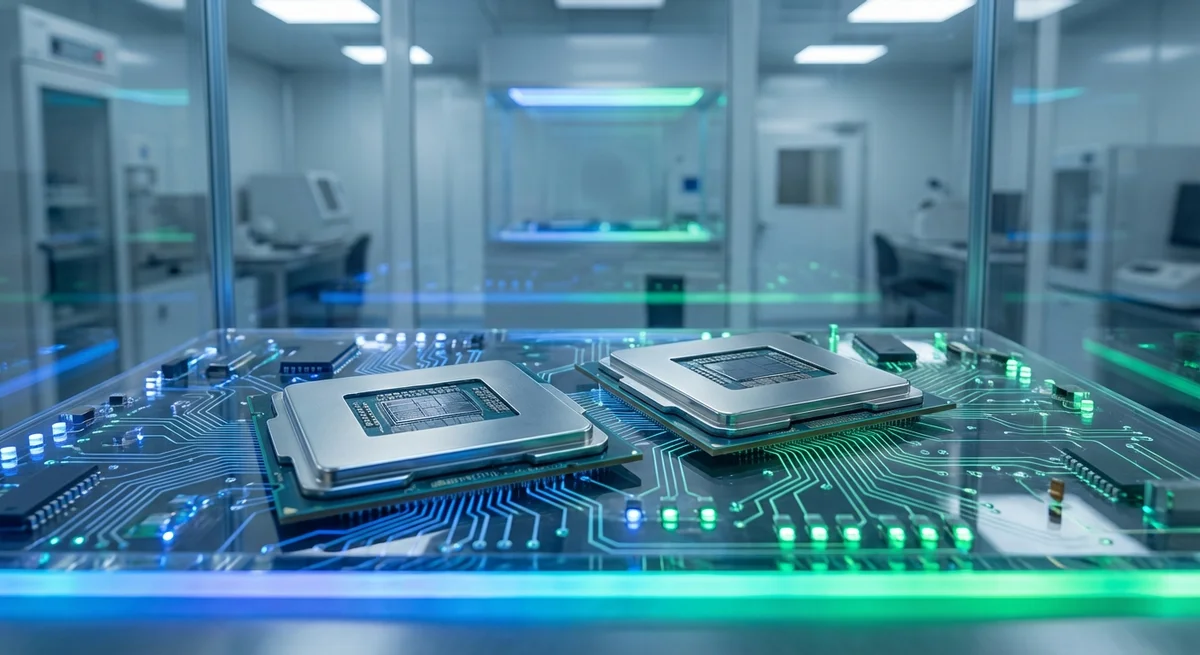
Jensen Huang knows how to surprise an audience, and not only with his leather jackets. While the world was guessing when Nvidia would finally bury x86 in favor of its ARM-based solutions, the head of the "green giant" confirmed that the company is hard at work with Intel on a custom processor. It reads like a plot twist in an expensive TV series, where two sworn enemies join forces against a common threat or for an incredible profit.
To grasp the scale of what is happening, remember that Nvidia and Intel spent decades trading barbs and lawsuits. Intel tried to push out discrete graphics cards with its integrated solutions, and Nvidia responded by calling CPUs mere auxiliary devices for its powerful GPUs. But times have changed. Today the market sets new rules, in which specialization and energy efficiency matter more than old corporate wars.
Why does Nvidia suddenly need x86? It already has Grace, an excellent ARM-based chip that works very well alongside Hopper or Blackwell accelerators. But the world of enterprise data centers and cloud computing is extremely inert. A huge amount of software is still tightly bound to x86 instructions, and moving that capacity to ARM takes time and enormous investment. By building a custom chip with Intel, Nvidia gets its ticket into systems where ARM is still not welcome because of compatibility problems.
For Intel, the deal is both a lifeline and an acknowledgment of the new reality. Pat Gelsinger is actively pushing the Intel Foundry strategy, trying to turn the company into a global contract chipmaker able to compete with TSMC. When the world's largest player in AI becomes your customer, it is the best marketing move you could ask for. Intel urgently needs to fill its new fabs with orders, even if those orders help its main competitor grow stronger.
The open question is how deep the customization will go. Most likely, we will see a processor heavily optimized for the NVLink bus and for the specific workloads of training large neural networks. This will not be just another Core i9. It is a specialized tool meant to remove the data-transfer bottleneck between the CPU and the GPU accelerator. The shift from General Purpose Computing to Accelerated Computing is exactly what Huang repeats at every presentation. In this new paradigm, the CPU stops being the brain of the system and becomes an efficient dispatcher.
The geopolitical context also matters. With trade restrictions and capacity shortages at TSMC's fabs, having an alternative manufacturer in Intel is a strategic insurance policy. Nvidia does not want to put all its eggs in one basket, even if that basket is in Taiwan. Localizing production at Intel's facilities in the US and Europe could become a deciding factor in winning government contracts and working in sensitive sectors of the economy.
The server market is in for a serious shake-up, and the x86 duopoly of Intel and AMD is turning into something more complex and unpredictable.
The bottom line: Nvidia has finally stopped being merely a graphics card maker and is building a full ecosystem in which the processor architecture is just a component that can be ordered from a former enemy in pursuit of dominance. Will Intel be able to keep its balance and avoid becoming a mere contractor for Jensen Huang?
- Nov 2, 2026Anthropic needs to grow revenue 32% a year to cover $850 billion in contracts
- Nov 2, 2026TensorFold 1.2.0 boosts Qwen3.8-27B throughput on M3 Ultra by 44.2% at 16 streams
- Nov 1, 2026Local models lose to Opus and Codex: 0.21 on a MacBook versus 1.00 for Codex
- Nov 1, 2026Habr author fine-tunes YOLOv8l on dental X-rays and pushes mAP50 to 0.642
Ship AI Faster with Founders, Engineers & Weekly Architecture Reviews
Inside Vibe Club (hamidun.com/club) — weekly live masterminds with Zhemal Khamidun, Tech Radar, full LMS access, and 370+ production Claude Code skills.
The AI world, distilled — once a week
Seven stories that actually mattered, hand-picked. No noise, no reposts, no press releases.
Done! Check your inbox for a confirmation.