AI Catches Aggressive Cancer: A Swedish Trial That Could Save Thousands of Lives
Swedish researchers have completed a large-scale trial of AI in breast cancer screening, covering more than 100,000 women. The results are impressive: the neural networks do not merely assist doctors, they find aggressive tumors at stages that used to be missed. This matters most for reducing interval cancer, the kind that appears between scheduled screenings and usually turns out to be the most dangerous. Using AI cut the workload of radiologists and improved diagnostic accuracy. The question is no longer whether to adopt the technology, but how quickly we can scale this success across global medicine.
AI-processed from Bloomberg Tech; edited by Hamidun News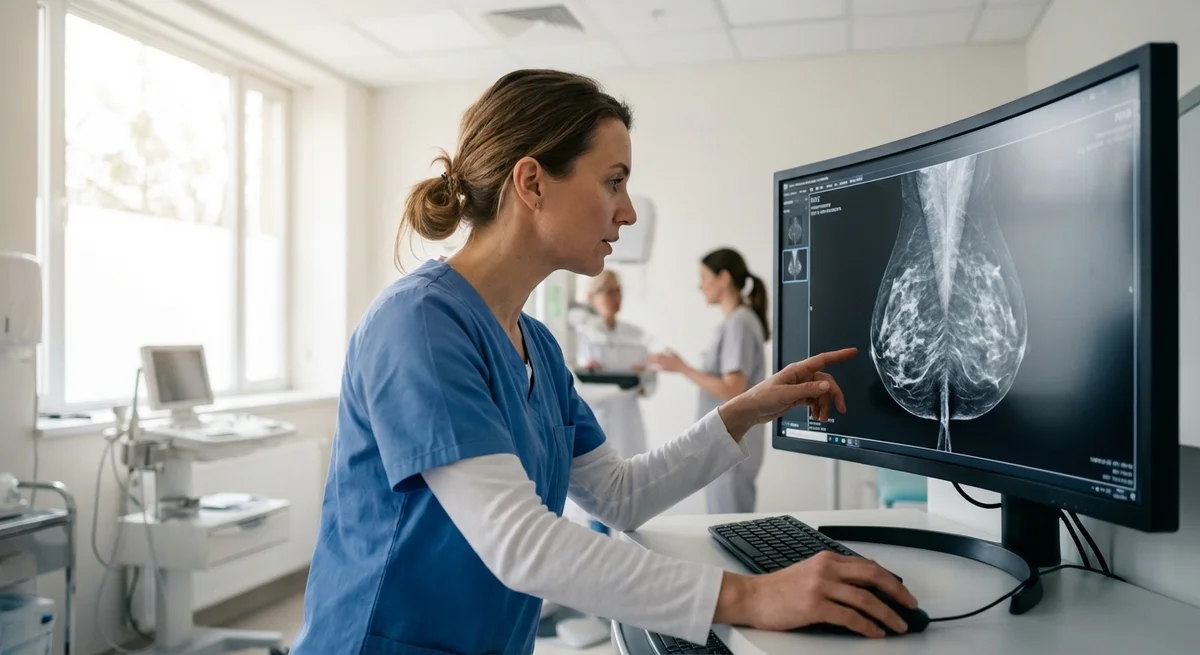
Medicine is by nature one of the most conservative industries, and rightly so. When human lives are at stake, "move fast and break things" sounds more like a threat than a startup motto. Yet the latest Swedish study suggests that excessive caution about AI may cost us too much. Researchers at Lund University ran a test that can fairly be called historic: they entrusted neural networks with analyzing the scans of more than 100,000 women. And the AI performed better than we expected.
The problem with traditional screening has always been the human factor. In most European countries, every mammogram must be read by two independent radiologists. This double check eats up enormous time and resources, yet still leaves room for error. Eyes glaze over, fatigue accumulates, and a tiny density on a scan can look like ordinary noise. The worst scenario here is so-called interval cancer: tumors that doctors miss during a scheduled screening and that grow into a serious problem before the next visit. These are usually the most aggressive, fast-growing forms of the disease.
The Swedish experiment showed that AI can find precisely these "invisible" threats. The algorithm did not just flag suspicious areas; it did so with accuracy exceeding the standard review by two doctors. At the same time, the workload on medical staff fell by almost half. Instead of spending hours going through thousands of "clean" scans, radiologists could focus on the truly difficult cases that the AI flagged as priorities. It is a classic example of technology that does not replace people but relieves them of routine, giving medicine back its human face and precision.
Why does this matter right now? Healthcare is at a point of demographic crisis. There are not enough doctors, screening queues are growing, and the cost of medical services is skyrocketing. If we keep clinging to methods that are thirty years old, the system will simply collapse under its own weight. The Swedish experience shows that bringing AI into diagnostics is not an "experimental feature" but a necessary survival standard. Neural networks do not get tired, do not need coffee, and are not distracted by phone notifications while examining your tissue for deadly threats.
Of course, questions of ethics and accountability remain. Who is to blame if the AI still makes a mistake? But the Swedish data cuts through philosophical debate with dry statistics: the number of detected cancers rose, while the number of false alarms stayed within the norm. That means thousands of women got a chance at timely treatment. The irony is that while we fear a machine uprising, the machines are quietly learning to save us from things we cannot always handle ourselves.
Bottom line: the Swedish case will become the foundation for new WHO protocols. Would you trust an algorithm with your diagnosis if it improved your chances of survival by 20 percent?
Test Frontier LLMs & Autonomous Agents in One Workspace
Run Claude Opus 5.5, GPT-6, Gemini 3.1, and DeepSeek side-by-side in Nomad AI (nomadnet.ai) — unified model routing, deep research, and multimodal workflows under one subscription.
The AI world, distilled — once a week
Seven stories that actually mattered, hand-picked. No noise, no reposts, no press releases.
Done! Check your inbox for a confirmation.