Tesla vs. China: Why Musk Is Retiring the Model S for Robots
Tesla is ending production of the Model S and Model X at its Fremont plant to free up capacity for Optimus humanoids. Musk is convinced that 80% of the company's value will soon come from robots, not electric cars. But Chinese players such as Li Auto, Xpeng and Chery are closing in fast. Autonomous-driving technology overlaps about 70% with the "brains" of robots, and the Chinese supply chain already controls 63% of the components market. While Musk promises sales by 2027, China's "involutionary" (neijuan) market has already started poaching top engineers. The coming fight will be decided not by range on a single charge, but by the dexterity of mechanical hands.
AI-processed from HuXiu (虎嗅); edited by Hamidun News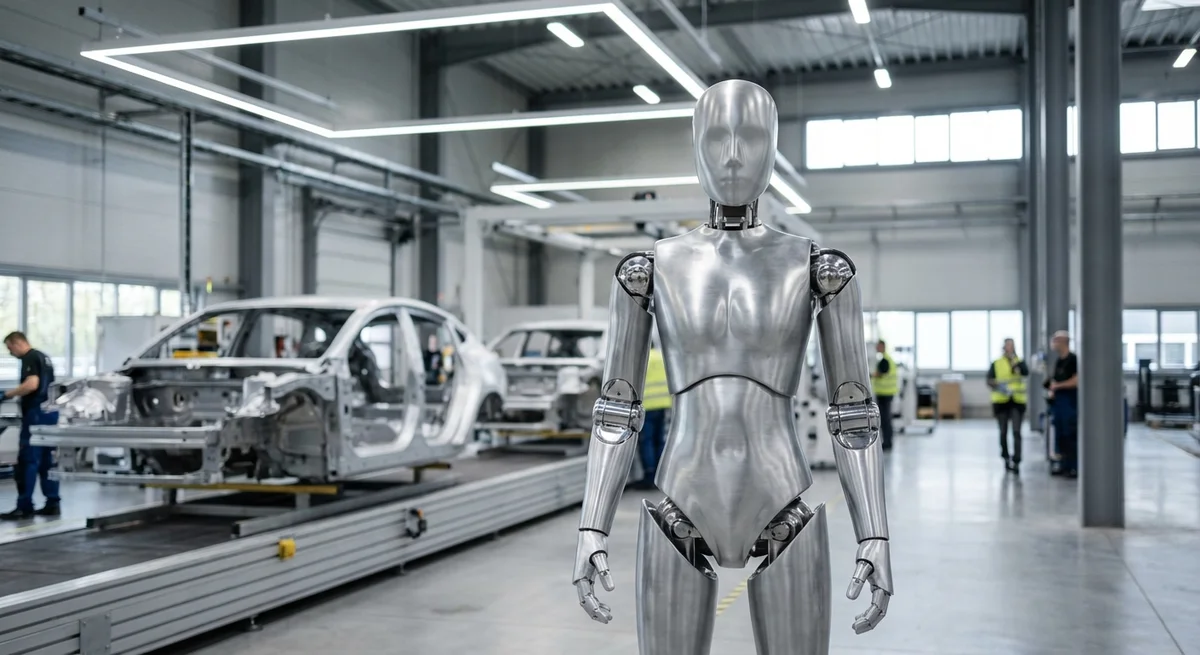
Elon Musk has officially announced that the era of the Model S and Model X is coming to an end. On the latest investor call he used the term "honorable discharge", saying production of these veterans will be almost completely halted next quarter. But don't rush to sympathize with old-school fans: this is not a surrender, it is a regrouping. The Fremont plant, where the company's first serious electric cars were born, will now be fully repurposed to build Optimus humanoid robots.
Musk is playing for high stakes: by his forecasts, up to 80% of Tesla's future market value will come from robots, not cars.
Why now? It's simple: the EV market is turning into a bloodbath with thin margins, while robotics is a new "blue ocean". Musk openly admits that the main threat to his ambitions comes not from Ford or Toyota but from China. Chinese companies are phenomenally good at AI and even better at mass production. We used to debate whose batteries were denser; now the fight is moving to anthropomorphic machines.
Chinese automakers have already accepted the challenge. For a carmaker, building a robot is not a leap into the unknown but a logical extension of the business. He Xiaopeng, head of Xpeng, says directly that about 70% of the technology in a modern electric car transfers straight to robotics. Look at the architecture: the computer-vision systems, decision-making algorithms and actuators of a self-driving car and an android are practically identical. Tesla uses its FSD work for the "brains" of Optimus, and Chinese companies do the same with their autonomous-driving systems. It is the same technology base in a different form factor.
Chinese players are moving at a frightening pace. Li Xiang, CEO of Li Auto, confirmed at a closed meeting that the company will unveil its own humanoid in the shortest possible time. Chery has already begun deliveries of its first robot, Mornine, and plans to ship hundreds of units in 2025. While Tesla targets 2027 as the start of public sales, the Chinese are already building supply chains. According to Morgan Stanley estimates, China already controls 63% of the global market for robotics components. It is the same lever that once let them seize the solar panel and battery markets.
However, the Chinese side has a serious internal problem: so-called "involution". Frenzied competition and price wars in the auto market are squeezing every drop out of companies. This has a paradoxical effect: talented engineers are fleeing large automakers for narrowly specialized robotics startups to escape corporate burnout. Tesla, despite all the scandals around Musk, remains a magnet for top talent in the US. The robot battle will be not only a contest of algorithms but also a test of whose corporate culture can endure this marathon.
The shift from wheels to legs is not just a product change; it is an attempt to create a market worth 25 trillion dollars by 2050. For comparison, the car market is unlikely to show comparable growth in the coming decades. Musk understands that if he does not lead this race now, he will simply be eaten by the same people who are now dumping prices in the EV market.
2027 will be the moment of truth: either Optimus goes mainstream, or the "Chinese legion" of robots does to Tesla what BYD did to the Model 3.
The bottom line: Tesla is officially ceasing to be a car company in its own self-perception. Can Musk beat the Chinese manufacturing machine on its home turf, or will Optimus become yet another ambitious project that never finishes?
- Nov 2, 2026Karpathy builds a YouTube clone with 6454 videos from Hacker News recommendations in two hours
- Nov 2, 2026Karpathy used Claude to build HackerTube from 6,454 videos recommended on Hacker News
- Nov 2, 2026Arca gives AI agents finance tasks lasting up to 10 days, but leaves the trades to humans
- Nov 2, 2026DeepSeek open-sources Super-agent prototype: p95 task completion time of 15.7 minutes vs. 29.5
Test Frontier LLMs & Autonomous Agents in One Workspace
Run Claude Opus 5.5, GPT-6, Gemini 3.1, and DeepSeek side-by-side in Nomad AI (nomadnet.ai) — unified model routing, deep research, and multimodal workflows under one subscription.
The AI world, distilled — once a week
Seven stories that actually mattered, hand-picked. No noise, no reposts, no press releases.
Done! Check your inbox for a confirmation.