The Silent Death of the GPU: Why Your Neural Network Is Killing Your VRAM Right Now
Enthusiasts have found a critical problem: when running LLMs or upscaling video, the GPU core stays cool while video memory (VRAM) heats up to 105°C. Factory cooling algorithms often ignore memory temperature and look only at the chip. The fix is a Python utility called VRAM Guard. It uses pulsed throttling, forcibly slowing processes for fractions of a second to let the memory cool down. This matters most for owners of RTX 30 and 40 series cards, where overheating GDDR6X chips leads to irreversible hardware degradation. Protect your neural networks and your money.
AI-processed from Habr AI; edited by Hamidun News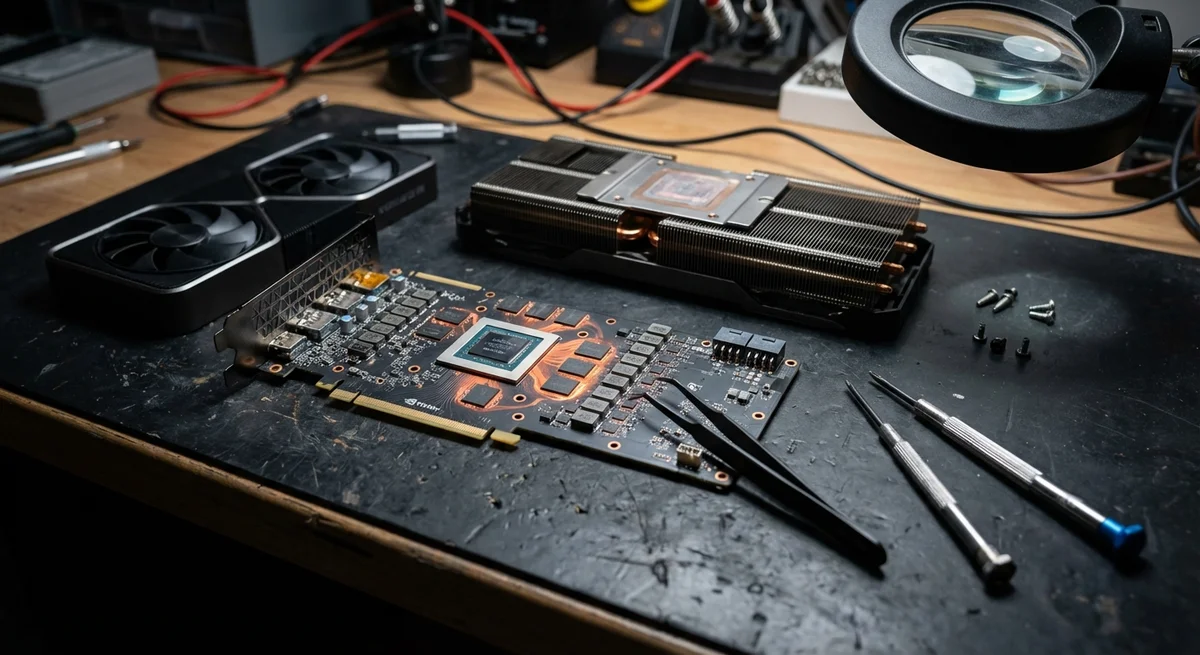
You have almost certainly seen those reassuring monitoring graphs: a flat core temperature line, a steady 65 degrees, and the sense that the system is coping. But while you feed yet another heavy model to your graphics card, a real drama plays out inside the PCB, one that standard software prefers to ignore. The problem is that a modern GPU is not only the central die but also tightly packed video memory chips, which suffer far more in machine learning workloads than in the heaviest games.
The industry has long judged a graphics card's health by its GPU Core temperature. That worked for decades, but the era of local neural networks sets its own rules. When generating text or upscaling video, the load on the memory controller becomes continuous. The result is a dangerous imbalance: the graphics processor has barely warmed up, the fans spin lazily at low speed, and meanwhile the VRAM modules are already cooking at 105 degrees. For GDDR6X memory chips, that is a borderline state beyond which thermal degradation and unavoidable artifacts begin.
Hardware makers often build rather strange logic into their drivers. They let memory run at its limit as long as the core stays cool. Rather than wait for NVIDIA or AMD to change their approach, an enthusiast developer created VRAM Guard. It is a compact Python utility that does what engineers at large corporations should have done three years ago: it puts the memory sensors first. If the software sees VRAM overheating, it does not simply push the fans to maximum but applies pulsed throttling.
The method is elegant in its simplicity. Instead of crashing clock speeds and turning work into a slideshow, the utility sends the process microscopic pause commands. It resembles intermittent breathing: the neural network keeps working but gets short breaks of a few milliseconds. That is enough time for excess heat to dissipate, and memory temperature drops by a critical 5-10 degrees without a noticeable performance loss for the user.
Why does this matter right now? After the crypto boom, the used graphics card market is already full of "tired" hardware, and the boom in local LLMs creates a new wave of load. If you use a card like the RTX 3090 or 4090 for constant computing, you are in the risk zone. Replacing burned-out or degraded memory chips costs half the price of the card, if repair is possible at all. Using monitoring tools like this is no longer just a geeky pastime but a necessary condition for keeping your home server alive.
We are entering an era in which AI software evolves faster than cooling systems can adapt to it. It is a classic case of "technical debt" in hardware. While corporations sell us new teraflops, looking after the longevity of those teraflops falls to users themselves and to the authors of small open-source projects. Python once again proves itself the best tool for quickly patching the systemic flaws of industry giants.
The takeaway: your graphics card's factory settings may be its death sentence in AI workloads. Are you ready to risk a two-thousand-dollar card for the sake of quiet fans?
- Nov 2, 2026Karpathy builds a YouTube clone with 6454 videos from Hacker News recommendations in two hours
- Nov 2, 2026Karpathy used Claude to build HackerTube from 6,454 videos recommended on Hacker News
- Nov 2, 2026The Verge reviewer builds a $50 Meta Muse Charm alternative with Claude Code
- Nov 2, 20268 Skills for video in Claude Code: from 244 pixel effects to rough-cut editing
Test Frontier LLMs & Autonomous Agents in One Workspace
Run Claude Opus 5.5, GPT-6, Gemini 3.1, and DeepSeek side-by-side in Nomad AI (nomadnet.ai) — unified model routing, deep research, and multimodal workflows under one subscription.
The AI world, distilled — once a week
Seven stories that actually mattered, hand-picked. No noise, no reposts, no press releases.
Done! Check your inbox for a confirmation.