China's 2 Trillion Yuan Market: Algorithms Take Over the Shanghai and Beijing Exchanges
Combined turnover on the Shanghai, Shenzhen and Beijing exchanges has again broken through the 2 trillion yuan mark. Despite a token dip of 24.9 billion from the previous day, the market remains overheated. For the AI industry this is a critical signal: volumes like these cannot be processed by hand. We are watching a large-scale test drive for China's quant funds and algorithmic trading systems. The surge in activity is directly tied to expectations of government support for the tech sector, which is flooding neural networks with incoming data.
AI-processed from 36Kr (36氪); edited by Hamidun News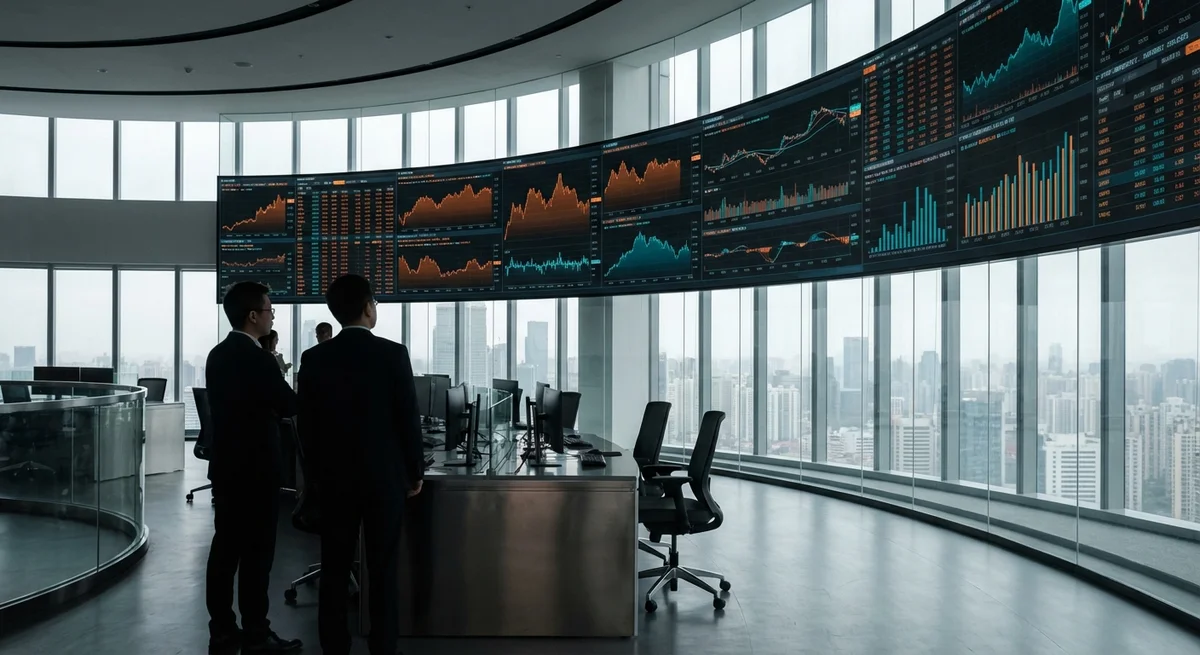
While you were drinking your morning coffee, Chinese server farms digested the budget of an average European country. Combined turnover on the Celestial Empire's three main venues — the Shanghai, Shenzhen and Beijing exchanges — has again exceeded 2 trillion yuan. Even a slight "cooling" of 24.9 billion compared with the previous day does not change the overall picture: China's stock market has become a giant sandbox for artificial intelligence. When the numbers reach this scale, human traders become spectators, and the real battle plays out between algorithms.
To understand the context, recall what has happened in China over recent months. The government is actively injecting liquidity, and investors are scrambling to find a home for their capital amid the property slump.
But the most interesting part is under the hood of this trading. A huge share of the turnover is generated by high-frequency bots and deep-learning systems. China is now seeing a genuine boom in "quant" funds that use transformer models to analyze social media sentiment and execute trades instantly. These systems are trained to react to every word in state media faster than a human can blink.
Why does this matter right now? First, it places a colossal load on national infrastructure. Processing this volume of trades demands immense computing power. With sanctions restricting Nvidia chip supplies, Chinese companies have to squeeze the maximum out of domestic hardware. Every such trading day is a hidden stress test for local GPU accelerators and data-transmission systems. If the infrastructure withstands 2 trillion, then China's tech stack is ready for serious loads not only in finance but also in AI-driven public administration.
Second, this volatility and volume create an ideal environment for training new models. Data on the behavior of millions of retail investors at peak trading moments is "digital oil" for LLM developers. Companies such as Baidu and Alibaba are watching these patterns closely in order to integrate financial predictions into their ecosystems. The financial sector is becoming both the main customer and a proving ground for the boldest automation ideas.
But there is a flip side. Mass use of similar algorithms can trigger a domino effect. If one model decides it is time to lock in profits, the others may follow in the same second. The modest 24.9 billion drop in trading volume may be a sign that the algorithms have begun to turn cautious, probing for a new resistance level. Either way, China's market is now the most dynamic place on the planet, where technology and big money have merged in ecstasy.
The bottom line: China has fully shifted its finance onto AI-managed rails. Will the algorithms be able to keep the market from overheating, or will we witness the fastest digital crash in history?
- Nov 2, 2026Anthropic needs to grow revenue 32% a year to cover $850 billion in contracts
- Nov 2, 2026TensorFold 1.2.0 boosts Qwen3.8-27B throughput on M3 Ultra by 44.2% at 16 streams
- Nov 1, 2026Local models lose to Opus and Codex: 0.21 on a MacBook versus 1.00 for Codex
- Nov 1, 2026Habr author fine-tunes YOLOv8l on dental X-rays and pushes mAP50 to 0.642
Test Frontier LLMs & Autonomous Agents in One Workspace
Run Claude Opus 5.5, GPT-6, Gemini 3.1, and DeepSeek side-by-side in Nomad AI (nomadnet.ai) — unified model routing, deep research, and multimodal workflows under one subscription.
The AI world, distilled — once a week
Seven stories that actually mattered, hand-picked. No noise, no reposts, no press releases.
Done! Check your inbox for a confirmation.