Breathe Deeper: Why a Russian Neural Network Is Watching Your Chest
Specialists at Kryptonite have developed a contactless method for measuring respiratory rate. Instead of uncomfortable chest straps, it uses an ordinary webcam and the MediaPipe neural network. The algorithm segments the chest and abdomen areas and builds a dynamic mask that ignores extraneous movement and gesturing. Accuracy is comparable to medical sensors, and the error, which previously reached 13%, has been reduced to a minimum. It is an important step for telemedicine: a patient's condition can now be monitored literally over Zoom, without wiring them up and without requiring them to sit still.
AI-processed from Habr AI; edited by Hamidun News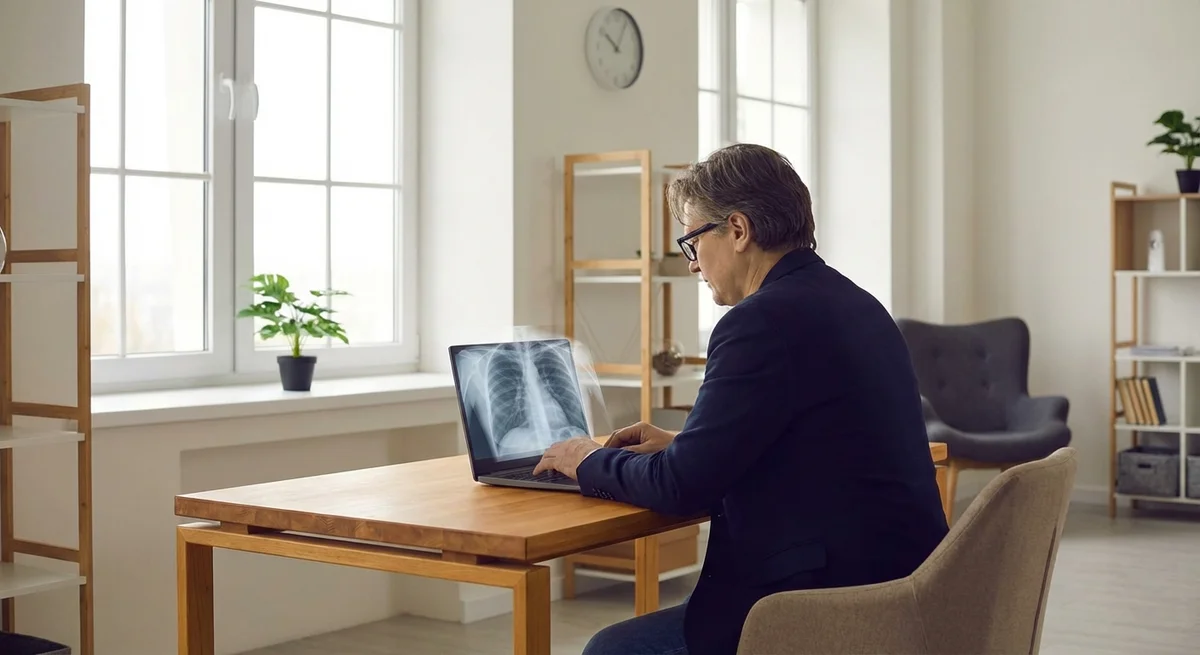
Imagine you are under the weather and your doctor asks you to measure your respiratory rate. In the classic scenario, you would either have to count your breaths yourself (which immediately disrupts your natural rhythm) or strap on sensors, fasten a chest belt, or stick special cannulas up your nose. All of this is awkward, archaic and adds needless stress. While our smartwatches have become adept at counting heartbeats and steps, breathing has long remained a "contact sport." Researchers at the Russian company Kryptonite decided that the webcam on your laptop is already smart enough to handle the task without any touching.
The idea of contactless health monitoring is not new, but until now it has been, to put it mildly, temperamental. Earlier attempts to teach AI to "see" breathing often ran into harsh reality: a person is not a mannequin. As soon as a patient scratched their nose, adjusted their glasses or simply shifted position in the chair, the algorithms produced errors. An error of 13% in medicine is not just a statistical inaccuracy; it is the difference between "everything is fine" and "call the ICU immediately." The problem was that the systems could not effectively separate natural body movements from the micro-displacements of the chest.
Developer Alexey Protopopov proposed an elegant solution using the MediaPipe neural network. Rather than simply tracking pixel changes in the frame, the algorithm performs deep image segmentation. It picks out specific zones, the chest and abdomen, and creates a dynamic mask for them. This process is fairly resource-intensive and takes about 90% of the total video-stream processing time, but it is worth it. Thanks to this "mask," the system knows where to look for the signal, even if you gesture actively or turn sideways to the camera.
The method was tested on a group of 14 volunteers of different sexes and ages, from 20 to 65. In total, the neural network "watched" more than 2.5 hours of video in which people behaved completely naturally. The results confirmed that segmentation lets the system ignore interference from posture changes almost entirely. This is a fundamental difference from older methods, which required patients to sit still, as if for a passport photo. Measurement accuracy for respiratory rate (breaths per minute) has now come very close to that of professional medical equipment.
Why does this matter right now? Telemedicine is booming, but it is still limited by the quality of data a patient can send to a doctor from home. If an ordinary office laptop "peephole" turns into an accurate diagnostic tool, the barrier to quality healthcare drops. We are moving toward a future where your computer notices signs of breathlessness or an emerging illness before you feel unwell yourself. And it will do so as unobtrusively as possible, with no rubber straps on your chest.
Of course, when a neural network starts watching the movements of our bodies this closely, privacy questions arise. But from a technical standpoint, this is a big win for signal processing over the chaos of everyday life. Perhaps soon the phrase "breathe deeper" will come not from a doctor in an office, but from a notification in your browser.
The key point: Kryptonite has shown that neural-network body segmentation turns an ordinary camera into a medical instrument that withstands user movement. Will it become the standard for home check-ups in the next couple of years?
- Nov 2, 2026Karpathy builds a YouTube clone with 6454 videos from Hacker News recommendations in two hours
- Nov 2, 2026Karpathy used Claude to build HackerTube from 6,454 videos recommended on Hacker News
- Nov 2, 2026The Verge reviewer builds a $50 Meta Muse Charm alternative with Claude Code
- Nov 2, 20268 Skills for video in Claude Code: from 244 pixel effects to rough-cut editing
Test Frontier LLMs & Autonomous Agents in One Workspace
Run Claude Opus 5.5, GPT-6, Gemini 3.1, and DeepSeek side-by-side in Nomad AI (nomadnet.ai) — unified model routing, deep research, and multimodal workflows under one subscription.
The AI world, distilled — once a week
Seven stories that actually mattered, hand-picked. No noise, no reposts, no press releases.
Done! Check your inbox for a confirmation.