China's Farm Sector on Steroids: Why Beijing Is Putting AI in Farmers' Seats
Chinese authorities have unveiled a rural development strategy that gives artificial intelligence the leading role. Under the "new productive forces" concept, Beijing plans to roll out drones, the Internet of Things and robotics across agriculture on a large scale. The emphasis falls on biological production and seed breeding. This is not just an attempt to ease farmers' workload, but a strategic step toward full food independence through high technology. For the market, that means huge subsidies for agritech startups and a new round of the arms race in autonomous systems.
AI-processed from 36Kr (36氪); edited by Hamidun News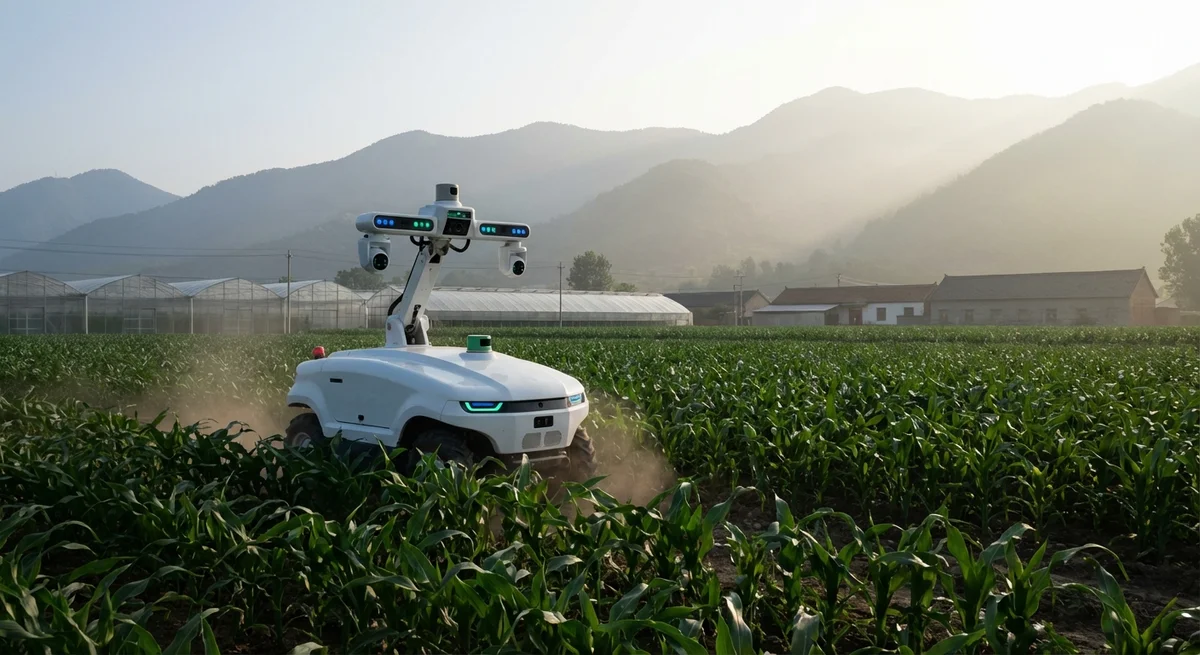
Every year, at the start of the production cycle, Beijing issues the so-called "No. 1 Central Document." It is a kind of scripture for the Chinese economy, setting priorities for rural regions. In 2026 the document reads like the script of a science-fiction film: the party has ordered artificial intelligence to be merged with soil and plough. Where China once simply tried to feed a billion people, it now wants to do so with algorithms and minimal human involvement.
The root of these changes lies in the concept of "new productive forces." The term, which lately seems to blare from every Chinese appliance, implies abandoning extensive growth in favor of deep high tech. In agriculture, this means traditional methods no longer count for much. Beijing is betting on drones, the Internet of Things and robots that are meant to replace the aging population of its villages. The labor shortage in rural China is more acute than it looks, and AI here is not a luxury but the only way for the agricultural sector to survive.
The document pays particular attention to biological production and breeding. China intends to accelerate the creation of "breakthrough varieties" of seeds, using AI to model genetic combinations. This is a direct challenge to Western agribusiness giants. Beijing clearly does not want to depend on imported technology for food, so a key focus will be developing equipment for complex terrain: hilly and mountainous areas where an ordinary tractor is useless and a smart, maneuverable robot is just the thing.
But technology does not work without people, so the government is launching a large-scale reform of agricultural universities. The notion of a "new agronomist" now includes programming skills and the ability to manage complex data systems. The state plans to train specialists "to order," so graduates go straight to deploying AI on specific farms. It is a systemic approach: from changing plant DNA to rewriting university curricula.
Why does this matter right now? Global logistics is unstable, and trade wars are pushing China to look for domestic reserves. Farm automation is a way to insure against any external shock. When swarms of drones work your fields and a neural network forecasts yields from data gathered by thousands of sensors, you become far less vulnerable to sanctions or swings in world market prices. China is building a digital fortress, with high-tech food as its foundation.
Bottom line: Beijing has definitively moved agriculture from the "tradition" category into the "high tech" category. For the global market, this is a signal: demand for agritech solutions in China will grow exponentially, and Chinese autonomous farms will soon become an export product.
Will neural networks be able to beat the laws of nature at this scale?
- Nov 2, 2026Karpathy builds a YouTube clone with 6454 videos from Hacker News recommendations in two hours
- Nov 2, 2026Karpathy used Claude to build HackerTube from 6,454 videos recommended on Hacker News
- Nov 2, 2026Arca gives AI agents finance tasks lasting up to 10 days, but leaves the trades to humans
- Nov 2, 2026DeepSeek open-sources Super-agent prototype: p95 task completion time of 15.7 minutes vs. 29.5
Test Frontier LLMs & Autonomous Agents in One Workspace
Run Claude Opus 5.5, GPT-6, Gemini 3.1, and DeepSeek side-by-side in Nomad AI (nomadnet.ai) — unified model routing, deep research, and multimodal workflows under one subscription.
The AI world, distilled — once a week
Seven stories that actually mattered, hand-picked. No noise, no reposts, no press releases.
Done! Check your inbox for a confirmation.