The End of the SaaS Era: Why Asian Investors Have Started Dumping Software Stocks
Asian markets have seen a mass exodus of investors from software stocks. The cause is fear of the "creative destruction" that AI brings. Traders worry that neural networks will not complement existing software but simply make it unnecessary. Why pay for complex interfaces and subscriptions if an AI agent can perform the task directly? While the West still believes in synergy, the East is already voting with its money against traditional business models. It is an alarming signal for the entire SaaS sector: old monetization methods may not survive this decade.
AI-processed from Bloomberg Tech; edited by Hamidun News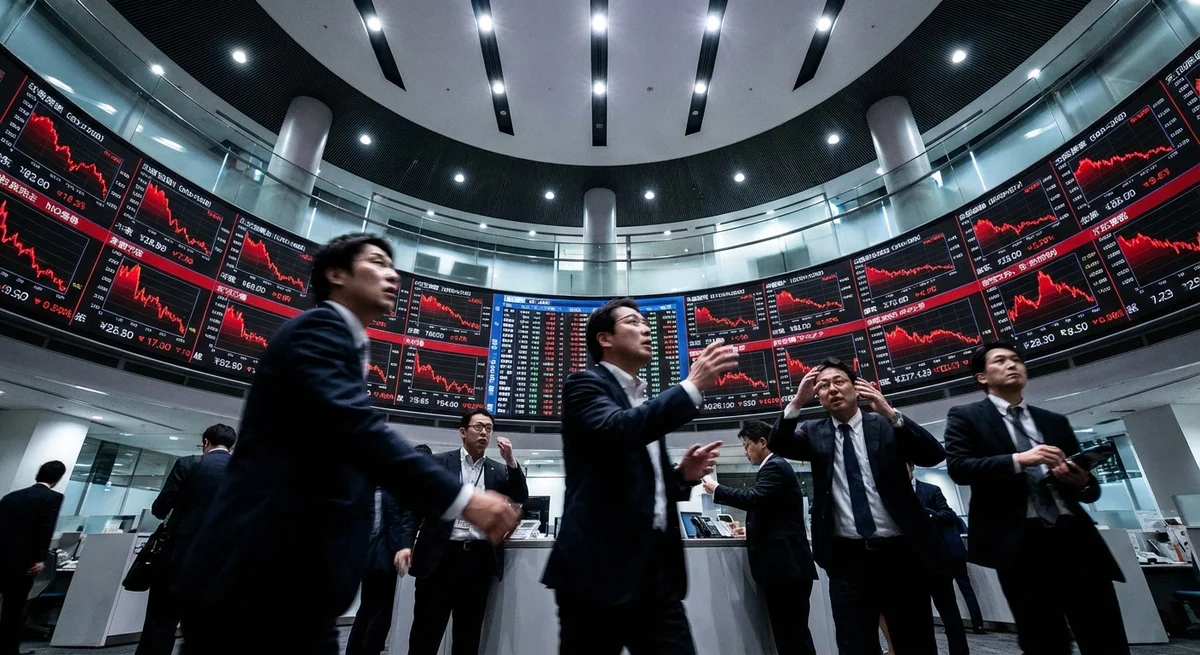
Remember how, just a couple of years ago, buying shares in any software company looked like a ticket to a comfortable retirement? The SaaS (software as a service) model seemed invulnerable: subscriptions kept rolling in, users got used to the interface, and margins soared. Then generative AI arrived, and the rules suddenly changed. What was supposed to be the industry's new fuel has turned into a giant shredder for the market value of companies that failed to adapt. The irony is that AI no longer helps sell software; it makes software redundant.
This week, Asian trading venues turned into an arena of quiet panic. Traders began dumping software developers' shares en masse. And this is not just a technical correction or seasonal profit-taking. We are watching a fundamental shift in investor thinking. According to the latest data, a conviction is growing in Asian markets: artificial intelligence will not complement existing software but simply devour it. Investors have started shedding the assets of companies whose business model rests on selling access to tools that AI can now imitate or replace entirely.
For a long time, AI was advertised as the main growth driver for the entire tech sector. But investors are pragmatic people, and they have started asking uncomfortable questions. Why should corporations pay huge sums for a complex project management system or a heavyweight graphics editor if a neural-network agent can talk directly to a database and deliver a result without an interface in between? Software has always been a layer between a person and a task. Now that layer is becoming too thick, too slow and, most importantly, too expensive. Traders in Tokyo and Hong Kong were the first to feel the draft.
The trend has been especially pronounced in Asia because local markets often serve as a litmus test for global sentiment, reacting faster and more sharply to change. The fear of "creative destruction" now outweighs any faith in a bright future. Traders see that companies' AI deployment costs are rising while revenue from their older products is starting to stagnate. It is a classic efficiency trap: software does the work faster, but as a result less of it is needed, and it should cost less. The market simply does not understand how software giants will sustain their previous growth rates.
The main problem scaring capital is the erosion of the per-seat pricing model. Most software giants live on companies buying licenses for every employee. But if AI lets one person do the work of ten, the number of licenses needed shrinks several times over. For investors, this looks like a mathematical nightmare. Where we once assessed software companies on their ability to scale sales, we now have to assess their odds of survival in a world where code is no longer scarce and human labor in the interface is replaced by an API call.
We have seen something similar before, when mobile apps killed desktop software or when the cloud buried on-premise servers. But the scale of the current shift is far greater. AI is not just a new platform; it is a new form of computing. Asian investors, it seems, were the first to realize that many of today's IT giants are just pretty wrappers around processes that will soon become automatic. And if a company cannot clearly explain how it will earn money in a world where AI can do everything, its shares go into the trash without sentimentality.
What does this mean for us? Most likely, we are on the verge of a major purge. The market is overheated with expectations, and a phase of painful sobering up is now beginning. Asia has only given the starting signal, but the wave will inevitably reach Wall Street. The old guard of developers will have to either completely reinvent themselves or become history, making way for new players who build their products around AI agents from the start, not around buttons, menus and monthly subscription bills.
The bottom line: the era of safe investing in "just software" is over. The market will now look not for those who adopt AI for show, but for those who can avoid being eaten by it.
- Nov 2, 2026Karpathy builds a YouTube clone with 6454 videos from Hacker News recommendations in two hours
- Nov 2, 2026Karpathy used Claude to build HackerTube from 6,454 videos recommended on Hacker News
- Nov 2, 2026Arca gives AI agents finance tasks lasting up to 10 days, but leaves the trades to humans
- Nov 2, 2026DeepSeek open-sources Super-agent prototype: p95 task completion time of 15.7 minutes vs. 29.5
Test Frontier LLMs & Autonomous Agents in One Workspace
Run Claude Opus 5.5, GPT-6, Gemini 3.1, and DeepSeek side-by-side in Nomad AI (nomadnet.ai) — unified model routing, deep research, and multimodal workflows under one subscription.
The AI world, distilled — once a week
Seven stories that actually mattered, hand-picked. No noise, no reposts, no press releases.
Done! Check your inbox for a confirmation.