Gemini 3 Flash: Google Teaches Neural Networks to Look Closer Instead of Guessing
For a long time, multimodal models behaved like a lazy student: glance at the picture once, then give an answer. If a chip's serial number wasn't visible in a photo, the network simply made one up. Google wants to fix that with Agentic Vision in Gemini 3 Flash. The model now runs an iterative loop: it analyzes the image, recognizes that it lacks data, and "looks closer" a second time, using tools to refine what it sees. That matters most for industrial tasks, blueprints and document work. Gemini no longer guesses; it checks facts in the visual field, which makes it a genuinely useful tool for business.
AI-processed from MarkTechPost; edited by Hamidun News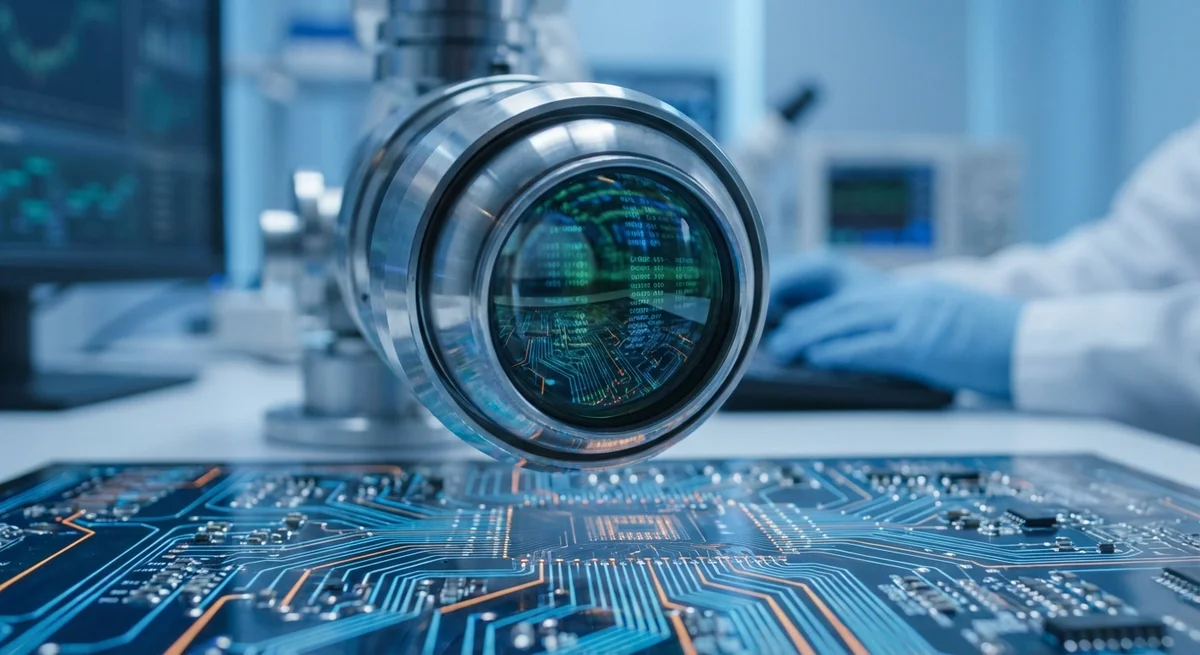
Have you ever noticed how modern neural networks behave when analyzing complex images? It resembles a nearsighted person trying to read a bus number from far away: if they can't make out the digits clearly, they simply invent them based on context. Until now, even the most advanced multimodal models worked in a single pass. They received an image, ran it through their weights and produced a result. If a tiny symbol was lost in a building blueprint, or a chip marking on a motherboard was unreadable, the model never admitted defeat. It hallucinated.
Google decided it was time to end this visual carelessness. The new Agentic Vision technology, built into Gemini 3 Flash, turns vision from passive contemplation into active search. It is a fundamental shift in how AI interacts with the world around it. Instead of just "looking," the model can now "look closer." It understands the limits of its own perception and, when the data is not enough for an accurate answer, launches a refinement loop using the tools available to it.
The context matters more than it first appears. We are used to Gemini or GPT-4o describing a landscape or finding a cat in a photo. But try asking them to analyze a complex technical diagram or a multi-page legal document in small print. The error rate there skyrockets precisely because of the architectural limit of the "single glance." Google recognized that for real-world sectors such as engineering, medicine and logistics, 90% accuracy is not merely useless, it is dangerous. So Agentic Vision introduces the notion of an "active loop," in which the model itself decides which part of the image to zoom into or virtually re-shoot in order to confirm its hypothesis.
How does it work in practice? Imagine giving Gemini 3 Flash a photo of a huge warehouse shelving unit. Previously, the model might miscount boxes or miss damaged packaging in a corner. Now, when it detects uncertainty, the agent inside the model issues a command: "I need more detail in sector B-4." It focuses on that fragment, rechecks the data and only then delivers a verdict. That turns AI from a simple classifier into a full inspector who answers for its words.
Why Gemini 3 Flash specifically? It is a strategic move. Flash is the fastest and cheapest model in Google's lineup. By putting such a complex feature into the "light" version, the company hints that agentic behavior will soon become an industry standard rather than an elite perk of heavy models. It is a direct challenge to Anthropic and OpenAI, which for now are betting on more parameters rather than on changing how models handle visual input.
The consequences for the market will be large. If a neural network learns to read fine details reliably, it will open the door to automating quality control in manufacturing, where only the human eye used to suffice. It is also a step toward truly autonomous agents that can navigate the physical world without getting lost at unfamiliar objects or unclear signs. Google is effectively giving its models the ability to doubt themselves, which is the first sign of real intelligence.
The key question: will "active vision" become the standard for all models in 2025, or will we keep trusting neural network hallucinations in mission-critical tasks?
- Nov 2, 2026Karpathy builds a YouTube clone with 6454 videos from Hacker News recommendations in two hours
- Nov 2, 2026Karpathy used Claude to build HackerTube from 6,454 videos recommended on Hacker News
- Nov 2, 2026Anthropic needs to grow revenue 32% a year to cover $850 billion in contracts
- Nov 2, 2026Bun creator uses Claude Code to port 750K lines from Zig to Rust in 11 days
Test Frontier LLMs & Autonomous Agents in One Workspace
Run Claude Opus 5.5, GPT-6, Gemini 3.1, and DeepSeek side-by-side in Nomad AI (nomadnet.ai) — unified model routing, deep research, and multimodal workflows under one subscription.
The AI world, distilled — once a week
Seven stories that actually mattered, hand-picked. No noise, no reposts, no press releases.
Done! Check your inbox for a confirmation.