The $1 Trillion AI Selloff: Investors Suddenly Sober Up
The stock market is going through its biggest shake-up since the launch of ChatGPT. Tech giants lost a combined trillion dollars in market capitalization in just one week. This is not an ordinary correction but a moment of truth: investors have started demanding real profit from AI, not just polished demo videos. While Nvidia and Microsoft report gigantic infrastructure spending, Wall Street is asking when those investments will start paying off. Where any AI news used to push shares up, the market now behaves like a skeptical debt collector. The era of blind optimism looks to be officially over.
AI-processed from Bloomberg Tech; edited by Hamidun News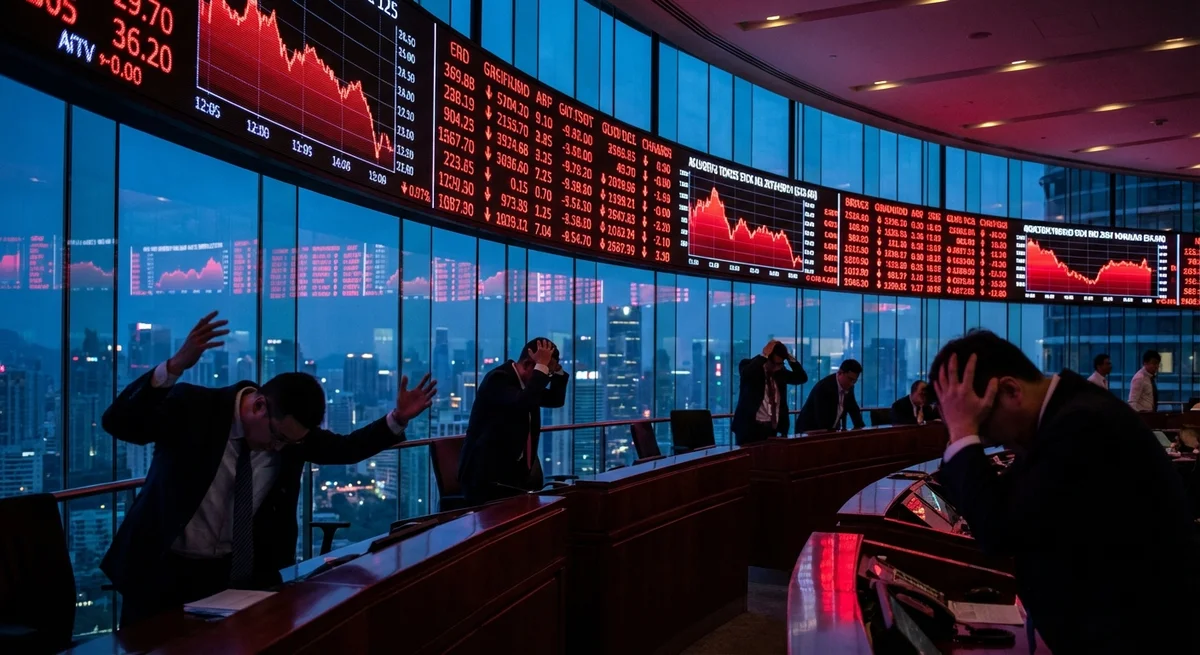
Remember the almost religious excitement of late 2022? Every presentation with the letters AI in its title added billions to a company's market capitalization. We lived in a wonderful world where Nvidia graphics cards were the new oil and language models were the philosopher's stone. This week the fairytale ended. A wave of selling hit the stock and bond markets and wiped out a trillion dollars of market value. This is not just a technical pullback or seasonal profit-taking. It is a full-blown hangover after a three-year party where the champagne flowed freely, paid for with future achievements.
Let's be honest: we all saw this coming, even if we hoped the party would last a little longer. You cannot inflate a bubble forever with expectations that quarterly reports do not back up. While Microsoft, Google and Meta* announce record capital expenditures on data centers and chip purchases, investors are nervously glancing at their watches. The question "Where's the money?" has finally replaced "What else can your neural network do?" The trillion-dollar drop showed that the market is no longer willing to pay in advance for promises to change the world in some unspecified number of years. Right now, the only thing anyone cares about is operating profit, here and now.
The problem is that AI infrastructure costs a staggering amount of money. Training a single model on the level of GPT-5 or its rivals takes hundreds of thousands of chips, gigawatts of power and an army of engineers with sky-high salaries. Companies are spending tens of billions today in the hope of earning trillions tomorrow. But that "tomorrow" keeps receding. Corporate customers are in no hurry to bring raw, expensive tools into their business processes, and ordinary users are not yet ready to pay enough for subscriptions to cover even the cost of cloud computing. The gap between costs and real revenue has become too obvious to ignore.
This week became a moment of truth for many tech giants. Where any company that mentioned neural networks in a press release used to get an automatic bump in its share price, the rules of the game have now reversed. Investors punish even those who show growth if that growth looks insufficiently "artificially intelligent" or too expensive to sustain. We are seeing a classic crisis of confidence, the kind that usually precedes the maturing of any breakthrough technology. Euphoria gives way to dry calculation, and not every player will pass the stress test.
What does this mean for the industry as a whole? Most likely, the golden age of free and unlimited neural networks is coming to an end. Companies will have to tighten the screws, introduce strict limits and look for ways to monetize literally every user request. The era of "burning money for reach" is rapidly giving way to an era of harsh efficiency. Startups and giants that cannot prove their usefulness in concrete dollar terms in the coming quarters risk simply disappearing, despite all their technological sophistication and the parameter counts of their models.
It is interesting to watch how the rhetoric of top executives is changing. They used to tell us, with inspiration, about the technological singularity and the full replacement of human labor. Now the CEOs of the largest corporations increasingly use down-to-earth phrases on investor calls, such as "optimizing internal processes" and "reducing operating costs." The romance of the future has given way to dull bookkeeping. And that is arguably the best scenario for the industry in the long run. Artificial intelligence needs to stop being an expensive toy and become a real instrument of the economy, even if the road there runs through a bloodbath on the stock market.
The bottom line: The market has stopped taking things on faith and extending credit on the strength of the abbreviation AI. Technology now has to prove it is profitable, or the trillion-dollar losses will be only the beginning of the end of a great illusion.
*Meta is designated an extremist organization and banned in Russia.
- Nov 2, 2026Karpathy builds a YouTube clone with 6454 videos from Hacker News recommendations in two hours
- Nov 2, 2026Karpathy used Claude to build HackerTube from 6,454 videos recommended on Hacker News
- Nov 2, 2026Anthropic needs to grow revenue 32% a year to cover $850 billion in contracts
- Nov 2, 2026Bun creator uses Claude Code to port 750K lines from Zig to Rust in 11 days
Test Frontier LLMs & Autonomous Agents in One Workspace
Run Claude Opus 5.5, GPT-6, Gemini 3.1, and DeepSeek side-by-side in Nomad AI (nomadnet.ai) — unified model routing, deep research, and multimodal workflows under one subscription.
The AI world, distilled — once a week
Seven stories that actually mattered, hand-picked. No noise, no reposts, no press releases.
Done! Check your inbox for a confirmation.