Google goes all in: why $180 billion on AI is only the beginning
Alphabet, Google's parent company, published a financial report that left analysts at Wedbush and other investment houses reeling. Instead of the forecast $119 billion, the company plans to put up to $185 billion into infrastructure. Most of the money will go to chips and data centers to support Gemini and cloud computing. It is a clear signal to the market: Google is not just taking part in the AI race, it is willing to overpay for the right to stay among the leaders. While investors worry about margins, Sundar Pichai is betting that in the world ahead, whoever has the most computing power wins.
AI-processed from Bloomberg Tech; edited by Hamidun News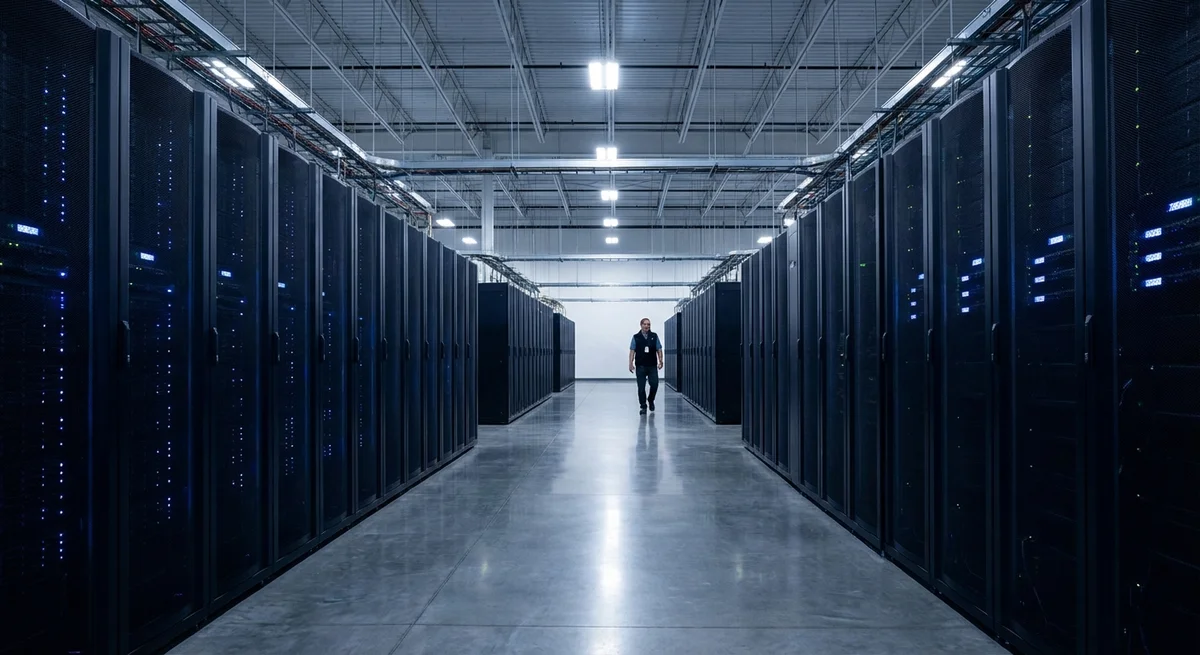
When the numbers in an earnings report differ from analysts' forecasts by tens of billions of dollars, Wall Street usually goes quiet. Alphabet has just staged exactly that kind of performance. While experts at Wedbush and other firms politely predicted spending of around $120 billion for the current year, Google's leadership decided modesty did not suit it. The new range is $175 billion to $185 billion. To grasp the scale: that is more than the GDP of many European countries, and all of it will go toward buying "silicon" and building concrete boxes with powerful cooling.
Why now? For the past two years, Google has been playing catch-up. After the triumph of ChatGPT, the company scrambled to prove that its neural networks were just as good and its ecosystem more reliable. But AI is not only elegant code; above all it is electricity and transistors. Every Gemini query costs many times more than an ordinary Google search. To defend its dominance in search without losing ground to Microsoft and Amazon in cloud services, the company needs capacity that once seemed excessive. Alphabet is effectively admitting that the era of cheap software is over and the era of ultra-expensive hardware has begun.
Wedbush analyst Scott Devitt, commenting on the figures, points to an important nuance: the market was not ready for this level of aggression. Investors love AI when it brings profit, but they get nervous when capital expenditures (Capex) grow exponentially. Still, Google simply has no choice. If it does not build these data centers today, tomorrow it will have to rent capacity from competitors or watch users leave for faster, smarter services. It is a classic "founder's trap": you either spend everything you earned from advertising on new technology, or you slowly turn into a technology museum.
Against this backdrop, Amazon's results also look intriguing. All of Big Tech is now locked in an arms race in which Nvidia is the main arms dealer. But Google is trying to play more subtly by developing its own TPUs (Tensor Processing Units). Part of these enormous billions will go precisely toward developing its own hardware, to reduce, at least somewhat, its dependence on the capricious chip market. It is a long-term strategy that could either make Google the absolute monopolist in computing efficiency or become the most expensive mistake in the company's history.
Ultimately, we are watching the end of the "diet" that tech giants announced last year. The year of efficiency has given way to a year of total procurement. Google understands that in generative AI, size matters: the size of clusters, the number of parameters and the amount of available memory. If it takes $185 billion, they will spend it, even if it drives analysts to drink valerian tincture. The only question is how quickly these investments will turn into real products that users will want to pay for.
The bottom line: the entry ticket to the club of top-tier AI creators has become 1.5 times more expensive. Can anyone besides the Google-Microsoft-Amazon trio afford such stakes?
- Nov 2, 2026Bun creator uses Claude Code to port 750K lines from Zig to Rust in 11 days
- Nov 2, 2026The Verge reviewer builds a $50 Meta Muse Charm alternative with Claude Code
- Nov 1, 202616 models tested on 7 search tools: Exa averaged 10.5 out of 14, SearXNG about 3
- Nov 1, 2026Google's StreamVibe video agent beats other models by 10.7% on response timing and quality
Test Frontier LLMs & Autonomous Agents in One Workspace
Run Claude Opus 5.5, GPT-6, Gemini 3.1, and DeepSeek side-by-side in Nomad AI (nomadnet.ai) — unified model routing, deep research, and multimodal workflows under one subscription.
The AI world, distilled — once a week
Seven stories that actually mattered, hand-picked. No noise, no reposts, no press releases.
Done! Check your inbox for a confirmation.