The AI Boom vs. the Toilet: Why No One Is Left to Fix Your Faucet
The irony of the digital age: while the world debates replacing white-collar workers with algorithms, the real crisis has erupted in physical labor. The construction of giant data centers to train models has absorbed every available pair of hands. The US and Europe have a catastrophic shortage of electricians, plumbers and ventilation technicians. These specialists have become the elite of Big Tech construction sites, where budgets run into the billions. As a result, ordinary homeowners wait months to get a leaking faucet repaired. The digital revolution has run into physical limits: wires and pipes. It turns out that without a skilled worker with a wrench, even the most powerful neural network is just a useless pile of code.
AI-processed from CNews AI; edited by Hamidun News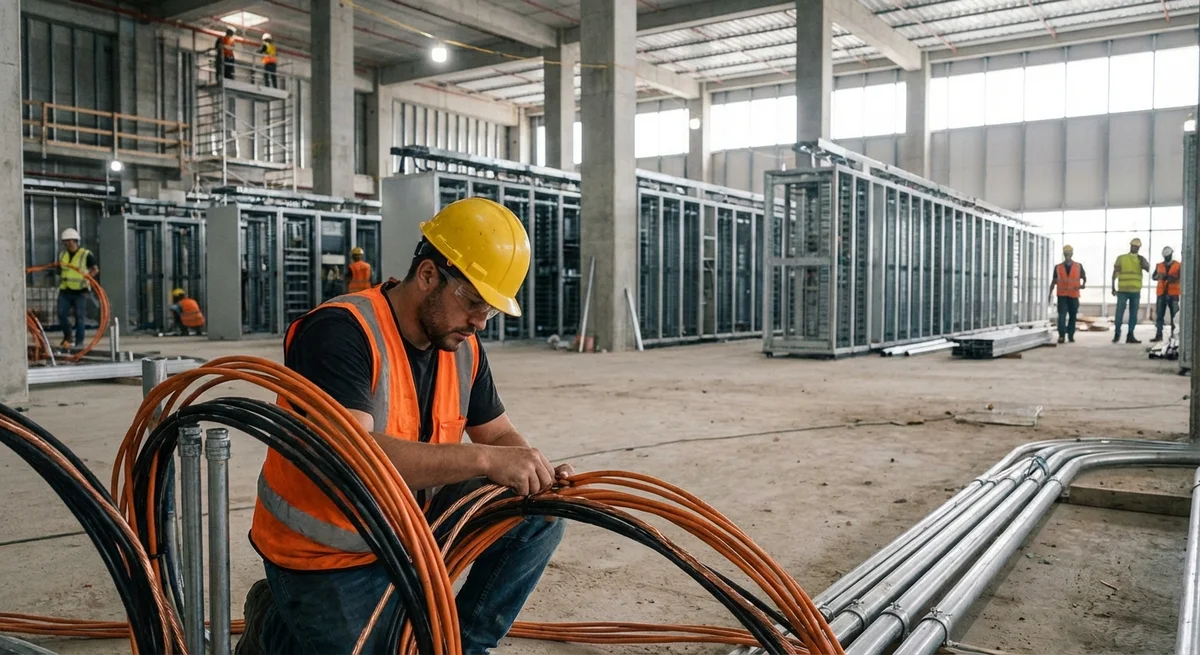
While we were lazily arguing in the comments about whether GPT-5 will replace the average junior developer in fintech, or when Midjourney will put illustrators out of work, reality served up a far more ironic plot. It turns out the main casualty of the AI revolution at this stage is not your designer friend, but your neighbor the plumber, who suddenly stopped answering his phone. And no, he didn't learn to code in Python in his spare time. He went where the pay is several times higher than at any ambitious Silicon Valley startup: to the construction sites of endless, power-hungry data centers.
The generative AI boom has produced a monstrous, almost physiological appetite for computing power. But behind every "smart" chatbot that writes you poems or fixes bugs in your code stands not just an abstract cloud, but very tangible tons of concrete, miles of copper cable and highly complex cooling systems. Industry giants like Microsoft, Google and Amazon are building server farms at a pace that suggests the survival of humanity depends on it. As a result, the labor market in the US and Europe has been skewed so badly that simply calling a tradesman to your home has turned into a "mission impossible" quest.
Why is this happening now, and why have these particular professions been hit? It comes down to scale and the technical demands of new chips. A modern data center built for training neural networks is not just a warehouse full of computers. It is an energy and plumbing monster. Cooling racks of the latest NVIDIA GPUs, which give off enormous amounts of heat, takes thousands of liters of water and complex closed circulation loops. This is where plumbers and HVAC (heating, ventilation and air conditioning) specialists step in. They no longer clear clogs in kitchen sinks; they design and install life-support systems for the planet's "digital brain."
Electricians are in an even scarcer and more privileged position. The power consumption of new Big Tech facilities is now measured not in megawatts but in gigawatts. Someone has to connect all of it, test it and, most importantly, maintain it around the clock, 24/7. Large technology corporations are literally vacuuming up the labor market, offering salaries, bonuses and benefits packages that the private sector, small businesses and municipal services simply cannot compete with. A good electrician used to be merely a sought-after craftsman; today he has become a strategic resource on a national scale, one that billionaires fight over.
The situation is made worse by a decades-long demographic and educational trend. For the past several decades, young people were actively told that the future belonged exclusively to digital professions. The result is an oversupply of marketers and social media specialists, and a critical shortage of people who can tell a live wire from a neutral or properly weld a pipe under pressure.
The irony is that an industry that promised us full automation and relief from routine manual labor has ended up tripping over a shortage of those very "blue-collar workers." We can refine data compression algorithms or transformer architecture as much as we like, but we cannot "download" an extra mile of copper wire, or get a neural network to install a distribution panel in an open field.
The physical world has presented the digital one with a bill, and it is a hefty one. For the average consumer, this means two things. First, the cost of owning and maintaining property will only rise, and the services of any handy tradesman will become a luxury.
Second, construction timelines for anything not tied to AI infrastructure will stretch out indefinitely. The focus of global capital and human resources has shifted toward serving the needs of Big Tech. We are entering a strange era in which knowing how to hold a wrench or a multimeter is valued by the market no less than knowing how to write complex prompts.
Perhaps soon we will see yesterday's programmers enrolling in retraining courses to learn how to install cooling systems for the servers that replaced them.
Bottom line: the AI revolution has suddenly run into a shortage of manual-labor specialists. If you thought the future was only code and pixels, just look at the queue for your plumber. The next critical step for the industry may well be not building GPT-6, but a desperate attempt to build a robot that can replace an electrician on a construction site. Until that happens, you will most likely have to fix a leaking faucet yourself or pay a great deal of money for it.
Bottom line: physical infrastructure has become the bottleneck for AI. Without plumbers and electricians, the "digital future" will simply overheat and burn out.
- Nov 2, 2026Bun creator uses Claude Code to port 750K lines from Zig to Rust in 11 days
- Nov 2, 2026The Verge reviewer builds a $50 Meta Muse Charm alternative with Claude Code
- Nov 1, 202616 models tested on 7 search tools: Exa averaged 10.5 out of 14, SearXNG about 3
- Nov 1, 2026Google's StreamVibe video agent beats other models by 10.7% on response timing and quality
Test Frontier LLMs & Autonomous Agents in One Workspace
Run Claude Opus 5.5, GPT-6, Gemini 3.1, and DeepSeek side-by-side in Nomad AI (nomadnet.ai) — unified model routing, deep research, and multimodal workflows under one subscription.
The AI world, distilled — once a week
Seven stories that actually mattered, hand-picked. No noise, no reposts, no press releases.
Done! Check your inbox for a confirmation.