MADrive: Yandex Builds a Digital Matrix for Its Self-Driving Cars
Training self-driving cars in the real world is expensive and dangerous, and ordinary simulators look too much like video games. Yandex set out to fix this with MADrive, a method for generating photorealistic road scenes. The technology uses a "memory" of past trips to build new scenarios that the robot's sensors perceive as real. The company also released MAD-Cars as open source, the largest dataset of 3D car models. This is not just generosity but an attempt to set a standard in the 3DCV industry. Training autonomous systems should now get faster, and simulation should become almost indistinguishable from reality.
AI-processed from Habr AI; edited by Hamidun News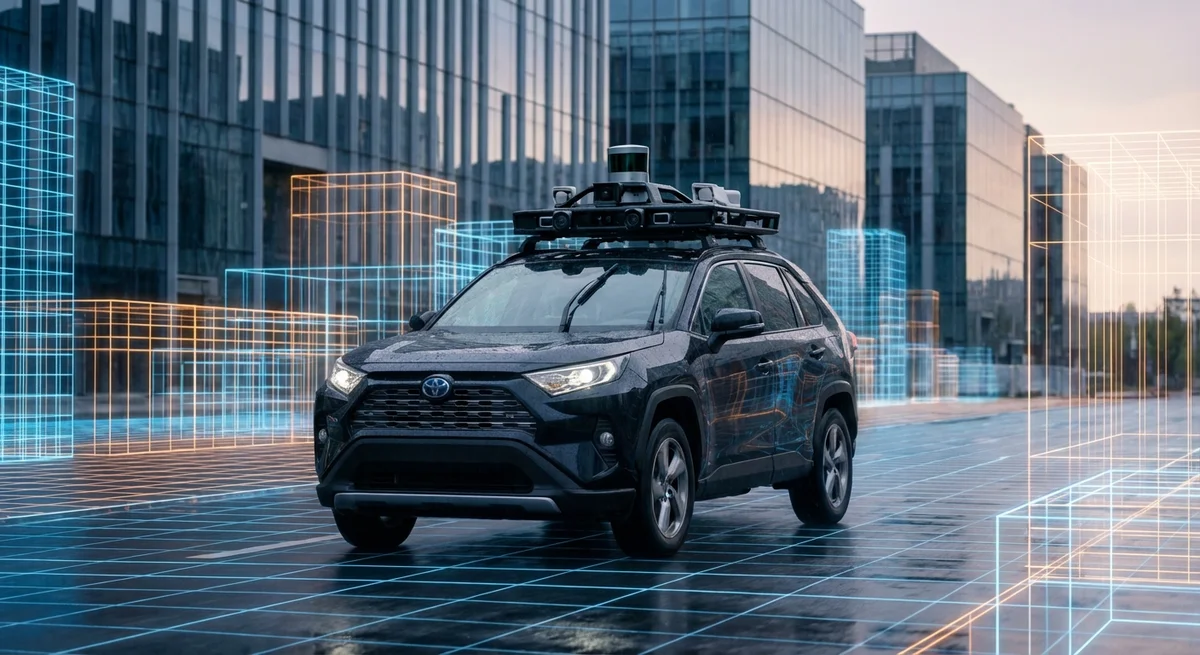
Imagine you have to teach an artificial intelligence to drive a multi-ton vehicle in the middle of a megacity. You cannot simply release a "raw" algorithm onto the street and hope for the best: the cost of a mistake is too high. That is why the entire autonomous transport industry lives in simulations. But this raises the main problem: the so-called gap between simulation and reality (sim-to-real gap). If the picture in the virtual world differs even slightly from the real one, the self-driving car's sensors start to "stall" when they meet real asphalt.
Yandex's sensor simulation team decided to go beyond ordinary game engines and created MADrive (Memory-Augmented Driving Scene Modeling). It is not just an image generator but a complex system that can model road scenes while accounting for physics and context. Simulators used to suffer from objects that looked flat or behaved unnaturally when the viewing angle changed. MADrive uses memory mechanisms to keep objects consistent: if a self-driving car "looked" at a parked car from a different angle, it stays the same car and does not turn into a shapeless blob.
Why does this matter right now? The self-driving industry has hit a wall with "edge cases": rare situations on the road that happen once in a hundred thousand kilometers. You can wait for them in the real world forever. MADrive makes it possible to generate such scenarios an unlimited number of times in digital space. This lets developers train neural networks on aggressive drivers, pedestrians suddenly running into the road or abnormal weather conditions, without risking real hardware or human lives.
Alongside the generation method, Yandex open-sourced MAD-Cars, a huge data collection that the developers themselves call the largest of its kind. It contains thousands of detailed 3D car models that can be used for computer vision tasks. In AI, data is the new oil, and the move looks like an attempt by Yandex to become a key player in the academic and research community. When every lab in the world starts using your dataset as the benchmark, you automatically become the one who sets the rules of the game.
For the ordinary user this means one simple thing: robotaxis will become safer and reach the streets sooner. The better the simulation, the less time engineers need to spend on real roads "polishing" their algorithms. We are entering an era in which a self-driving car's virtual experience matters more than its real mileage. Where we once took pride in millions of miles driven, we will now compete on the quality of synthetic data.
The bottom line: MADrive makes simulation so good that the line between a virtual test and a real drive is blurring. Will the industry be able to give up road testing entirely within the next five years?
- Nov 2, 2026Karpathy builds a YouTube clone with 6454 videos from Hacker News recommendations in two hours
- Nov 2, 2026Karpathy used Claude to build HackerTube from 6,454 videos recommended on Hacker News
- Nov 2, 2026Arca gives AI agents finance tasks lasting up to 10 days, but leaves the trades to humans
- Nov 2, 2026DeepSeek open-sources Super-agent prototype: p95 task completion time of 15.7 minutes vs. 29.5
Test Frontier LLMs & Autonomous Agents in One Workspace
Run Claude Opus 5.5, GPT-6, Gemini 3.1, and DeepSeek side-by-side in Nomad AI (nomadnet.ai) — unified model routing, deep research, and multimodal workflows under one subscription.
The AI world, distilled — once a week
Seven stories that actually mattered, hand-picked. No noise, no reposts, no press releases.
Done! Check your inbox for a confirmation.