$650 Billion on Silicon: Big Tech Bets Everything on AI
Microsoft, Alphabet, Amazon and Meta have pushed their capital spending targets into the stratosphere. By 2026, their combined infrastructure spending will reach $650 billion. That is not just a matter of buying more Nvidia GPUs: it means building entire cities of servers with their own power plants. Investors are getting nervous and demanding returns soon. But the tech giants have no choice: in the race for artificial general intelligence, the winner will be whoever has more computing capacity and cheaper electricity. We are watching the largest restructuring of the global economy yet, from software to infrastructure. *Meta is designated an extremist organization and banned in Russia.
AI-processed from Bloomberg Tech; edited by Hamidun News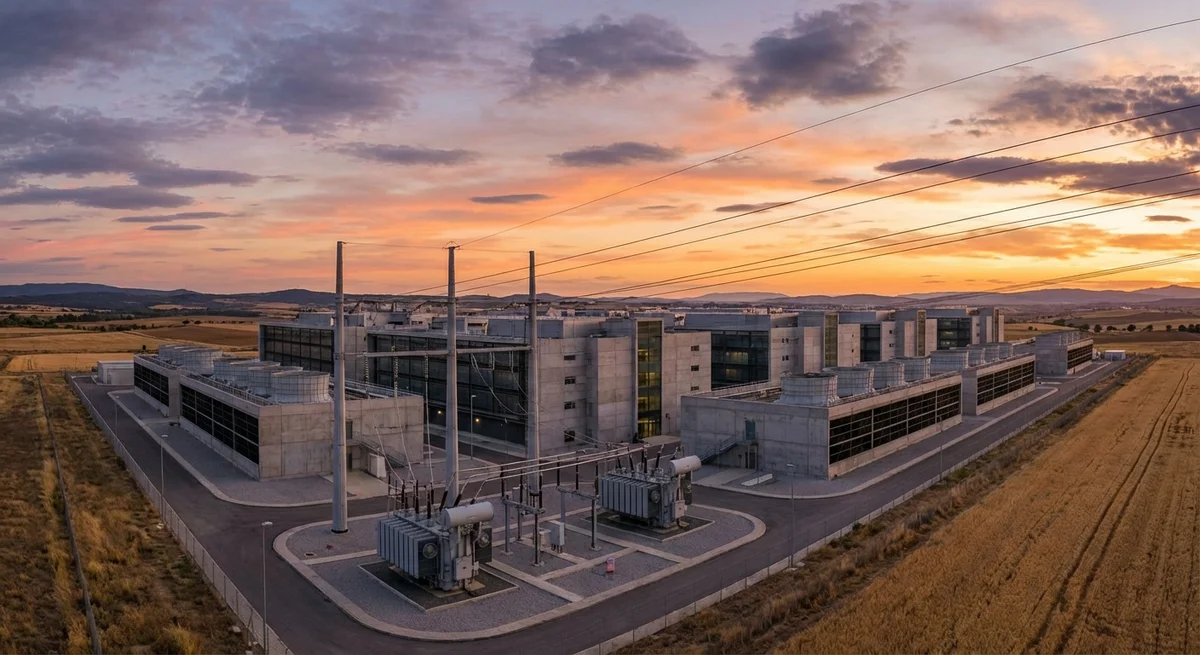
When we talk about hundreds of billions of dollars, the numbers stop being mere lines in financial reports and become something like a geological force. The four main players of the American market — Microsoft, Alphabet, Amazon and Meta — forecast that their combined capital expenditure will reach a staggering $650 billion by 2026. To grasp the scale: that is more than the GDP of many developed countries, spent exclusively on hardware, concrete and wiring. We have entered a phase in which software companies have suddenly realized they are construction and energy conglomerates, because without a physical foundation their neural networks are just elegant code in a void.
Let's recall how it all began. A couple of years ago, investors applauded Big Tech for "efficiency" and headcount cuts. Then ChatGPT arrived, and the rules changed overnight. Success is now measured not by lines of code but by the number of Nvidia H100 chip clusters and by a company's ability to negotiate building its own nuclear power plant. All this money flows into giant data centers that consume electricity on the scale of cities. These are no longer just cloud storage for your photos but genuine "intelligence factories," where every square meter costs more than elite real estate in Manhattan.
The situation looks ironic given earlier cycles of the industry. IT used to be considered a low-capital-intensity business: write a program once and scale it indefinitely. Now every step toward a smarter model demands exponential growth in infrastructure investment. Companies are buying everything: from specialized AI chips and next-generation network cables to backup generators with capacities of hundreds of megawatts. It is a survival race in which the entry ticket is so expensive that new competitors are weeded out at the foundation-design stage.
Wall Street is starting to glance nervously at the clock. Investors are used to quick returns, yet here they are asked to wait while billions of dollars turn into a working AGI (artificial general intelligence) that may repay everything many times over. The same questions come up on every quarterly call: "When will we see a profit from these investments?" Executives answer like a mantra: underinvesting now means losing the future. They are literally burning bridges, making a return to the old business model impossible. If the AI bubble bursts, it will leave behind not just empty offices but whole fields of server farms that someone will have to maintain.
It is also interesting how this process reshapes adjacent industries. Demand for Nvidia chips is only the tip of the iceberg. There is now a battle for copper for cables, transformers for substations, and land plots with access to powerful grids. Microsoft is already signing contracts to restart nuclear reactors, and Amazon is buying up data centers located next to nuclear power plants. The digital economy is finally merging with the energy and industrial sectors. This is no longer just "big tech" but a new form of industrial capitalism, where the main resource is not oil but the compute token.
What does this mean for us? Most likely, we will see further consolidation of power in the hands of those who can afford this spending. The gap between leaders and followers will become unbridgeable. Even well-funded startups like OpenAI or Anthropic are forced to seek shelter under the wing of these giants, because no one else can pay their electricity bills. We are present at a moment when the architecture of the world for the next 50 years is being created, and the price of that architecture is more than half a trillion dollars a year.
Bottom line: Big Tech has finally turned into the "heavy industry" of the 21st century, and its success now depends less on brilliant programmers than on uninterrupted supplies of concrete, copper and uranium.
*Meta is designated an extremist organization and banned in Russia.
- Nov 2, 2026Meta's Muse assistant keeps dossiers on loved ones and gets root on Ubuntu by default
- Nov 1, 2026Local models lose to Opus and Codex: 0.21 on a MacBook versus 1.00 for Codex
- Nov 1, 2026Kimi scores 96.2% on a 1C database analytics test and emerges as a fallback if Claude access is blocked
- Nov 1, 2026OpenAI Rewrites GPT Behavior Rules: Five Values and a Chain of Command
Test Frontier LLMs & Autonomous Agents in One Workspace
Run Claude Opus 5.5, GPT-6, Gemini 3.1, and DeepSeek side-by-side in Nomad AI (nomadnet.ai) — unified model routing, deep research, and multimodal workflows under one subscription.
The AI world, distilled — once a week
Seven stories that actually mattered, hand-picked. No noise, no reposts, no press releases.
Done! Check your inbox for a confirmation.