Trumpf: German Lasers Make AI Possible (and Earn Billions)
While the world stares at chatbots, Swabian laser maker Trumpf is regaining its former strength. As a key supplier to Dutch company ASML, it sits at the heart of the global chip battle. Without its ultra-precise lasers, EUV lithography, the technology that makes the world's most powerful processors possible, simply doesn't work. It is a classic story: in the age of software, hardware still decides everything. While tech giants argue over algorithm safety, Trumpf sells the shovels for this gold rush, showing that the road to superintelligence runs through precise German optics and a headquarters near Stuttgart.
AI-processed from Bloomberg Tech; edited by Hamidun News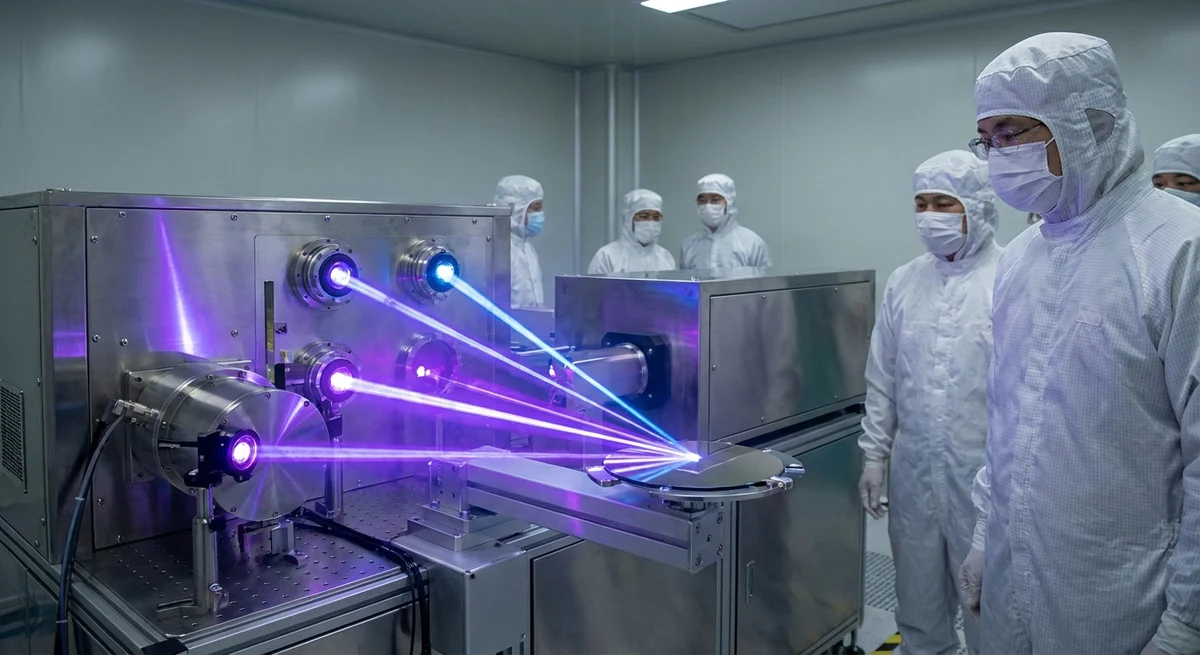
Every time you ask a neural network to generate an image or write code, a silicon chip comes to life somewhere inside a data center, built with technologies that seem like magic. But that magic has a very specific address. While Silicon Valley fights over talent and investment, the German company Trumpf, based in the small town of Ditzingen near Stuttgart, is steadily on the road to recovery. It is doing so not through marketing, but because without its lasers the modern AI revolution would simply stall.
To understand why Trumpf is riding high, look at how global chip manufacturing is structured. At the center of this universe stands the Dutch company ASML, the world's only maker of extreme ultraviolet (EUV) lithography machines. These machines cost hundreds of millions of dollars and "print" transistors just a few nanometers across. But here is the irony: ASML does not make the heart of the machine, the light source. Trumpf does. Its laser system hits a droplet of molten tin 50,000 times per second, turning it into plasma that emits the light the process needs.
After a lull in orders caused by general market instability, Trumpf is again reporting growth. The global semiconductor arms race between the US, China and Europe has made demand for ASML equipment practically unlimited. That means the production lines near Stuttgart will be busy for years to come. Trumpf has effectively become a bottleneck for the entire industry: if it runs into problems, chip production for the next generation of iPhones or new Nvidia accelerators would simply stop.
It is striking to watch a traditional German family business, founded more than a hundred years ago, become the foundation of the most futuristic technologies of our time. It is a good example of how, in the AI value chain, the most durable positions often belong not to those who write code, but to those who own unique physical technologies. While software companies burn billions on training models, Trumpf monetizes the physics of the process and remains an indispensable link in the supply chain.
Trumpf's success today is not just a lucky coincidence, but the result of decades of R&D investment that has finally met market demand. When the world realized that data is the new oil, it turned out that the drilling rigs for that oil are made right here, in Swabia. And although geopolitical pressure on ASML and its suppliers is growing because of export restrictions on China, fundamental demand for computing power outweighs any political risk.
Ultimately, Trumpf's story reminds us how much the real economy matters. In a world where everyone discusses model parameters and AI hallucinations, someone has to deliver precision at the atomic level. And while competitors try to catch up with ASML, and ASML relies on Trumpf, German engineers can look to the future calmly. Their lasers shine bright enough to clear any clouds from the company's financial reports.
Key takeaway: The world's AI dependence on a single German company is both a huge strength and the industry's main vulnerability. Is the world ready for the key to progress to sit in the hands of a private family business from Germany?
- Nov 2, 2026TensorFold 1.2.0 boosts Qwen3.8-27B throughput on M3 Ultra by 44.2% at 16 streams
- Nov 1, 2026Local models lose to Opus and Codex: 0.21 on a MacBook versus 1.00 for Codex
- Nov 1, 2026Habr author fine-tunes YOLOv8l on dental X-rays and pushes mAP50 to 0.642
- Nov 1, 2026Voice bots built on LLMs turn to Jev, a fast classifier, for decisions in 200–500 ms
Test Frontier LLMs & Autonomous Agents in One Workspace
Run Claude Opus 5.5, GPT-6, Gemini 3.1, and DeepSeek side-by-side in Nomad AI (nomadnet.ai) — unified model routing, deep research, and multimodal workflows under one subscription.
The AI world, distilled — once a week
Seven stories that actually mattered, hand-picked. No noise, no reposts, no press releases.
Done! Check your inbox for a confirmation.