DeepMind and activation-function 'mining': why it's time to retire ReLU
DeepMind has unveiled a new approach to finding activation functions, using methods that resemble mining. Instead of deriving formulas by hand, the researchers ran a massive brute-force search to find a replacement for the classic ReLU. The result: functions that run faster and more accurately on modern GPUs. It's an important step toward automating neural network design. When algorithms optimize their own building blocks, progress accelerates exponentially. While the industry chases ever-larger models, DeepMind is digging deeper, revisiting foundations laid decades ago.
AI-processed from Jiqizhixin (机器之心); edited by Hamidun News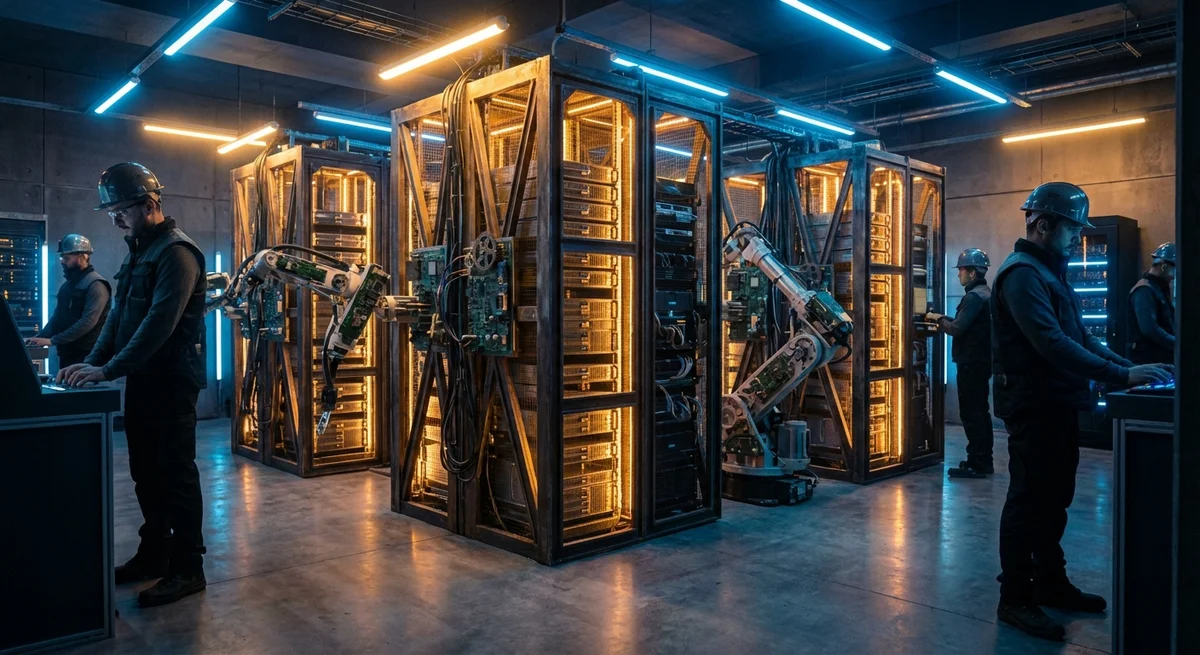
For decades, we've lived in a world where the ReLU activation function was an unshakable standard. It's as simple as a brick and just effective enough not to get in the way of neural networks learning. But let's be honest: ReLU (Rectified Linear Unit) didn't become popular because it's perfect.
It became popular because in 2012 we didn't have the resources to try anything more complex. Now DeepMind has decided to stop reading tea leaves and has turned the search for mathematical formulas into full-scale industrial mining. The research team built what they call a "computational mine."
The idea is simple and slightly insane at the same time: if we don't know which mathematical function works best for deep learning, let's just try them all. It's classic brute force, taken to the extreme. Instead of making mathematicians spend years deriving elegant proofs, DeepMind threw thousands of GPUs at the problem to "dig up" the ideal algorithm.
Why is this happening now? The LLM market has hit an efficiency ceiling. We keep piling on parameters, but the models' basic building blocks barely change.
DeepMind realized that even a tiny efficiency gain at the activation-function level, at the scale of GPT-4 or Gemini, saves millions of dollars in electricity and weeks of training. This isn't just academic curiosity; it's pure economics. During its "mining," the system tested millions of combinations of mathematical operators.
The researchers looked for functions that not only post high accuracy on paper but also "play nicely" with modern hardware. It turned out that many theoretically strong functions are too expensive to compute on GPUs, which makes them useless in real production. DeepMind aimed for the sweet spot: computational lightness plus mathematical flexibility.
The results are impressive. The discovered functions beat not only good old ReLU but also more modern alternatives like Swish and GeLU. The most interesting part is the shift in approach.
We're moving from an era of "smart people inventing algorithms" to an era of "smart systems growing algorithms." This is the real AutoML people have dreamed about for the past five years, except now it has reached the very foundation of neural connections. What does this mean for the industry?
Most likely, the next generation of large language models will feature architectures that look strange to us. They'll use functions that no sane human would ever derive on a whiteboard, because they don't look "pretty" by the standards of classical calculus. But they will work.
And they'll run faster than anything we've seen before. The bottom line: DeepMind has clearly shown that the AI "gold rush" is moving from giant datasets to reinventing basic math. If you thought the foundations of deep learning were already set in concrete, brace yourself: someone just started taking a jackhammer to them.
- Nov 2, 2026Karpathy builds a YouTube clone with 6454 videos from Hacker News recommendations in two hours
- Nov 2, 2026Karpathy used Claude to build HackerTube from 6,454 videos recommended on Hacker News
- Nov 2, 2026Anthropic needs to grow revenue 32% a year to cover $850 billion in contracts
- Nov 2, 2026Bun creator uses Claude Code to port 750K lines from Zig to Rust in 11 days
Test Frontier LLMs & Autonomous Agents in One Workspace
Run Claude Opus 5.5, GPT-6, Gemini 3.1, and DeepSeek side-by-side in Nomad AI (nomadnet.ai) — unified model routing, deep research, and multimodal workflows under one subscription.
The AI world, distilled — once a week
Seven stories that actually mattered, hand-picked. No noise, no reposts, no press releases.
Done! Check your inbox for a confirmation.