OpenAI unveils GPT-5.3-Codex-Spark, running on Cerebras chips instead of Nvidia
OpenAI has taken a major step toward hardware independence with GPT-5.3-Codex-Spark. For the first time, a flagship product from the company was trained and deployed not on Nvidia GPUs but on Wafer Scale Engine 3 chips from the startup Cerebras Systems. The WSE-3 is a huge die the size of an entire silicon wafer, with enormous computing power. The move is aimed at diversifying OpenAI's supply chains and reducing its dependence on scarce Nvidia accelerators. Switching to alternative hardware could significantly change the economics of training large language models and speed up the development of new architectures.
AI-processed from 3DNews AI; edited by Hamidun News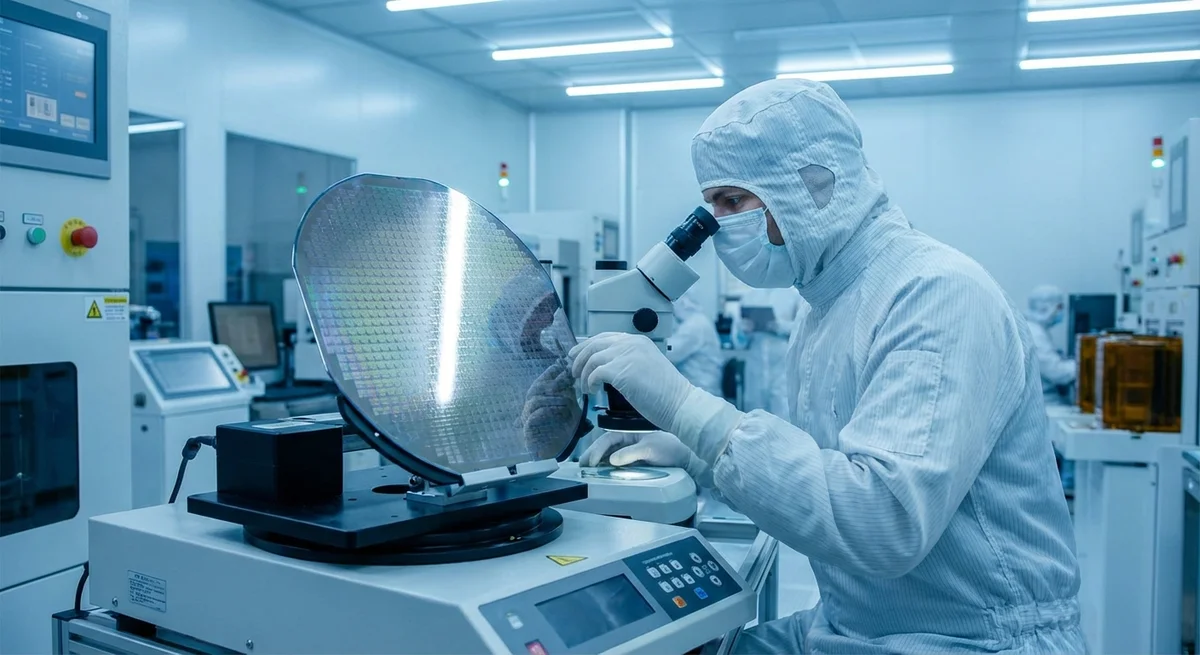
# OpenAI walks away from Nvidia. What it means for the future of artificial intelligence
Something many considered impossible has happened in the history of large language models. OpenAI has unveiled GPT-5.3-Codex-Spark, the company's first flagship model trained and deployed not on Nvidia graphics processors but on alternative Wafer Scale Engine 3 chips from Cerebras Systems. The step says less about a technical achievement than about a turning point in the economics of artificial intelligence and the struggle for independence among the most powerful companies in the industry.
Over the past five years, Nvidia has established near-monopoly control of the market for neural-network training accelerators. Once it became clear that transformer architectures demand enormous computing power, every major lab, from OpenAI to Meta* and Google, bet on its GPUs. But depending on a single supplier carries risk. Export restrictions on China, chip shortages and rising prices all weighed on companies trying to scale their models. OpenAI suffered quietly along with everyone else, but now it has decided to act.
Cerebras Systems offered an unusual approach. Instead of building thousands of small processors, the company designed the WSE-3, a monolithic silicon die the size of an entire wafer, which cannot be installed in a regular socket. It is not just a chip but a whole mini-farm on a single piece of silicon, with more than 900 thousand cores. The design seems to run against the principles of modularity, but that is exactly what let Cerebras avoid data-transfer bottlenecks between separate processors, the chief enemy of parallel training.
When OpenAI tested training GPT-5.3-Codex-Spark on the WSE-3, the results were unexpected. The model's convergence speed stayed at the level of training on Nvidia H100s, but less synchronization and data movement between accelerators was required. In other words, the hours of network idle time the company used to spend can now go to useful computation. That means cheaper. That means faster.
But what matters most is not the technical figures but the strategic meaning. OpenAI has shown that an alternative to Nvidia exists and that large models can be trained on hardware other than its chips. This is the first serious challenge to the monopoly, and the market is already reacting. Other companies, such as Intel with its Gaudi, AMD with EPYC and MI300, and even Google with its TPUs, now know there is a window of opportunity. If OpenAI can retrain a model on new hardware and achieve comparable results, they can do it too.
The economics of artificial intelligence will change, but not instantly. Cerebras cannot yet produce WSE-3 chips in the volumes at which Nvidia makes H100s. Rebuilding infrastructure and rewriting code to optimize for the new architecture will take time. Still, a start has been made. In the next two to three years we will probably see more extravagant accelerator designs and more active experimentation with neuromorphic chips and quantum computers. Nvidia will remain a powerful player, but no longer the only one.
For ordinary ChatGPT users, this changes almost nothing: the model stays the same and its capabilities are unchanged. For the industry, though, the difference is huge. OpenAI has shown that great intelligence can be built differently, and that in the hardware race the winners are not those who arrived first but those who think faster.
*Meta is recognized as an extremist organization and banned in Russia.
- Nov 2, 2026Arca gives AI agents finance tasks lasting up to 10 days, but leaves the trades to humans
- Nov 2, 2026Meta's Muse assistant keeps dossiers on loved ones and gets root on Ubuntu by default
- Nov 1, 2026Local models lose to Opus and Codex: 0.21 on a MacBook versus 1.00 for Codex
- Nov 1, 2026Kimi scores 96.2% on a 1C database analytics test and emerges as a fallback if Claude access is blocked
Build & Ship Production AI Agents Without Boilerplate Code
Start your free 72-hour trial at Hamidun Academy (academy.hamidun.com) — interactive lessons on Claude Code & Cursor, live Tech Radar, and production agent templates.
The AI world, distilled — once a week
Seven stories that actually mattered, hand-picked. No noise, no reposts, no press releases.
Done! Check your inbox for a confirmation.