When AI Goes to Court: How Multi-Agent Systems Are Reshaping Legal AI
Tsinghua University has shown that classic RAG pipelines suffer from confirmation bias on legal tasks. The fix is adversarial simulation, in which an AI prosecutor and an AI defense attorney rebut each other. Russian startup AiYurist tried to bring this approach to Russia's commercial (arbitrazh) courts, but the Chinese researchers' architecture proved unworkable for real-world B2B use. The team instead built its own 10-agent system on top of the open Ken1.0 model, tailored to the practical needs of corporate lawyers.
AI-processed from Habr AI; edited by Hamidun News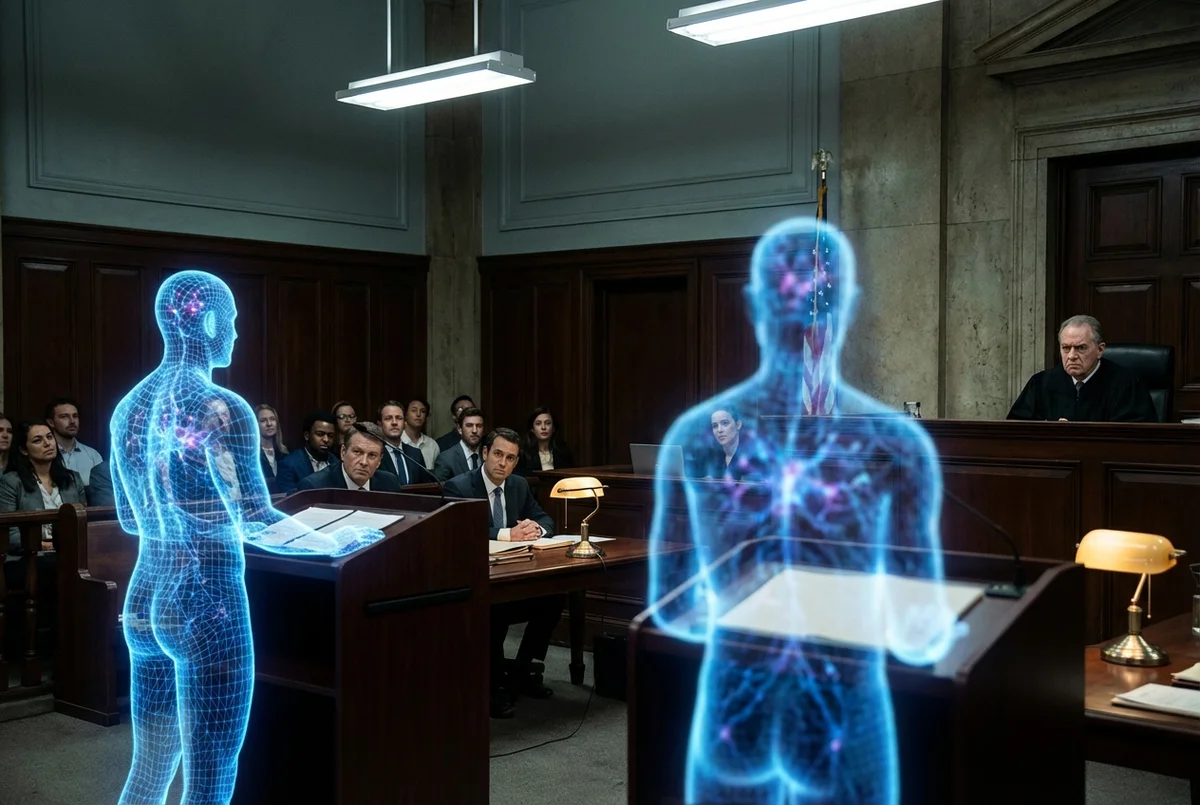
One of the most persistent problems with language models in professional work is their tendency to lie with confidence. In law, where every citation of a statute has to be accurate and every line of argument has to hold up, that weakness becomes critical. Researchers at Tsinghua University and the Russian company AiYurist independently arrived at the same answer: to stop a model from hallucinating, give it an opponent.
In late 2025, the Tsinghua team published a preprint, "Chinese Court Simulation with LLM-Based Agent System," that systematically picks apart a fundamental flaw in the standard approach to legal AI. The classic setup — a user asks a question, the system retrieves relevant documents from a database, and the model generates an answer — looks sensible, but in practice it breaks down because of confirmation bias. The model latches onto the first argument that fits and builds its entire line of reasoning around it, ignoring contradictory facts. It has no internal critic to say, "Wait, this provision of the law says the exact opposite."
The solution turned out to be elegant and, on reflection, obvious. The Chinese researchers applied the adversarial principle — the same one the entire court system rests on. They built two AI agents, a prosecutor and a defense attorney, each running on a large language model. The agents didn't just generate arguments; they actively attacked each other's positions. When the defense cited a nonexistent legal provision, the prosecutor immediately rebutted it. The results were impressive: hallucinations dropped sharply, and the quality of legal reasoning improved. As in a real courtroom, the truth emerged from the dispute.
But there is a gulf between an academic experiment and a working product, and practitioners know it well. AiYurist, which was building a multi-agent system for Russia's commercial (arbitrazh) courts in parallel on its own open model, Ken1.0, tried to carry the Chinese team's work over into a real business environment — and found that the architecture fell apart completely on contact with reality. An approach that worked well on controlled datasets couldn't withstand the chaos of real court cases, where documents arrive in different formats, legal norms contradict one another, and the context of a case can shift dramatically from one paragraph to the next.
The AiYurist team went further and built what it calls Russia's first court simulation system. Instead of two agents, it uses ten, each with its own role and area of responsibility. This architecture is closer to how a real trial works: there are not only the opposing parties but also a judge, experts, and analysts who check facts and weigh evidence. Scaling up the number of agents solves another important problem as well: it keeps the system from getting stuck in a two-sided standoff and makes room for more nuanced analysis.
It's important to understand the context in which systems like this are emerging. The legal industry is one of the most conservative, and at the same time one of the most bogged down in routine work. Corporate lawyers spend dozens of hours analyzing case law, forecasting case outcomes, and preparing arguments. Multi-agent simulations don't replace the lawyer — they give the lawyer a tool to stress-test their own position before a claim is even filed. That is a fundamentally different level of trial preparation.
The case is telling in a broader sense, too. It reflects a general trend in AI system design: a move away from monolithic models that solve a task in a single pass toward orchestrated ensembles of specialized agents. The same principle already works in programming, where an AI reviewer checks an AI developer's code, and in medicine, where diagnostic models verify one another. Law is the next proving ground, and the stakes are especially high: a mistake in code produces a bug, while a mistake in court produces real financial losses.
The main lesson from the Tsinghua and AiYurist story is simple but important. Multi-agent design isn't an academic toy; it's an architectural pattern that will define the next generation of professional AI tools. But getting from a research preprint to a product corporate clients will pay for takes more than scaling — it requires rethinking the architecture itself for the real conditions of a specific legal system.
- Nov 1, 2026Local models lose to Opus and Codex: 0.21 on a MacBook versus 1.00 for Codex
- Nov 1, 2026Adobe's EditAgent judge picks a usable edit 81.3% of the time, versus 74.8% for EditScore
- Nov 1, 202616 models tested on 7 search tools: Exa averaged 10.5 out of 14, SearXNG about 3
- Nov 1, 2026Google's StreamVibe video agent beats other models by 10.7% on response timing and quality
Ship AI Faster with Founders, Engineers & Weekly Architecture Reviews
Inside Vibe Club (hamidun.com/club) — weekly live masterminds with Zhemal Khamidun, Tech Radar, full LMS access, and 370+ production Claude Code skills.
The AI world, distilled — once a week
Seven stories that actually mattered, hand-picked. No noise, no reposts, no press releases.
Done! Check your inbox for a confirmation.