Agentation: the tool changing how developers talk to AI agents
Agentation has passed 120,000 npm downloads in a couple of months by tackling one of vibe coding's biggest pain points: imprecise communication with AI agents when working on UI. Instead of verbal descriptions like "make that button darker," developers can point the agent to exactly the interface element they mean. Version 2.0 adds MCP support, widening the integration options. The project targets React developers first and foremost, particularly those who already use AI heavily in their daily work.
AI-processed from Habr AI; edited by Hamidun News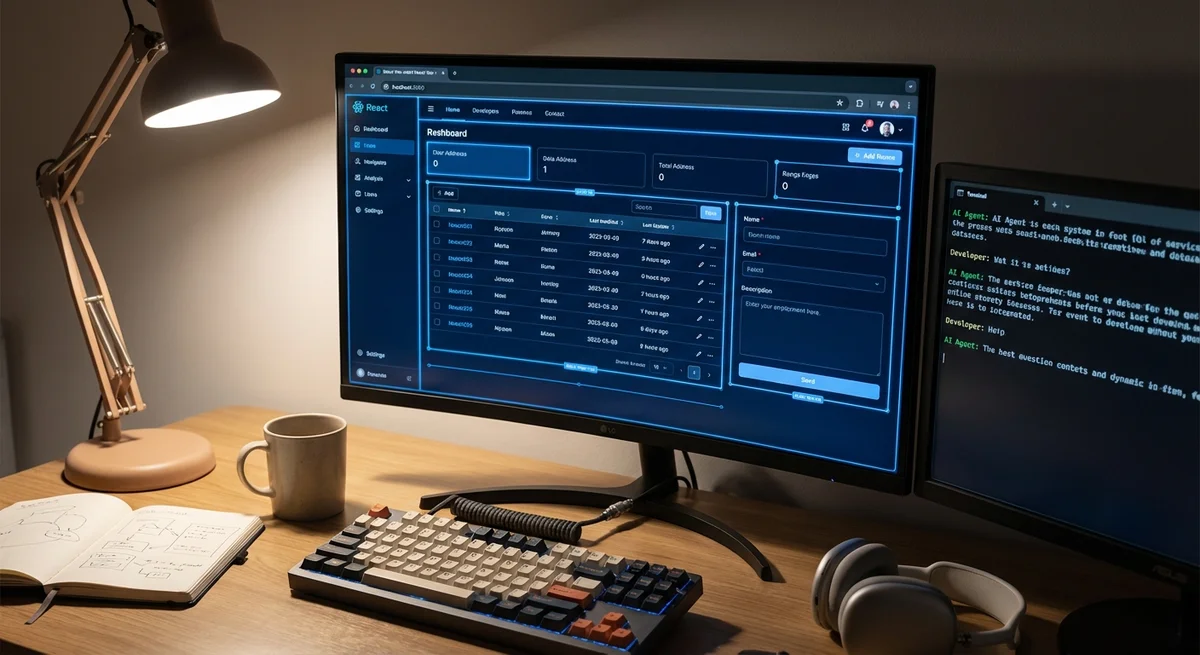
Anyone who has ever tried to explain to an AI agent which interface element needs fixing knows the feeling. "Make the button darker." Which button? "The one in the sidebar." There are three. "The second from the top, with the icon." The agent edits the first one. You write a detailed description with CSS classes, coordinates and neighboring elements, and the result is still unpredictable. This is the problem Agentation is trying to solve. In a matter of weeks it went from a niche utility to a tool that a significant part of the developer community practicing so-called vibe coding is talking about.
The problem Agentation addresses looks trivial at first glance, but in practice it eats an enormous amount of time. Modern AI agents such as Claude Code handle code generation, refactoring and even architectural decisions superbly. But when it comes to fine-tuning a user interface, communication between human and machine turns into a game of "guess what I meant." A developer looks at the screen and intuitively knows what needs to change, but translating that visual understanding into a text description precise enough for an AI is a non-trivial task, especially with complex interfaces containing dozens of nested components.
Agentation takes a fundamentally different approach to this communication. Instead of describing an element in words, the tool lets the developer point at the exact component and gives the agent all the context it needs, from the DOM hierarchy to applied styles and component state. In essence, it is a bridge between human visual perception and the text-based perception of an AI agent. The tool plugs into a React developer's workflow and acts as a layer that enriches requests to the agent with structured context about the interface.
The numbers speak for themselves: more than 120,000 npm downloads in two months is a serious result for a tool with no large corporation or large-scale marketing campaign behind it. The growth comes mainly from Agentation hitting a real pain point. Vibe coding, an approach in which the developer describes the desired result in natural language and AI generates the code, is rapidly gaining popularity. By various estimates, 30 to 40 percent of front-end developers were regularly using AI agents in their daily work by early 2026. But the quality of that interaction has so far depended heavily on the ability to phrase requests, a skill that has nothing to do with programming itself.
Version 2.0 deserves particular attention, as it adds support for MCP, the Model Context Protocol. It is an open standard that gives AI models structured access to external tools and data sources. MCP integration means Agentation is no longer just a utility for one specific agent and becomes a universal bridge between any compatible AI tool and the user interface of a React application. This is a strategically important step: as the AI agent ecosystem grows more diverse, tools built on open protocols gain a clear advantage over proprietary solutions.
That said, the project has obvious limitations. For now, Agentation targets the React ecosystem exclusively, leaving out developers who use Vue, Svelte, Angular or other frameworks. In addition, the promotional tone surrounding the project invites healthy skepticism: the promise to "speed up work twofold" is a marketing claim that is hard to verify in the general case. The real gain depends heavily on the type of task, the complexity of the interface, and how well the developer already knows how to phrase requests for AI.
Still, Agentation points to an important trend in developer tooling. We are watching a new class of software take shape: not IDEs, not plugins, not linters, but "translators" between human intent and machine understanding. As AI agents take over more routine work, the bottleneck is no longer the speed of code generation but the accuracy of context transfer. Tools that solve this problem will shape developer productivity in the years ahead.
For React developers who actively use Claude Code or similar tools, Agentation is definitely worth a look. Not as a silver bullet, but as one more item in a growing arsenal of tools that make working with AI agents less frustrating and more predictable. And predictability in development is what real productivity is.
- Nov 2, 2026Karpathy builds a YouTube clone with 6454 videos from Hacker News recommendations in two hours
- Nov 2, 2026Karpathy used Claude to build HackerTube from 6,454 videos recommended on Hacker News
- Nov 2, 2026Arca gives AI agents finance tasks lasting up to 10 days, but leaves the trades to humans
- Nov 2, 2026Anthropic needs to grow revenue 32% a year to cover $850 billion in contracts
Build & Ship Production AI Agents Without Boilerplate Code
Start your free 72-hour trial at Hamidun Academy (academy.hamidun.com) — interactive lessons on Claude Code & Cursor, live Tech Radar, and production agent templates.
The AI world, distilled — once a week
Seven stories that actually mattered, hand-picked. No noise, no reposts, no press releases.
Done! Check your inbox for a confirmation.