Data Centers vs. the Power Grid: An Australian Case With Global Consequences
Australia's data center construction boom has exposed a systemic problem: giant server farms consume enormous amounts of electricity and water, threatening higher household tariffs and the country's climate commitments. Authorities are increasingly insisting that data center operators cover their own energy needs, but there are more questions than answers. The Australian case is becoming a model for the world, where the AI industry is running into the physical limits of the planet.
AI-processed from Guardian; edited by Hamidun News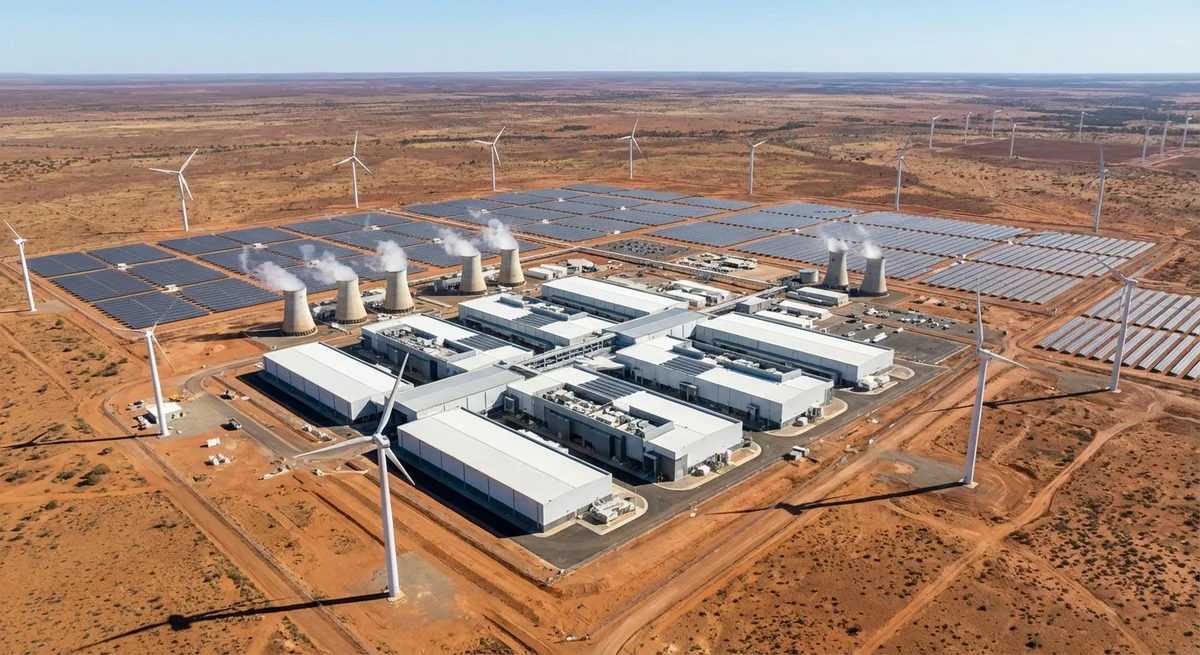
Every ChatGPT query, every generated video, every transcript of an online meeting: none of it lives in an abstract "cloud." Behind each operation sits very material infrastructure: giant warehouses packed with servers that draw electricity, give off heat and need water cooling. Australia, in the middle of a data center building boom, is the first developed country to face a question that will soon confront every government: who pays for artificial intelligence's appetite for energy?
Data centers have existed for decades, and there is nothing new in that. What is new is the scale and the speed of growth. The explosive spread of generative AI has turned server farms from a quiet infrastructure story into one of the main challenges for energy policy. By various estimates, a single query to a large language model consumes ten times more energy than an ordinary Google search. Multiply that by hundreds of millions of daily requests and the load is comparable to the energy consumption of small countries. Australia, where the world's largest technology companies are actively building new facilities, already feels this pressure.
The problem is not limited to electricity. Data centers are also major water consumers. Server cooling systems use evaporative technologies that require significant volumes of fresh water. In a country that regularly suffers droughts and water shortages, this is not an abstract threat but a concrete conflict of interest between technology corporations, agriculture and urban water supply. Every new data center in the suburbs of Sydney or Melbourne puts extra load on infrastructure that is already strained.
A new political consensus is forming in Australia: if you build a data center, you must supply your own energy. It sounds logical, but in practice it triggers a cascade of questions. Should operators build their own solar and wind farms? Is connecting to the shared grid acceptable if it raises tariffs for ordinary consumers? How should data center emissions count toward national climate commitments? None of these questions has a clear answer yet, and Australian regulators are effectively creating case law in real time.
Fairness is a particularly sharp issue. Big tech companies such as Microsoft, Google and Amazon have the resources to build renewable energy sources. But if they buy up "green" generation for their own needs, the rest of the economy is left with a dirtier and more expensive energy mix. This is already happening in some regions of the US, where data centers' contracts to buy solar and wind power are effectively crowding out other buyers. Australia is trying to avoid that scenario, but finding the balance between attracting investment and protecting the public interest is not easy.
There is also a climate dimension. Australia has committed to cutting greenhouse gas emissions, and the rapid growth in data center energy use could undermine those plans. If new server farms run even partly on fossil fuels, which is unavoidable during the transition period, the country risks missing its climate targets. The paradox is that AI technologies are often positioned as a tool for fighting climate change, yet their own carbon footprint is growing faster than the ability to offset it.
The Australian case matters far beyond a single continent. Similar debates are under way in Ireland, where data centers already consume about twenty percent of the country's electricity; in Singapore, which imposed a moratorium on new facilities; and in the Nordic countries, which attract operators with a cold climate and cheap hydropower. Russia, which is developing its own AI infrastructure, will also inevitably face these questions, especially given the load on the power systems of Moscow and the Moscow region, where most domestic data centers are concentrated.
The main lesson of the Australian discussion is simple and uncomfortable: the digital economy has very physical limits. The era when data centers could quietly plug into the shared grid and dissolve into the overall energy balance is ending. Ahead lies a time of hard political decisions about who pays for the infrastructure of the AI future and whether society is ready to bear those costs. Australia is the first to ask these questions. The answers will determine the balance between technological progress and sustainable development for decades to come.
- Nov 2, 2026Arca gives AI agents finance tasks lasting up to 10 days, but leaves the trades to humans
- Nov 2, 2026Meta's Muse assistant keeps dossiers on loved ones and gets root on Ubuntu by default
- Nov 1, 2026Local models lose to Opus and Codex: 0.21 on a MacBook versus 1.00 for Codex
- Nov 1, 2026Kimi scores 96.2% on a 1C database analytics test and emerges as a fallback if Claude access is blocked
Test Frontier LLMs & Autonomous Agents in One Workspace
Run Claude Opus 5.5, GPT-6, Gemini 3.1, and DeepSeek side-by-side in Nomad AI (nomadnet.ai) — unified model routing, deep research, and multimodal workflows under one subscription.
The AI world, distilled — once a week
Seven stories that actually mattered, hand-picked. No noise, no reposts, no press releases.
Done! Check your inbox for a confirmation.