AI code review without the cloud: how Ollama changes local development
Developers have demonstrated a working AI code review pipeline that runs entirely locally through Ollama, with no cloud and no API keys. The system analyzes a git diff, passes the changes through a local language model and generates a structured report of comments. The approach is especially relevant for teams with strict data security requirements and for anyone who doesn't want to pay for cloud APIs. It suggests that local LLMs are already mature enough for practical development work.
AI-processed from Habr AI; edited by Hamidun News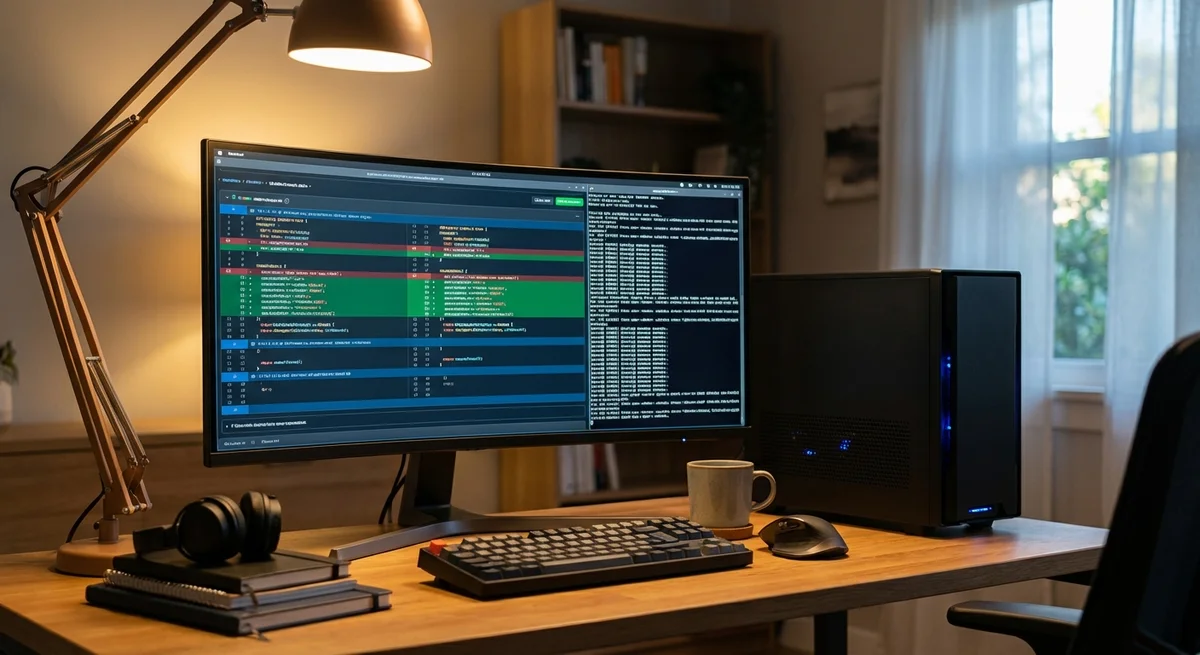
Using artificial intelligence to review code stopped being exotic a long time ago. GitHub Copilot, Amazon CodeWhisperer and dozens of SaaS products all offer automated pull request analysis. But they share one trait: your code leaves for the cloud. For many teams, especially in fintech, healthcare or the defense industry, that is categorically unacceptable. A recent case from Habr shows that an alternative already exists and runs right on your machine.
It is a full AI code review pipeline built on Ollama, a tool for running large language models locally. The architecture is very simple: the system takes a git diff from the repository, passes the changes to a locally deployed LLM and gets back a structured report with comments on code quality, potential bugs and style issues. No cloud servers, no API keys, no monthly subscriptions. Everything runs on the developer's hardware.
Over the past year Ollama has grown from a niche enthusiast tool into a serious platform for production tasks. The project lets you run models such as Llama, Mistral, CodeLlama and dozens of others directly on a local machine with minimal setup. Installation takes one command, and models are accessed through a simple REST API that is easy to integrate into any CI/CD pipeline or script. That simplicity is what made possible solutions that previously required expensive cloud infrastructure.
Technically, the approach works like this. A script extracts the diff between the current branch and the main one, formats it into a prompt with clear instructions for the model (what to look for and in what format to respond) and sends a request to a local Ollama instance. The model analyzes the changes and returns a report that can include pointers to potential bugs, style violations, performance problems and refactoring suggestions. The whole process takes from a few seconds to a couple of minutes, depending on the size of the changes and the power of the hardware. On a machine with a modern graphics card with 16 gigabytes of video memory, the speed is quite acceptable.
The context in which this solution appears matters. The developer tools market is going through a tectonic shift. On one side, large corporations such as Microsoft and Google are aggressively pushing their cloud AI assistants, tying developers to their ecosystems. On the other, a movement for digital sovereignty and data control is growing. The European AI Act, tighter rules on processing personal data and corporate security policies all create demand for solutions that work without handing information to third parties. Local AI code review fits that trend perfectly.
Of course, the approach has limits. Local models still trail flagship cloud systems such as GPT-4o or Claude in analysis quality. They may miss subtle logic errors or give less accurate architectural recommendations. Running serious models takes fairly powerful hardware; a budget laptop with integrated graphics will not cope. But progress in compact models is impressive: quantized versions with 7-13 billion parameters already deliver results that a year ago were available only to models ten times larger.
For the industry, this case matters less for its specific implementation than for the direction it points to. We are moving toward a world where developers' AI tools run locally by default, and the cloud becomes an option rather than a necessity. Ollama, llama.cpp, vLLM and other projects are building an infrastructure layer on which dozens of practical solutions already rest, from code review to test and documentation generation. And all of it without a single request to an external server.
The main takeaway is simple: the barrier to entry for local AI in development has dropped to a minimum. If your team still isn't experimenting with local models to automate routine tasks, now is the time to start. The technology has matured, the tools are available, and the advantages in security and cost are obvious. The cloud AI giants are, of course, not going anywhere, but they no longer have a monopoly on smart development tools.
- Nov 2, 2026Karpathy builds a YouTube clone with 6454 videos from Hacker News recommendations in two hours
- Nov 2, 2026Karpathy used Claude to build HackerTube from 6,454 videos recommended on Hacker News
- Nov 2, 2026Arca gives AI agents finance tasks lasting up to 10 days, but leaves the trades to humans
- Nov 2, 2026Anthropic needs to grow revenue 32% a year to cover $850 billion in contracts
Test Frontier LLMs & Autonomous Agents in One Workspace
Run Claude Opus 5.5, GPT-6, Gemini 3.1, and DeepSeek side-by-side in Nomad AI (nomadnet.ai) — unified model routing, deep research, and multimodal workflows under one subscription.
The AI world, distilled — once a week
Seven stories that actually mattered, hand-picked. No noise, no reposts, no press releases.
Done! Check your inbox for a confirmation.