WhatsApp opens its doors to rivals: third-party AI chatbots are coming to Brazil
Meta is expanding its program that lets third-party AI chatbots into WhatsApp. After launching in Europe, the same option is coming to users in Brazil. Rival AI companies will be able to offer their assistants inside the messenger on a paid basis. The decision comes amid regulatory pressure in the EU and Meta's strategic interest in Latin America's largest market. The move could turn WhatsApp from a plain messenger into a full-fledged AI platform with an ecosystem of third-party developers. *Meta is designated an extremist organization and banned in Russia.
AI-processed from TechCrunch; edited by Hamidun News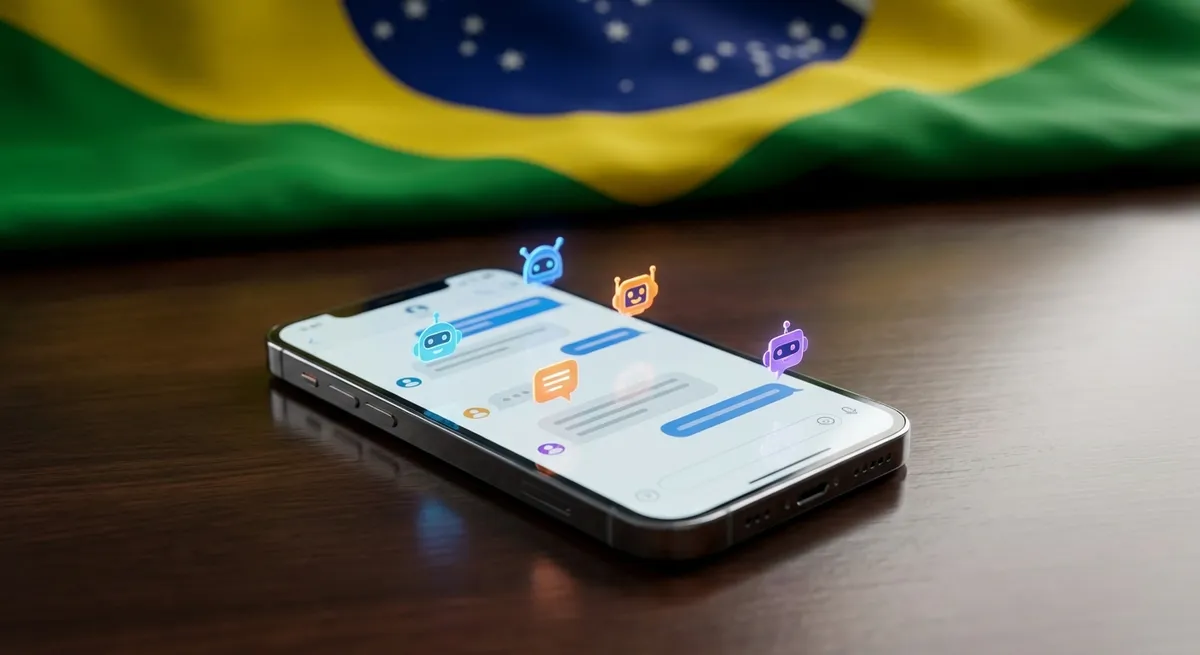
Meta has opened WhatsApp to third-party AI chatbots in Brazil, the messenger's second-largest market in the world after India, where WhatsApp is installed on more than 93% of smartphones. Access comes at a price, and the move landed just one day after a similar step in Europe. Unlike in Europe, though, nobody forced Meta's hand in Brazil. The country has no equivalent of the Digital Markets Act, which means Meta is opening the platform to competitors voluntarily.
From Europe to Brazil: different motives
In Europe, letting third-party AI bots into WhatsApp was largely a forced move. The Digital Markets Act requires the biggest tech platforms to ensure interoperability and not to discriminate against competitors, and WhatsApp, as a designated "gatekeeper," falls directly under these rules. Opening the messenger to outside chatbots was a logical response to regulatory pressure.
Brazil is a completely different story. It has no DMA equivalent and no strict platform openness requirements. Meta extended the same policy to the Brazilian market literally the day after Europe. That suggests the company is driven not by legal necessity but by strategic calculation, and that it is moving noticeably faster than anyone might have expected.
WhatsApp's second-largest market
Brazil is WhatsApp's second-largest market after India. The messenger there long ago outgrew simple chatting: people use it to run businesses, book doctor's appointments, pay for purchases, and deal with government services. By various estimates, WhatsApp is installed on the smartphones of more than 93% of Brazilians, and for a large share of the population it is effectively synonymous with the internet. Opening that audience to third-party AI companies means creating a potentially massive AI marketplace, not just adding a new feature to a messenger.
A new model: platform instead of monopoly
For now, the mechanics look like this: AI companies will be able to offer their chatbots inside WhatsApp on a paid basis. Meta hasn't disclosed pricing details, but monetizing access for competitors is a fundamentally new business model for the company. Instead of competing with everyone through its own Meta AI, Zuckerberg is betting on a platform approach. WhatsApp becomes something like an app store for AI assistants, and Meta earns money from each one. It mirrors the strategy that once made Apple and Google the dominant players in the mobile ecosystem.
For competitors, whether OpenAI, Google, Anthropic, or regional AI startups, access to WhatsApp's audience radically lowers the barrier to entry. There's no need to convince users to download a separate app: the assistant shows up right in the messenger people already open dozens of times a day.
Open questions: moderation, data, LGPD
Serious questions remain unanswered. How will Meta moderate third-party bots, and who is responsible for their errors and hallucinations? What happens to user data, given that WhatsApp has traditionally positioned itself as an end-to-end encrypted platform, while interacting with an AI bot by definition means passing data to a third party? In Brazil, which has its own personal data protection law (LGPD), these questions are especially pressing.
There's also a competitive wrinkle. By letting outside players in, Meta also gains data on which AI services are in demand and how users interact with them. It can use that information to develop its own Meta AI, which echoes the criticism Amazon has faced for using third-party seller data on its marketplace. If the experiment in Europe and Brazil succeeds, India, Indonesia, Mexico, and other major WhatsApp markets will likely be next in line.
What exactly did Meta announce for Brazil?
Meta has allowed rival AI companies to offer their chatbots in WhatsApp to users in Brazil on a paid basis. The announcement came one day after a similar decision for the European market.
How does the Brazil decision differ from the European one?
In Europe, letting third-party AI bots in was a response to the Digital Markets Act's interoperability requirements for "gatekeeper" platforms. Brazil has no such regulatory requirement, so Meta's decision there is voluntary and strategic, not forced.
What risks does the decision carry?
The main open questions are how third-party bots will be moderated and who is liable for their errors; whether admitting AI assistants is compatible with WhatsApp's end-to-end encryption principle; compliance with Brazil's LGPD data protection law; and the fact that, by giving competitors access to its platform, Meta gains data on how popular they are, which it can use to develop its own Meta AI.
*Meta is designated an extremist organization and banned in Russia.
- Nov 2, 2026Arca gives AI agents finance tasks lasting up to 10 days, but leaves the trades to humans
- Nov 2, 2026Meta's Muse assistant keeps dossiers on loved ones and gets root on Ubuntu by default
- Nov 1, 2026Local models lose to Opus and Codex: 0.21 on a MacBook versus 1.00 for Codex
- Nov 1, 2026Kimi scores 96.2% on a 1C database analytics test and emerges as a fallback if Claude access is blocked
Key Questions Answered
What exactly did Meta announce for Brazil?
Meta has allowed rival AI companies to offer their chatbots in WhatsApp to users in Brazil on a paid basis. The announcement came one day after a similar decision for the European market.
How does the Brazil decision differ from the European one?
In Europe, letting third-party AI bots in was a response to the Digital Markets Act's interoperability requirements for "gatekeeper" platforms. Brazil has no such regulatory requirement, so Meta's decision there is voluntary and strategic, not forced.
What risks does the decision carry?
The main open questions are how third-party bots will be moderated and who is liable for their errors; whether admitting AI assistants is compatible with WhatsApp's end-to-end encryption principle; compliance with Brazil's LGPD data protection law; and the fact that, by giving competitors access to its platform, Meta gains data on how popular they are, which it can use to develop its own Meta AI. Meta is designated an extremist organization and banned in Russia.
Test Frontier LLMs & Autonomous Agents in One Workspace
Run Claude Opus 5.5, GPT-6, Gemini 3.1, and DeepSeek side-by-side in Nomad AI (nomadnet.ai) — unified model routing, deep research, and multimodal workflows under one subscription.
The AI world, distilled — once a week
Seven stories that actually mattered, hand-picked. No noise, no reposts, no press releases.
Done! Check your inbox for a confirmation.