Salesforce AI Presented FOFPred: Managing Robots with Language
Salesforce AI continues to surprise with innovations in the field of artificial intelligence, presenting FOFPred – a revolutionary framework that leverages the power of language to predict object movement in video. This development marks an important step forward in the field of robot control and video content generation, opening doors to more intuitive and efficient human-machine interaction. At the core of FOFPred lies the idea of combining large vision language models (LVLM) with diffusion transformers. LVLM analyze visual information and transform it into textual descriptions, while diffusion transformers, in turn, use these descriptions to predict future object movement. A key advantage of FOFPred is the ability to control movement using natural language.
AI-processed from MarkTechPost; edited by Hamidun News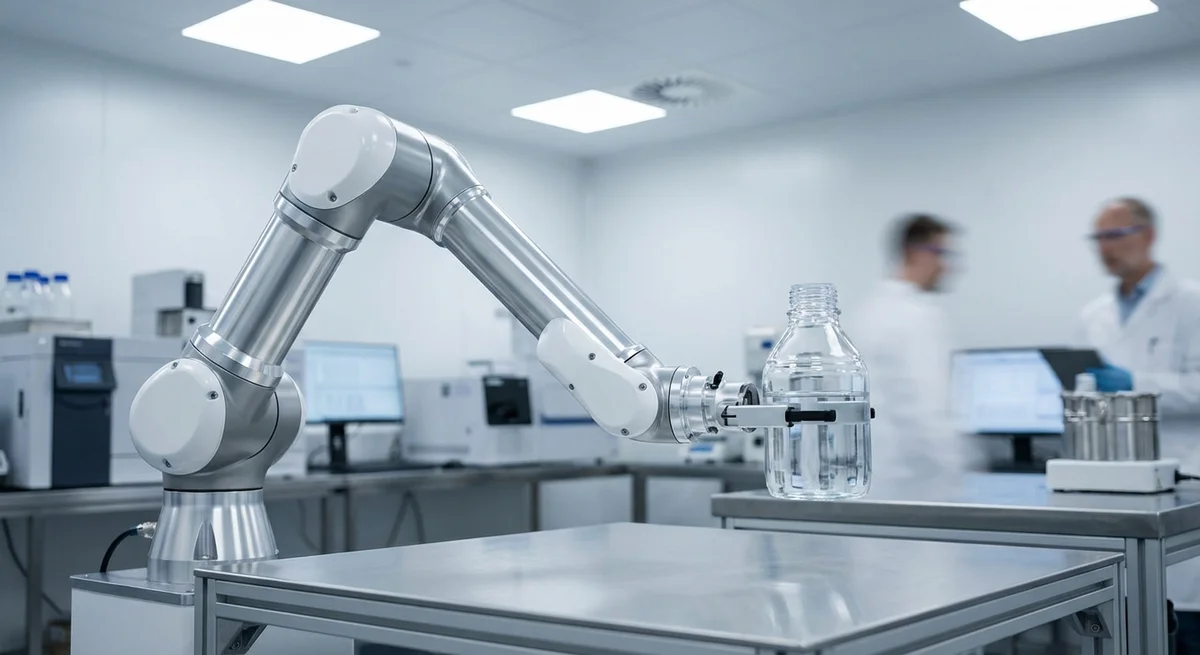
Salesforce AI continues to surprise with innovations in the field of artificial intelligence, presenting FOFPred – a revolutionary framework that leverages the power of language to predict object movement in video. This development marks an important step forward in the field of robot control and video content generation, opening doors to more intuitive and efficient human-machine interaction.
At the core of FOFPred lies the idea of combining large vision language models (LVLM) with diffusion transformers. LVLM analyze visual information and transform it into textual descriptions, while diffusion transformers, in turn, use these descriptions to predict future object movement. A key advantage of FOFPred is the ability to control movement using natural language. A user can give an instruction, for example, "move the bottle from right to left," and the system will predict how this movement should be executed.
Technically, FOFPred uses an architecture consisting of several key components. First, there is an image encoder that transforms input images into vector representations. Second, there is a language model that processes textual instructions and generates a vector representation of the desired movement. Third, there is a diffusion transformer that uses both vector representations to predict optical flow – a dense field of vectors describing the movement of each pixel in the image. Finally, there is a decoder that transforms the optical flow into a sequence of future video frames.
The significance of FOFPred extends far beyond a simple improvement of existing methods. This development opens fundamentally new possibilities for robot control. Imagine a robot that can perform complex tasks simply by following voice commands. FOFPred makes this possible, allowing users to intuitively control robots without requiring specialized knowledge in programming or robotics. Additionally, FOFPred can be used to create more realistic and controllable video. Artists and designers will be able to use textual instructions to create complex animations and special effects, significantly simplifying the content creation process.
The implementation of FOFPred can have a significant impact on various industries. In industry, this could lead to the creation of more flexible and automated production lines. In entertainment, this could open new horizons for creating visual effects and animation. In medicine, this could help in developing more accurate and efficient robotic surgical systems. However, like any new technology, FOFPred carries certain risks. It is important to consider the ethical aspects of using this technology, especially in the context of automation and possible job loss.
In conclusion, FOFPred represents a breakthrough in the field of artificial intelligence, combining the capabilities of language and computer vision to control object movement. This development opens new perspectives for robotics, video content generation, and many other fields. In the future, we will likely see even more innovations based on this technology, leading to the creation of smarter and more intuitive systems.
- Oct 28, 2026PyTorch 2.15 speeds up MoE models on Mac by 5–6.5x and adds FP8
- Oct 28, 2026OpenAI Releases GPT-6.1 Terra: Half the Price, Twice the Accuracy in Code
- Oct 28, 2026Meta open-sources Muse Spark Open: an 816B-parameter MoE with a 1M-token context
- Oct 28, 2026OpenAI Releases GPT-6.1 Terra: $1 per Million Input Tokens and Three Times Faster Than Astra
Build & Ship Production AI Agents Without Boilerplate Code
Start your free 72-hour trial at Hamidun Academy (academy.hamidun.com) — interactive lessons on Claude Code & Cursor, live Tech Radar, and production agent templates.
The AI world, distilled — once a week
Seven stories that actually mattered, hand-picked. No noise, no reposts, no press releases.
Done! Check your inbox for a confirmation.