Baidu Apollo Go robotaxis stall mid-road in Wuhan, trapping passengers
Dozens of Baidu Apollo Go robotaxis blocked roads in Wuhan on Tuesday. The vehicles suddenly stopped in the middle of streets and expressways, leaving passengers trapped inside. Police confirmed the incident and said they received numerous complaints from residents. No injuries have been officially recorded, but at least one crash has been reported. Baidu has not disclosed the cause of the failure.
AI-processed from The Verge; edited by Hamidun News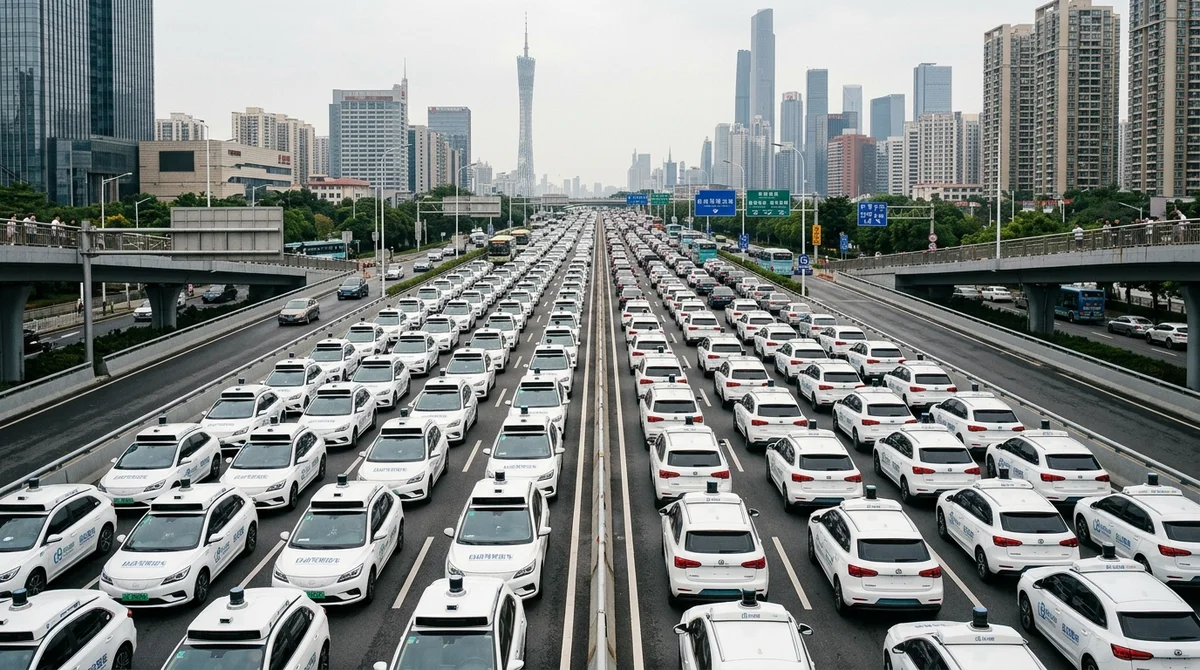
Dozens of Baidu Apollo Go robotaxis blocked roads in Wuhan on Tuesday. Passengers were trapped inside the vehicles, traffic jams built up on highways, and at least one crash was recorded because of the suddenly stopped cars.
The failure hit a large number of driverless vehicles in the Apollo Go service, which belongs to Chinese tech giant Baidu. The cars stopped in the middle of Wuhan's streets and highways and could not move. Some ended up on expressways, creating dangerous situations for other road users. Passengers inside at the moment of the failure were effectively locked in the cabins and could neither leave the vehicle on their own nor change the route.
Wuhan police confirmed they had received numerous complaints from residents. According to the authorities, no injuries from the incident have been officially recorded. A preliminary investigation points to a "system error," but specifics remain officially undisclosed: what exactly failed, at which point in the chain the fault occurred, and how many vehicles were affected. As of publication, Baidu had not issued an official comment.
Baidu is one of the leading players in the global autonomous transport market. The company has been developing Apollo Go since 2020, and Wuhan became the main testing ground for its commercial launch. The service operates here in fully autonomous mode, with no drivers in the cabin. According to the company, Apollo Go has completed more than 10 million rides in China. Wuhan has the highest concentration of driverless taxis on the streets of any city in the country: the service covers a significant part of the city's districts and runs around the clock.
The incident vividly illustrates one of the fundamental vulnerabilities of modern robotaxi systems: dependence on centralized infrastructure. When an entire fleet is controlled by a single platform, one server software failure or loss of connectivity can disable hundreds of vehicles across a city at once. This is a key difference from a traditional taxi, where a driver facing a breakdown can make an independent decision and keep the passenger safe. A robotaxi that hits a critical error switches to emergency stop mode. Technically, that is the right call from a safety standpoint, but in real urban conditions such behavior creates serious chaos.
The Wuhan incident comes amid a global race for leadership in autonomous transport. China's regulatory environment has so far been relatively favorable to driverless testing: authorities see autonomous transport as a strategic priority, and Wuhan has effectively become a nationwide experimental zone. A mass failure with real consequences for passengers and city infrastructure will inevitably draw heightened regulatory attention. For Baidu, this is a reputational blow at a key moment, as the company prepares to expand Apollo Go to other Chinese cities.
For the whole industry, this case is a harsh reminder that scaling autonomous transport requires not only technical excellence but also reliable fault-tolerance mechanisms, backup systems and transparent communication protocols for crisis situations.
- Nov 2, 2026Karpathy builds a YouTube clone with 6454 videos from Hacker News recommendations in two hours
- Nov 2, 2026Karpathy used Claude to build HackerTube from 6,454 videos recommended on Hacker News
- Nov 2, 2026Arca gives AI agents finance tasks lasting up to 10 days, but leaves the trades to humans
- Nov 2, 2026DeepSeek open-sources Super-agent prototype: p95 task completion time of 15.7 minutes vs. 29.5
Test Frontier LLMs & Autonomous Agents in One Workspace
Run Claude Opus 5.5, GPT-6, Gemini 3.1, and DeepSeek side-by-side in Nomad AI (nomadnet.ai) — unified model routing, deep research, and multimodal workflows under one subscription.
The AI world, distilled — once a week
Seven stories that actually mattered, hand-picked. No noise, no reposts, no press releases.
Done! Check your inbox for a confirmation.