Ring launches an app store to move beyond home security
Ring is launching its own app store and betting on artificial intelligence to move beyond home security. The new platform will let third-party developers build solutions for elder care, small-business needs and other use cases. Amazon intends to turn Ring cameras from surveillance devices into a full AI platform that spans many areas of daily life.
AI-processed from TechCrunch; edited by Hamidun News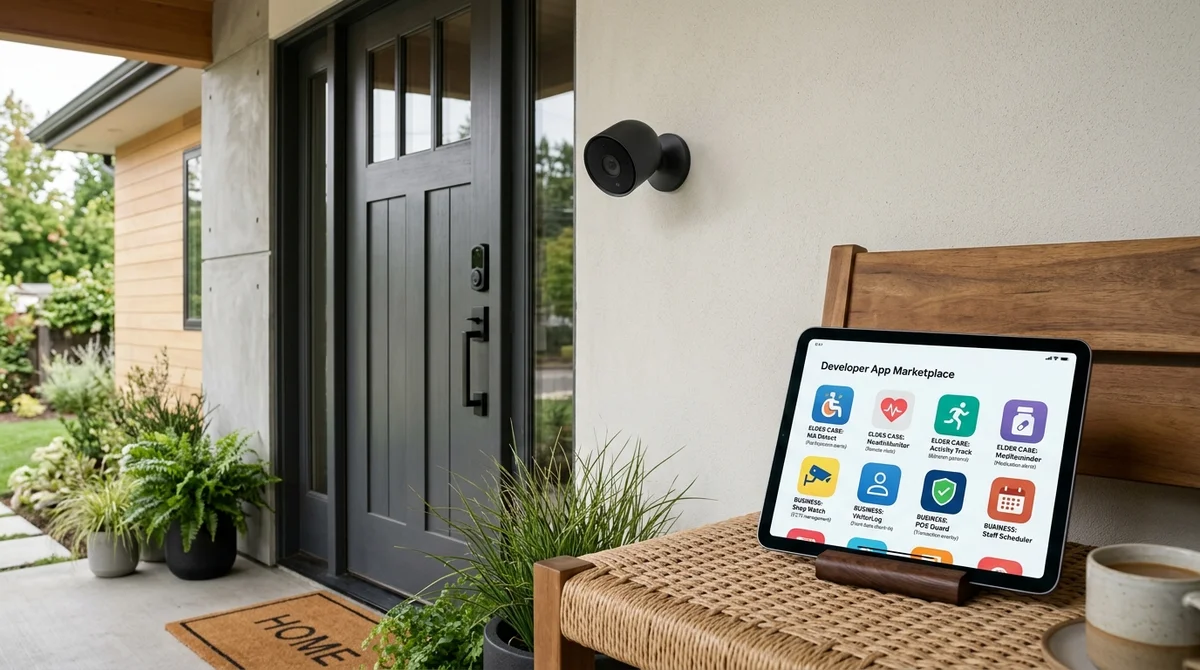
Ring, Amazon's smart home device unit, has announced the launch of its own app store. The new platform is meant to take the company beyond the traditional home security market and open up fundamentally new use cases, from monitoring elderly relatives to solutions for small businesses.
Ring has long been associated with video doorbells and security cameras. Millions of households in the US and other countries use its products to watch their front doors and property perimeters. Over the years, Ring has built a broad hardware ecosystem: video doorbells, indoor and outdoor cameras, spotlight cameras and motion sensors. But company leadership has long understood that this infrastructure can do more than simply record suspicious activity near a home.
The new app store opens the platform to third-party developers. They will be able to build solutions on top of Ring's existing infrastructure: its cameras, motion sensors, notification system and cloud storage. This turns Ring from a set of devices into a genuine platform with its own ecosystem.
Elder care is among the target markets. Apps will be able to track the activity of an elderly relative: whether they came into the kitchen in the morning, whether they opened the front door at the usual time, whether their daily routine matches their normal rhythm. Any anomalies will automatically become notifications for family members or a caregiver. This allows unobtrusive monitoring without expensive specialized monitoring systems.
Business scenarios are no less promising. A small shop or office could use Ring cameras for foot-traffic analytics, access control, monitoring when the premises open and close, or integration with time-tracking systems. Just a few years ago, such solutions required costly enterprise video surveillance systems with budgets in the thousands; now comparable functionality is available through a consumer device costing a few hundred dollars.
Residential complexes and property management companies deserve separate attention. Access control for building entrances, parking monitoring and management of common-area schedules are all potential use cases for apps in the Ring store. If the company wins this segment, its audience will extend far beyond individual homeowners.
Artificial intelligence plays the key role in this strategy. Ring already uses ML models to distinguish people, animals and vehicles in a video stream. Opening the platform to developers will allow much more sophisticated algorithms: recognition of specific individuals (with the user's consent), analysis of behavioral patterns and detection of unusual events. The company expects AI to turn cameras from passive recording devices into active digital assistants.
Strategically, the move fits Amazon's model. The company has long built ecosystems around its products: Kindle became a platform for books, Alexa for voice control of the smart home. Ring is now heading in the same direction, but with an emphasis on visual AI and perimeter monitoring. The more use cases Ring covers, the stronger users' long-term attachment to the Amazon ecosystem.
At the same time, privacy questions will inevitably come to the fore. Ring has already been criticized for sharing video recordings with law enforcement without users' consent. Opening video data to third-party developers will require a clear app verification policy, transparent permissions and reliable data protection mechanisms.
For the smart home market, the launch of the Ring app store is an important signal: competition is shifting increasingly from hardware to platforms. Companies that build a rich developer environment gain a long-term strategic advantage. Amazon, apparently, has bet on exactly this path.
- Nov 2, 2026Anthropic needs to grow revenue 32% a year to cover $850 billion in contracts
- Nov 2, 2026The Verge reviewer builds a $50 Meta Muse Charm alternative with Claude Code
- Oct 31, 2026Worldwide Express hands disputed invoices to AI agents and cuts unresolved disputes by 75%
- Oct 31, 202610 million people have activated Meta's Muse agent, but Hilton and eBay barely see any orders
Test Frontier LLMs & Autonomous Agents in One Workspace
Run Claude Opus 5.5, GPT-6, Gemini 3.1, and DeepSeek side-by-side in Nomad AI (nomadnet.ai) — unified model routing, deep research, and multimodal workflows under one subscription.
The AI world, distilled — once a week
Seven stories that actually mattered, hand-picked. No noise, no reposts, no press releases.
Done! Check your inbox for a confirmation.