Mistral releases open speech-generation model for smartphones and smartwatches
Mistral has released an open speech-generation model that runs directly on a smartphone or smartwatch, without calling cloud servers. Unlike ElevenLabs and OpenAI TTS, the model runs locally. That opens up uses where the cloud is unavailable: medical devices, corporate systems with privacy requirements, and IoT gadgets in areas without internet. The source code is open, which gives developers full control.
AI-processed from TechCrunch; edited by Hamidun News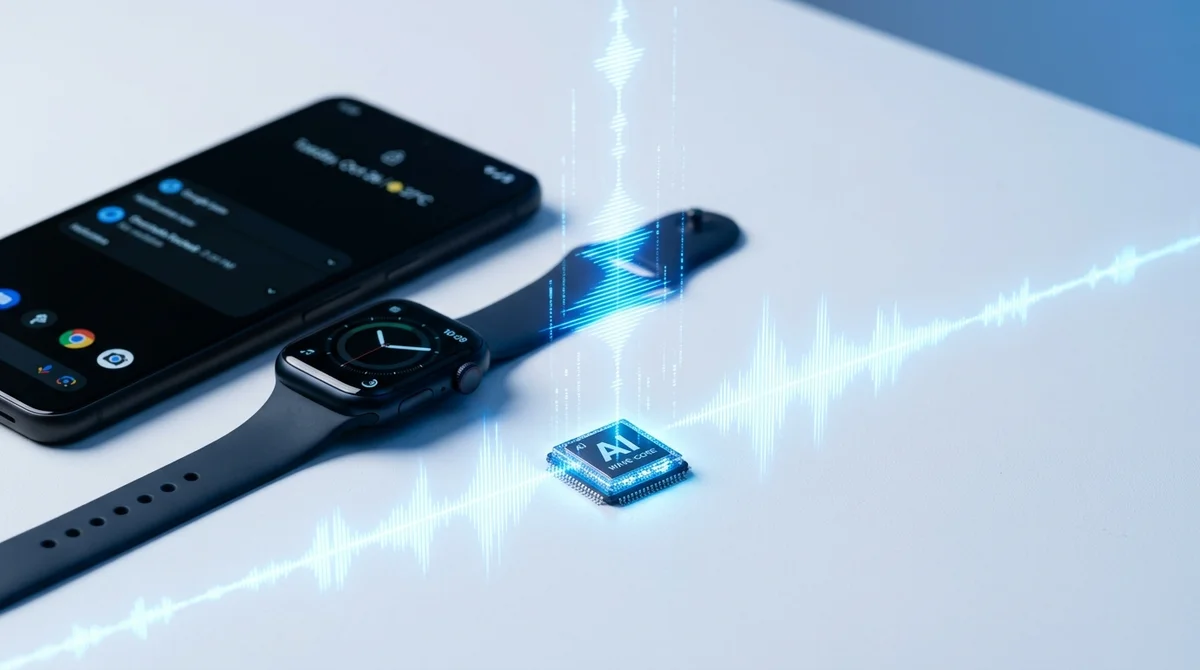
French AI company Mistral has released a new open model for speech generation. Its main difference from competitors is that it runs directly on a smartphone or smartwatch, without calling external servers.
Speech neural networks have traditionally demanded serious computing resources. Even relatively lightweight TTS systems often took up hundreds of megabytes and ran noticeably slowly on mobile processors. The industry solution is cloud inference: the request goes to a server, and the audio file comes back within fractions of a second.
The approach works, but it has fundamental limits. Dependence on the internet makes such systems useless in areas without coverage. The cost of each API call adds up as usage scales. And sending user data to third-party servers creates privacy problems, especially in medicine and the corporate sector. This approach is a poor fit for embedding in wearable devices.
Mistral offers a different path. The company built its reputation on language models: Mistral 7B and Mixtral 8x7B became a benchmark in the open-source community thanks to high quality at a compact size. Now the same philosophy is being applied to speech synthesis.
Smartwatches are a fundamentally tougher computing environment than smartphones. ARM chips in wearables run on a power budget of a few watts, and RAM rarely exceeds one gigabyte. For comparison, most modern TTS models weigh from 300 MB to several gigabytes and need a good GPU or at least a fast mobile processor.
To fit within wearable constraints while keeping acceptable speech quality, you need either aggressive weight quantization to 4 bits or lower, or a non-standard architecture that does not depend on heavy matrix computation. The company has not yet disclosed technical details, but the claim of smartwatch support itself sets an ambitious engineering bar.
The model's openness adds strategic value. The leading commercial players in speech AI, ElevenLabs, PlayHT and OpenAI TTS, work exclusively through cloud APIs. Mistral is publishing the model for local deployment. This opens up uses where the cloud is unacceptable: medical devices with confidentiality requirements, corporate systems where data may not leave the perimeter, IoT devices in areas without stable internet, and embedded systems in vehicles and industrial equipment.
For developers of mobile and wearable apps, the release unlocks a whole class of products. Voice assistants will be able to work fully offline. Read-aloud apps can generate audio without a third-party subscription and without network delays. Accessibility tools for people with visual impairments can function without a constant connection. Navigation apps, translators and smart speakers all gain high-quality voice output without depending on the cloud.
Open-source TTS alternatives already exist on the market: Piper TTS, StyleTTS2 and Coqui. Some run acceptably on a CPU, while others need a GPU or fall short of commercial systems in how natural they sound. Mistral carries a different level of recognition and trust in the developer community. The company has shown it can build compact models with better quality than expected. If the speech model follows the same pattern, the open-source TTS market could change significantly.
The release fits the company's broader strategy. Mistral is consistently building a position as the European alternative to American and Chinese AI giants, betting on openness and independence from any particular platform. A speech model for edge devices continues that line: AI directly on the device, with no intermediaries and no subscriptions, under the developer's control.
- Nov 1, 202616 models tested on 7 search tools: Exa averaged 10.5 out of 14, SearXNG about 3
- Oct 30, 2026Mistral opens Large 4 weights: strong at code, but Chinese models score 32 to its 26
- Oct 30, 2026Claude Enterprise Gets Smart Reports: Who Uses AI How, and What It Costs
- Oct 30, 2026SkyRL and vLLM Fine-Tune Mistral Large 4 with RL: AIME Score Rises from 64% to 75%
Test Frontier LLMs & Autonomous Agents in One Workspace
Run Claude Opus 5.5, GPT-6, Gemini 3.1, and DeepSeek side-by-side in Nomad AI (nomadnet.ai) — unified model routing, deep research, and multimodal workflows under one subscription.
The AI world, distilled — once a week
Seven stories that actually mattered, hand-picked. No noise, no reposts, no press releases.
Done! Check your inbox for a confirmation.