Bernie Sanders Proposes Freezing Data Center Construction Over AI Safety
Bernie Sanders has introduced a bill in the US Senate that would impose a moratorium on data center construction until lawmakers develop AI safety standards. According to the senator, the pause is needed to "make sure AI is safe." Representative Alexandria Ocasio-Cortez is preparing a similar bill for the House of Representatives.
AI-processed from Wired; edited by Hamidun News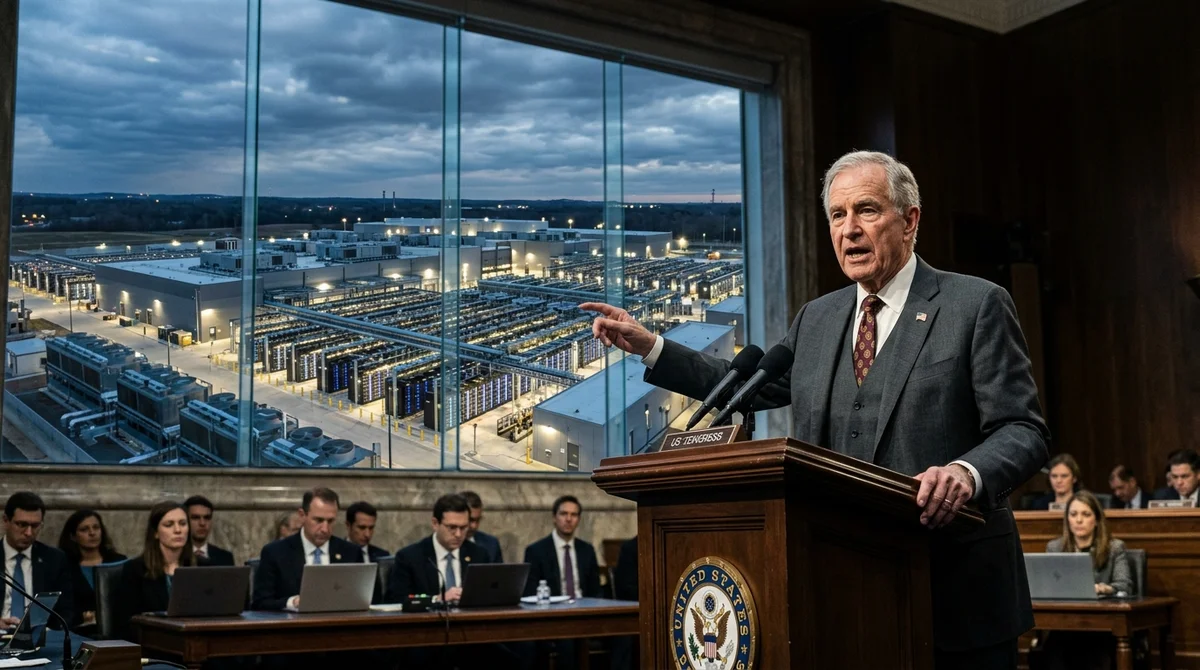
US Senator Bernie Sanders has introduced a bill that would temporarily ban the construction of new data centers in the United States. The main goal is to give Congress time to draft AI safety standards before the infrastructure that powers AI is rolled out on an even larger scale. Sanders announced the move on Tuesday, stressing that this is not about stopping progress but about a sensible pause. According to him, the moratorium would let lawmakers "make sure AI is safe" before data center construction continues at an accelerated pace across the country. The senator has long been skeptical of the unchecked expansion of tech corporations, and he has now chosen to attack on the infrastructure front.
In the coming weeks, Congresswoman Alexandria Ocasio-Cortez plans to introduce a similar bill in the House of Representatives. The coordinated action of the two left-leaning politicians points to a united front: they want to make the physical expansion of AI infrastructure conditional on the adoption of legislative safety standards.
The initiative comes amid an unprecedented construction boom. Microsoft, Google, Amazon and Meta have announced combined data center investments of hundreds of billions of dollars, and in 2024–2025 alone, several dozen large facilities were broken ground on in the US. The annual electricity consumption of American data centers is already comparable to that of entire countries. In several states they compete for power capacity with residential neighborhoods and industrial plants, and this is what became the political trigger.
The exact wording of the bill, in particular the length of the moratorium and the mechanisms for lifting it, has not yet been disclosed. Even so, the idea of regulating not algorithms or datasets but physical infrastructure (servers, power capacity, networks) is far from trivial in American politics. Until now, regulatory attention has focused on the software layer of AI, not on the hardware that powers it.
Critics have already called the bill unrealistic: halting construction projects tied to multiyear contracts with contractors and equipment suppliers is extremely hard, even with political will. The tech industry will predictably oppose it, arguing that delays in deploying capacity would weaken the competitive position of American companies in the global AI market, where China, actively building its own facilities, remains the main rival.
Still, the appearance of this bill marks a real shift. A year ago, most lawmakers saw AI as an unambiguously positive force for growth. Now more and more voices are demanding that the country slow down and assess the consequences for security, the environment and the balance of power. Sanders' bill, even with minimal chances of passing in the current Congress, sets the tone of the debate and puts pressure on the sector. Companies building in the US should follow developments: even if the moratorium fails, the accompanying debate could speed up new environmental and energy requirements for AI infrastructure facilities.
*Meta has been designated an extremist organization and is banned in Russia.
- Nov 2, 2026Bun creator uses Claude Code to port 750K lines from Zig to Rust in 11 days
- Nov 2, 2026The Verge reviewer builds a $50 Meta Muse Charm alternative with Claude Code
- Nov 1, 202616 models tested on 7 search tools: Exa averaged 10.5 out of 14, SearXNG about 3
- Nov 1, 2026Google's StreamVibe video agent beats other models by 10.7% on response timing and quality
Test Frontier LLMs & Autonomous Agents in One Workspace
Run Claude Opus 5.5, GPT-6, Gemini 3.1, and DeepSeek side-by-side in Nomad AI (nomadnet.ai) — unified model routing, deep research, and multimodal workflows under one subscription.
The AI world, distilled — once a week
Seven stories that actually mattered, hand-picked. No noise, no reposts, no press releases.
Done! Check your inbox for a confirmation.