Neither gamers nor developers like Nvidia DLSS 5, but it may become the standard
Nvidia DLSS 5, the fifth generation of AI upscaling, has drawn a wave of criticism. Gamers describe an "uncanny valley" effect: the image looks unnatural, especially on moving objects. Game developers are not thrilled either: integration takes extra effort, and results vary from game to game. Nvidia is not backing down. The company is convinced that within a few years the technology will become the default mode for the whole industry.
AI-processed from Wired; edited by Hamidun News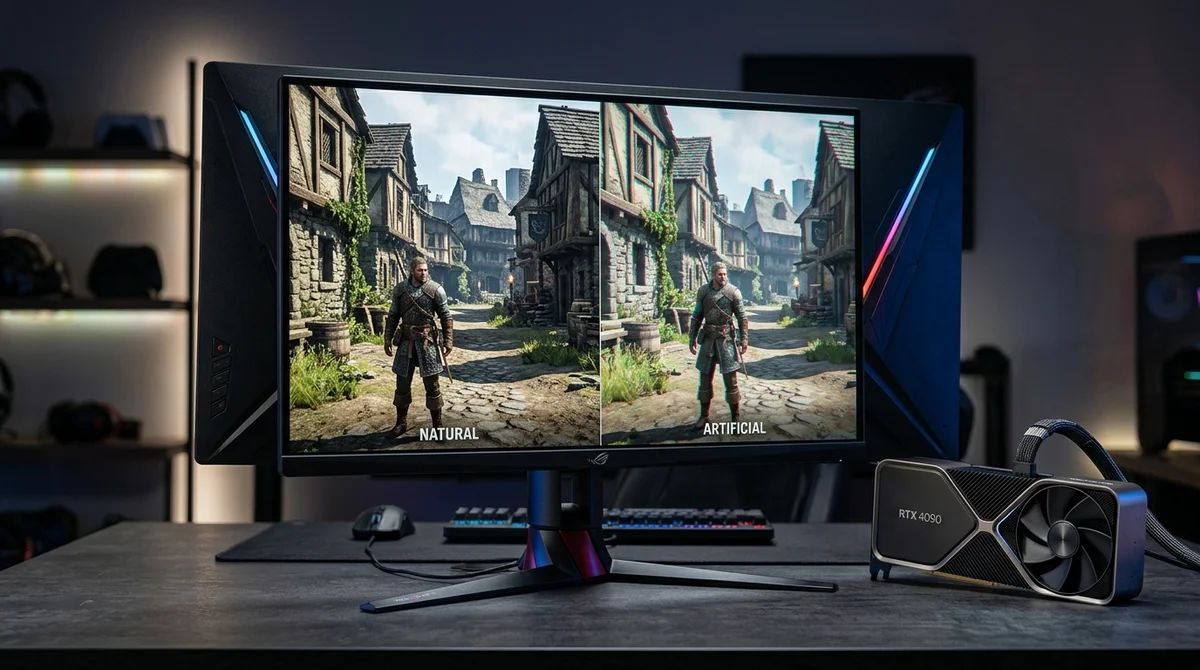
Nvidia DLSS 5, a new generation of AI upscaling technology, has received a cold reception from two sides at once. Gamers call the image creepy and unnatural. Game developers share the skepticism, although Nvidia insists that within a few years this will become the default mode for all graphics cards.
DLSS stands for Deep Learning Super Sampling. Nvidia has been developing the technology since 2018. The idea is to render a scene at a lower resolution and let a neural network fill in the detail and upscale the image to 4K or higher. Early versions worked well enough: many players could not tell the difference from native rendering, yet they got a substantial FPS boost.
DLSS 3, which arrived with the RTX 40-series graphics cards, added intermediate frame generation, known as Frame Generation. The technology inserted synthesized frames between real ones, allowing the FPS counter to double without extra load on the GPU.
DLSS 5 goes further. The fifth generation uses multi-frame generation: the AI creates several intermediate frames in a row, potentially multiplying the displayed FPS several times over. The problem is that the more frames the neural network generates, the more artifacts it introduces.
Gamers report an uncanny valley effect: the image looks almost right, but the eye picks up something unnatural. Blurred edges on moving objects, ghosting trails and flickering textures all break the immersion that players buy top-end graphics cards for.
The community's reaction was predictably harsh. Forums and Reddit filled up with comparison screenshots and videos in which DLSS 5 loses to native rendering on visual quality. This stings especially in light of the price: graphics cards supporting the latest DLSS features are expensive, and nobody wants to pay for a worse picture.
But the position of game developers is more telling. Studios are, by and large, not enthusiastic about DLSS 5. Integrating the technology demands extra development effort: parameters must be tuned for each specific game, tested across different scenes and resolutions, and artifacts must be managed. AI frame generation changes the familiar pipeline of working with a graphics engine, complicates optimization and adds unpredictability to the QA process. On top of that, the final result is inconsistent: in some games DLSS 5 performs acceptably, in others it is clearly worse than native rendering.
Nvidia, meanwhile, is not changing its rhetoric. The company positions DLSS 5 as the future of game graphics and predicts that within a few years the technology will become the default mode. Nvidia has arguments: screen resolutions are rising, game scenes are getting more complex, and traditional rendering is increasingly hard to scale. AI upscaling is a logical answer to that challenge; the only question is how quickly the technology will mature to acceptable quality.
Competitors are not asleep. AMD is pushing FSR (FidelityFX Super Resolution), and Intel is pushing XeSS. Both technologies run on graphics cards from any vendor, which gives them an advantage in reach. If DLSS 5 quality does not improve in upcoming updates, some developers may prefer solutions that are simpler to integrate, and that would hurt Nvidia's position in a segment that is key for it.
The story of DLSS 5 is one of speed versus quality. Nvidia is rushing to roll out a technology that has not yet matured to the expected level. Gamers sense this intuitively; developers feel it in practice. Until the company eliminates the artifacts and reduces the burden on studios, the future standard will remain a contested setting for those willing to turn a blind eye to the side effects.
- Nov 2, 2026Anthropic needs to grow revenue 32% a year to cover $850 billion in contracts
- Nov 2, 2026TensorFold 1.2.0 boosts Qwen3.8-27B throughput on M3 Ultra by 44.2% at 16 streams
- Nov 1, 2026Local models lose to Opus and Codex: 0.21 on a MacBook versus 1.00 for Codex
- Nov 1, 2026Habr author fine-tunes YOLOv8l on dental X-rays and pushes mAP50 to 0.642
Test Frontier LLMs & Autonomous Agents in One Workspace
Run Claude Opus 5.5, GPT-6, Gemini 3.1, and DeepSeek side-by-side in Nomad AI (nomadnet.ai) — unified model routing, deep research, and multimodal workflows under one subscription.
The AI world, distilled — once a week
Seven stories that actually mattered, hand-picked. No noise, no reposts, no press releases.
Done! Check your inbox for a confirmation.