Walmart shifts strategy: Sparky replaces OpenAI-powered auto-checkout
Walmart has acknowledged that its joint automatic-payment service with OpenAI failed, and it has restructured the partnership. The retailer's own chatbot, Sparky, will now be embedded directly in ChatGPT and Google Gemini, so users can buy Walmart products from the interface of their favorite AI without going to the website.
AI-processed from Wired; edited by Hamidun News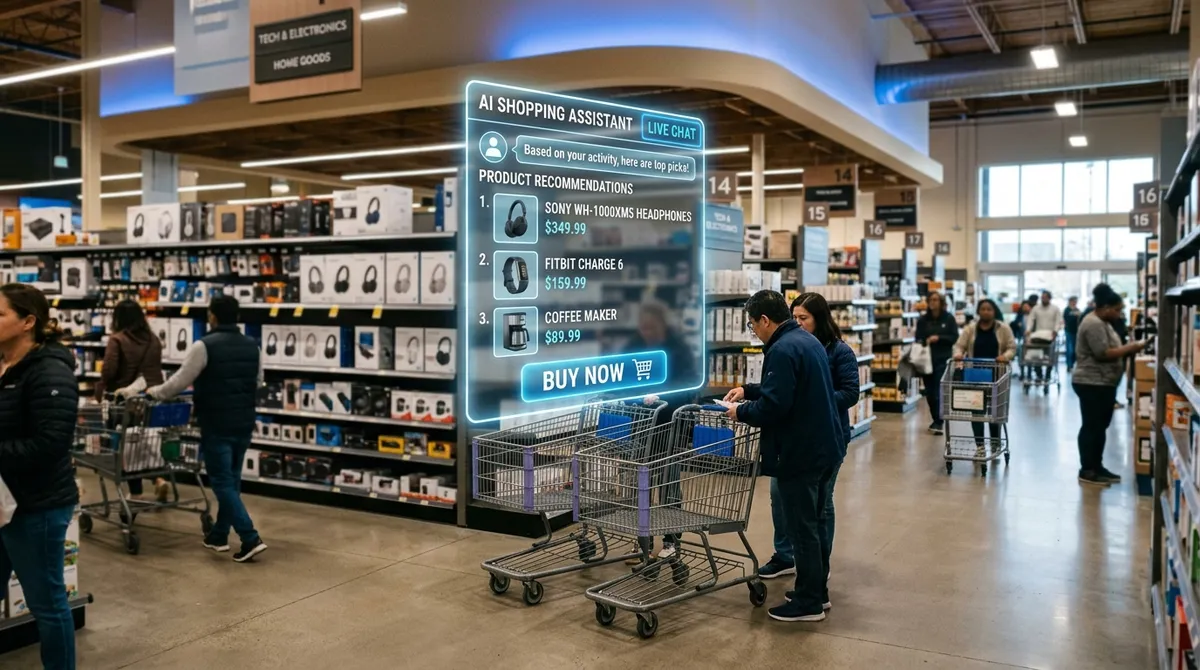
Walmart has changed its approach to agentic shopping. Instead of letting OpenAI place orders autonomously on users' behalf, the retailer will embed its own AI assistant, Sparky, in ChatGPT and Google Gemini.
In 2024, Walmart and OpenAI agreed on a feature called Instant Checkout, in which an agent would add items to the cart and complete the purchase on its own, with no human involvement. The idea looked like a logical step toward "agentic shopping," where AI takes over routine chores.
In practice, though, the feature fell short of expectations: conversion came in below forecast, and users were reluctant to trust a neural network with their payment data. Rather than fix a failing mechanism, Walmart bet on a different model.
Sparky, the chain's corporate AI assistant, launched in early 2024, will be integrated directly into ChatGPT and Gemini. Here is how it works: a user asks ChatGPT "what to give for a birthday, up to 3000 rubles," Sparky shows products from walmart.com within the same conversation, and the person clicks "buy" themselves, deliberately rather than without noticing. The approach differs fundamentally from agentic auto-ordering.
Walmart keeps full control over the shopping experience (brand, product selection, prices) but places the entry point where the user already is. That is more efficient than pulling the shopper to a separate website or app. For OpenAI and Google it is also a win: the more practical tasks get solved right in the chatbot, the longer users stay on the platform.
Still, the Instant Checkout episode raises an uncomfortable question: how ready are users for agentic shopping right now? Letting an AI spend your money requires a different level of trust than asking it to write an email. Walmart has effectively taken a step back, from an autonomous agent to an assistant that only recommends. That is more honest from a UX standpoint, but it means "true" agentic purchases, where the AI itself puts the item in the cart and pays, remain a thing of the future for now.
Restaurant chains, pharmacies and other retailers are watching the experiment closely. If Sparky shows meaningful conversion from ChatGPT into sales, it could set a new standard: not a company's own app, but a presence inside someone else's chatbot as the main sales channel.
- Nov 2, 2026Meta's Muse assistant keeps dossiers on loved ones and gets root on Ubuntu by default
- Nov 1, 2026Local models lose to Opus and Codex: 0.21 on a MacBook versus 1.00 for Codex
- Nov 1, 2026Kimi scores 96.2% on a 1C database analytics test and emerges as a fallback if Claude access is blocked
- Nov 1, 2026OpenAI Rewrites GPT Behavior Rules: Five Values and a Chain of Command
Test Frontier LLMs & Autonomous Agents in One Workspace
Run Claude Opus 5.5, GPT-6, Gemini 3.1, and DeepSeek side-by-side in Nomad AI (nomadnet.ai) — unified model routing, deep research, and multimodal workflows under one subscription.
The AI world, distilled — once a week
Seven stories that actually mattered, hand-picked. No noise, no reposts, no press releases.
Done! Check your inbox for a confirmation.