Nvidia releases DLSS 5, but the new technology mangles character faces in games
Nvidia has unveiled DLSS 5, a next-generation upscaling technology that the company calls "the biggest breakthrough in computer graphics since 2018." Generative AI is supposed to "infuse pixels with photoreal lighting and materials." The first demos, however, disappointed gamers: character faces in Resident Evil Requiem and Hogwarts Legacy look like AI slop, blurry and unnatural. The community compares the effect to motion smoothing on cheap TVs.
AI-processed from The Verge; edited by Hamidun News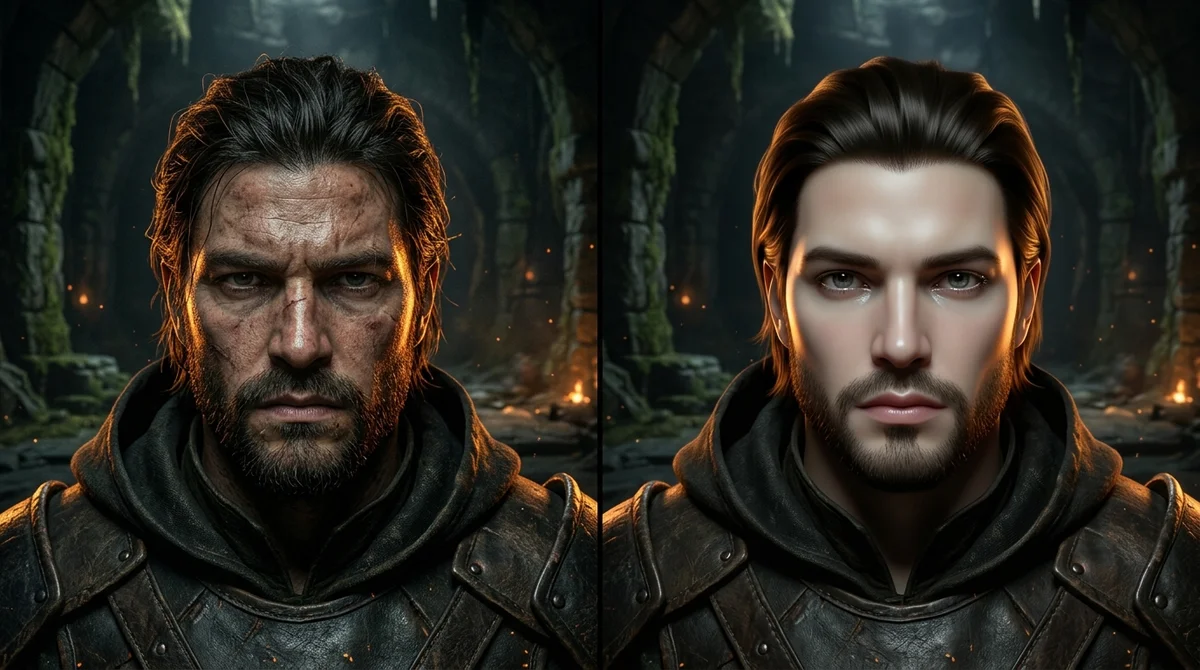

Nvidia has announced DLSS 5, a new version of its proprietary image upscaling technology for games. The company presented it as "the biggest breakthrough in computer graphics since real-time ray tracing arrived in 2018." The promises are big. The reality turned out to be far more prosaic, and far less pleasant for the first people to see it.
DLSS (Deep Learning Super Sampling) is Nvidia's technology that uses neural networks to raise image resolution in real time. The principle is simple: the game renders at a lower resolution, and DLSS fills in the missing pixels using a trained neural network. This delivers higher frame rates without a significant loss in image quality.
The previous versions, DLSS 2, 3 and 4, won broad recognition among gamers and developers. The fourth generation, introduced in early 2025, was praised in particular for Multi Frame Generation, which produces several intermediate frames between real ones and noticeably improves smoothness.
According to Nvidia, DLSS 5 takes the next step: the technology uses generative AI to infuse pixels with photoreal lighting and materials. It sounds high-tech and promising. But when gamers and technical journalists saw the first demos, the community's reaction was unanimous: something went wrong with the faces.
Grace, the protagonist of Resident Evil Requiem, looks in DLSS 5 mode as if she has been run through an aggressive AI filter: facial features are smoothed, details are blurred, and the expression has taken on the characteristic plasticky look that people online call AI slop. Characters in Hogwarts Legacy look as though they were processed with a blurry Instagram skin-smoothing filter.
The neural network invents details too aggressively exactly where humans notice them most, since we read faces more precisely and quickly than anything else in our field of view. Here the uncanny valley effect works at full strength: the closer an image gets to a real face, the more sharply the brain notices the slightest mismatch.
This is a fundamental difference between DLSS 5 and earlier versions. Earlier generations reconstructed pixels from accumulated motion data and information from previous frames. That was smart interpolation grounded in real data. The fifth generation actively tries to create details that were not in the original geometry, using the neural network's generative capabilities. That is what causes the problem: the algorithm hallucinates where any error is instantly obvious.
Upscaling has long been anything but a niche technology. AMD offers its own counterpart, FSR, Intel is developing XeSS, and all GPU makers are competing hard for the title of best solution. Nvidia has held its lead largely thanks to the quality of DLSS, which consistently delivered the best picture at lower rendering cost. If DLSS 5 earns a reputation as a technology that makes faces worse, that may affect developers' willingness to adopt it in their projects.
The situation partly resembles motion smoothing on modern TVs. Manufacturers enabled this mode by default for years. It technically makes the image smoother, but film directors and critics advised turning it off: the result made movies look like a cheap soap opera rather than cinema. DLSS 5 follows the same dynamic: the technical metric rises, but perceived quality falls.
It is not yet known whether Nvidia will refine the algorithm before a wide commercial release. Public reaction could push the company to tone down how aggressively it generates faces. Nvidia itself compares the breakthrough to the arrival of ray tracing and positions the technology as positively as possible. But the community's first reaction is unambiguous: for DLSS 5, the road from the biggest breakthrough to genuinely better-looking games is only beginning.
*Meta is recognized as an extremist organization and is banned in the Russian Federation.
- Nov 2, 2026Anthropic needs to grow revenue 32% a year to cover $850 billion in contracts
- Nov 2, 2026TensorFold 1.2.0 boosts Qwen3.8-27B throughput on M3 Ultra by 44.2% at 16 streams
- Nov 1, 2026Local models lose to Opus and Codex: 0.21 on a MacBook versus 1.00 for Codex
- Nov 1, 2026Habr author fine-tunes YOLOv8l on dental X-rays and pushes mAP50 to 0.642
Test Frontier LLMs & Autonomous Agents in One Workspace
Run Claude Opus 5.5, GPT-6, Gemini 3.1, and DeepSeek side-by-side in Nomad AI (nomadnet.ai) — unified model routing, deep research, and multimodal workflows under one subscription.
The AI world, distilled — once a week
Seven stories that actually mattered, hand-picked. No noise, no reposts, no press releases.
Done! Check your inbox for a confirmation.