Signull Labs' Skye raises $3.58M before launching its AI home screen for iPhone
Skye from Signull Labs hasn't been released yet, but it has already raised $3.58M and drawn tens of thousands of people to its waitlist. The startup isn't building another chatbot for iPhone, but an AI home screen built on widgets. It is meant to offer suggestions based on email, meetings, spending, weather and location, and eventually to become a permanent intelligent layer on top of the smartphone. The product is still in closed testing and has not been opened to the public.
AI-processed from TechCrunch; edited by Hamidun News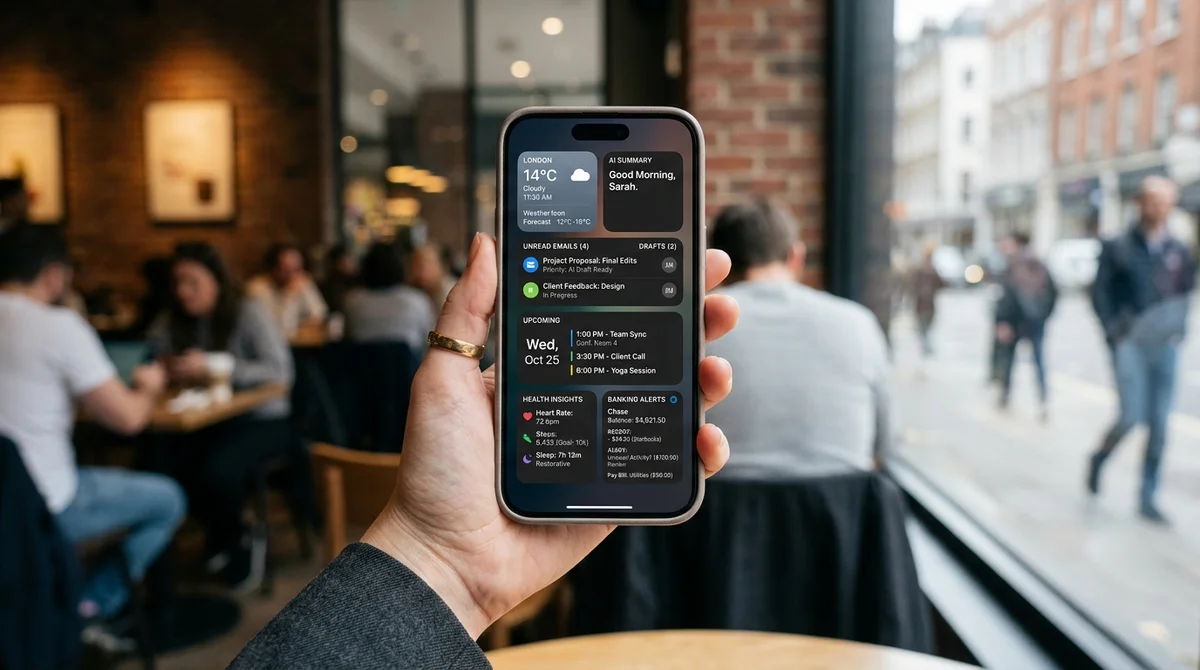
Skye, an iPhone app from Signull Labs that has not yet launched, has already raised $3.58 million and built a long waitlist. It is one of the first visible signs that users and investors are ready to bet on AI built directly into the everyday smartphone interface, not just into standalone chatbots.
The project rests on the idea of a home screen that doesn't simply show a grid of icons but adapts to the situation and surfaces what matters right now. Instead of opening an app or summoning a chatbot by hand each time, the user sees personalized suggestions on widgets.
According to the team, Skye can show weather information, take the current context into account, remind users of tasks, help them prepare for meetings, draft replies to emails and even spot suspicious charges on bank accounts. Another focus is location-based recommendations: the app is supposed to offer information about neighborhoods, venues and local points of interest near the user. To do this, the service uses data from connections the user has explicitly authorized.
Signull Labs, a small team based in New York, is developing the app. Its creator long appeared publicly under the pseudonym signull, but public documents link his name to Nirav Savjani. By his own account, he previously worked at Google and Meta*. The product remains in closed testing and has not been released publicly, but that hasn't stopped it from drawing attention quickly.
After the first publications about the project, its video gained about a million views, and tens of thousands of new users joined the waitlist. According to the founder, even before that wave, more than 25 thousand people were already in the queue.
Investors backed that interest. Signull Labs raised more than $3.58 million at the pre-seed stage, and the round closed back in September 2025. According to market data, the company's post-money valuation was $19.5 million. Early backers reportedly include a16z, True Ventures, SV Angel and a number of private investors; Signull Labs also appears in the Offline Ventures portfolio.
For a startup without a public release, that is a strong signal: the market is ready to fund not only new models, but new ways of interacting with them. With Skye, the bet is not on a separate device or yet another AI messenger, but on an interface layer on top of the familiar iPhone.
This matters in the broader context of mobile AI. In recent years, users have grown used to AI living either in a standalone app or as an assistant they have to summon deliberately. But the next stage of competition appears to be about making AI a permanent layer on top of the smartphone that works proactively. Skye tests exactly this hypothesis: if an assistant knows your calendar, email, location, tasks and basic daily patterns, it can propose an action in advance instead of waiting for a request. That experience is closer to a personal operating layer than to a familiar chat window.
For the market, this means the battle in mobile AI is gradually shifting from the question of whose model is more powerful to the question of who embeds intelligence best into the everyday interface.
Skye still faces many risks. It must prove that such a screen doesn't annoy users with excess notifications, handles private data carefully and genuinely saves time rather than creating a new point of overload. But the fact that a product with no launch has already won capital and a mass waitlist shows something simple: demand for an iPhone with more deeply embedded AI already exists, and startups are trying to claim this niche before the big platform players.
*Meta is recognized as an extremist organization and banned in Russia.
- Nov 2, 2026Karpathy builds a YouTube clone with 6454 videos from Hacker News recommendations in two hours
- Nov 2, 2026Karpathy used Claude to build HackerTube from 6,454 videos recommended on Hacker News
- Nov 2, 2026Anthropic needs to grow revenue 32% a year to cover $850 billion in contracts
- Nov 2, 2026Bun creator uses Claude Code to port 750K lines from Zig to Rust in 11 days
Test Frontier LLMs & Autonomous Agents in One Workspace
Run Claude Opus 5.5, GPT-6, Gemini 3.1, and DeepSeek side-by-side in Nomad AI (nomadnet.ai) — unified model routing, deep research, and multimodal workflows under one subscription.
The AI world, distilled — once a week
Seven stories that actually mattered, hand-picked. No noise, no reposts, no press releases.
Done! Check your inbox for a confirmation.